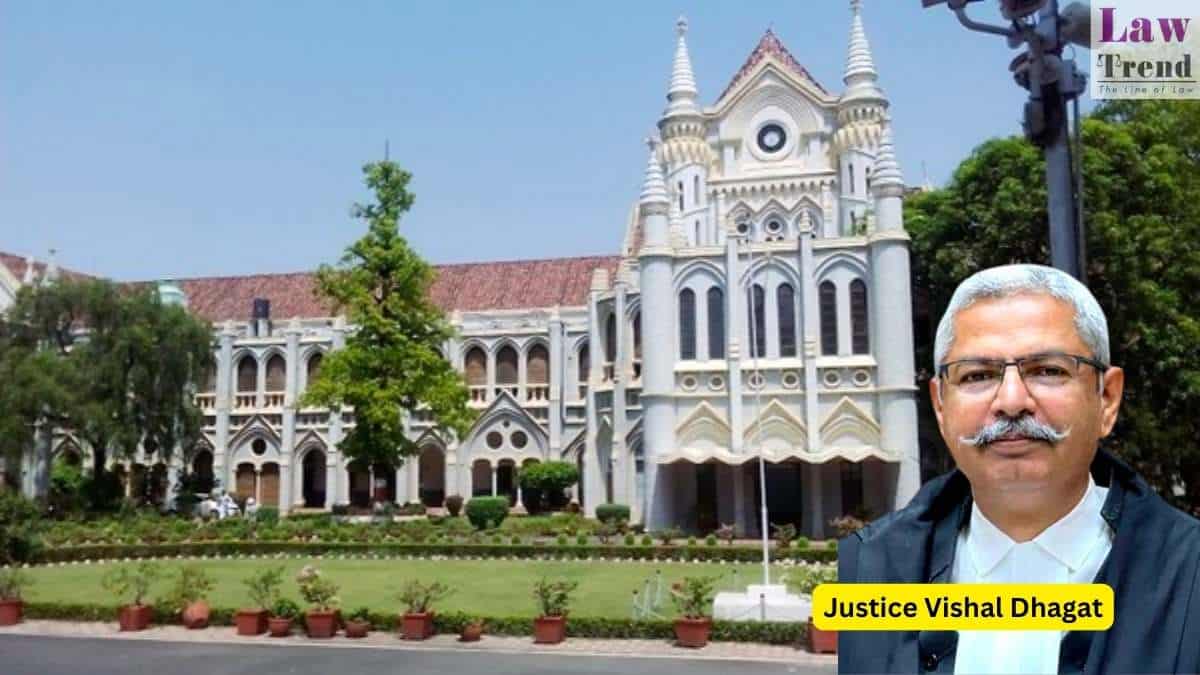
The High Court of Madhya Pradesh has ruled that employees engaged consistently on a contract basis for more than 10 years are entitled to the benefit of classification and permanent status under the State’s 2016 policy. Justice Vishal Dhagat held that excluding ‘contract’, ‘outsourced’, and ‘part-time’ workers from the benefits of the circular dated 07.10.2016 lacks rationale if their services have been required continuously by the State.
Background
The petitioners, Radheshyam Verma and others, were engaged on a contract basis by the respondent department via an order dated July 10, 2009. Following their appointment on July 30, 2009, their services were continued periodically, and they remain in employment after approximately 16 years. They approached the High Court under Article 226 of the Constitution of India seeking directions to the authorities to consider them for the grant of permanent status and the minimum pay scale admissible to their posts.
Arguments of the Parties
The counsel for the petitioners argued that despite working for over a decade and a half, the petitioners were being denied classification as ‘permanent’ employees. It was contended that the State’s failure to extend these benefits results in the exploitation of the petitioners and violates Articles 14 and 16 of the Constitution of India by paying them lower salaries than admissible.
The Government Advocate, representing the State of Madhya Pradesh, opposed the petition. He submitted that the State Government’s policy dated 07.10.2016 was specifically formulated to benefit daily wagers who could not be regularized. According to the State, the policy categorizes daily wagers into ‘skilled’, ‘semi-skilled’, and ‘unskilled’ workers. However, the State maintained that:
“said benefit is not available to those workers who are engaged on contract basis or are outsourced or they are employed temporarily.”
The State argued that because the petitioners were contract employees, the denial of classification was legal and supported by a reasoned order.
Court’s Analysis
The Court observed that while the petitioners were initially employed for limited terms, their contracts were extended repeatedly, demonstrating a “constant requirement of services” by the State Government.
Justice Dhagat analyzed the 2016 policy, describing it as a “master stroke of State Government” intended to provide employees with decent living conditions when regularization is not possible due to a lack of sanctioned posts. The Court held that the circular is consistent with the Directive Principles of State Policy, specifically citing Articles 38, 39(a), and 43 of the Constitution.
On the exclusion of contract workers, the Court observed:
“There is no rational in not giving benefit of circular dated 07.10.2016 to ‘contract’, ‘outsourced’ and ‘part time’ workers engaged by the State Government, if they are consistently being engaged by the State Government for more than 10 years.”
The Court further noted that petitioners cannot be denied “adequate means of livelihood, economic justice and decent standard of life” by being paid lower wages than others performing similar requirements.
Decision
Allowing the writ petition, the High Court directed the respondents to pass orders classifying the petitioners in accordance with the circular dated 07.10.2016. The Court further ordered the State to extend all consequential benefits available under the said classification.
Case Details
Case Title: Radheshyam Verma and Others v. The State of Madhya Pradesh and Others
Case No.: WRIT PETITION No. 3641 of 2020
Bench: Justice Vishal Dhagat
Date: April 9, 2026