

Illegal Lawyers’ Chambers in Lucknow: Allahabad HC Directs Fresh Notices Before Demolition
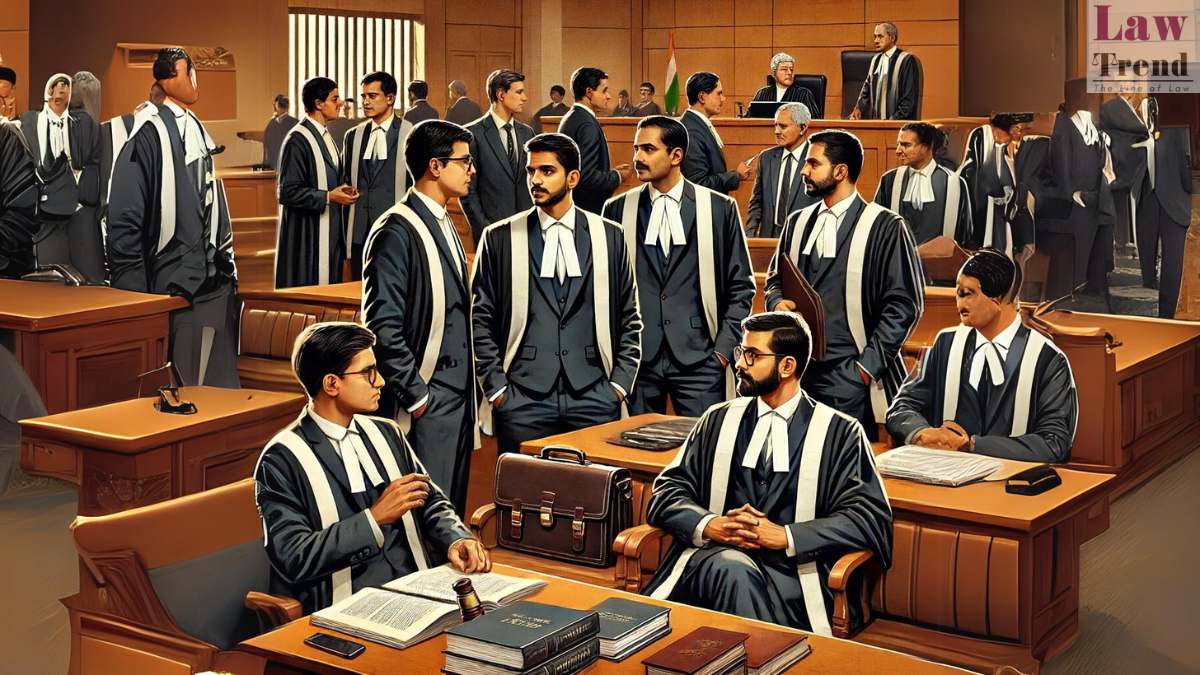
In a public interest litigation addressing unauthorized encroachments on public land and unlawful court boycotts by advocates, the High Court of Judicature at Allahabad (Lucknow Bench), comprising Justice Rajesh Singh Chauhan and Justice Rajeev Bharti, directed the Lucknow Municipal Corporation to serve fresh written notices to 72 encroachers—primarily advocates—occupying public utility land and pathways near Swasthya Bhawan before carrying out demolition drives. The Court reiterated that strikes and work abstentions by advocates constitute ex-facie criminal contempt, holding that no individual advocate or bar association has the right to disrupt judicial proceedings or obstruct public pathways.

Background of the Case

The proceedings arise out of Criminal Writ-Public Interest Litigation No. 4 of 2026, concerning 72 identified illegal encroachments, including chambers and shops, constructed on public pathways and utility land at Chakbast Crossing near Swasthya Bhawan, Lucknow. Although more than 100 illegal chambers across the area had been demolished in earlier enforcement efforts, only 14 of the 72 specific marked structures were removed, as subsequent municipal action was obstructed by protesting advocates.

Court records revealed that office bearers of the Central Bar Association, Lucknow, and the Lucknow Bar Association, Lucknow, called for a work boycott between May 18, 2026, and May 26, 2026, under the nomenclature of ‘Samuhik Avakash’. Reports submitted by the District Judge, Lucknow, accompanied by video evidence, showed advocates participating in strikes, making provocative social media speeches against police and administrative authorities, and distributing plastic lathis to advocate members to forcibly resist municipal compliance drives.

Following these events, show cause notices and five-year expulsion letters dated June 4, 2026, were issued by the Central Bar Association against Advocates Uttam Tripathi and Brijesh Kumar Yadav, while an explanation was sought from Advocate Himanshu Mishra. The High Court subsequently issued notices asking why criminal contempt proceedings and disciplinary referrals to the Bar Council of Uttar Pradesh should not be initiated against the involved advocates and bar office bearers.

Arguments of the Parties

Sri Shailendra Singh Chauhan, learned counsel for Lucknow Nagar Nigam, submitted that 58 of the 72 identified encroachers remained in illegal possession because municipal officers lacked sufficient police and administrative backing to counter advocate protests. He pointed out that previously demolished sites were also re-occupied temporarily by certain advocates. Sri Chauhan confirmed that notices had previously been served, pasted on structures, and published in Hindi and English daily newspapers.

READ ALSO  Testimony of Hostile Witness Can Be Accepted If Corroborated by Medical Evidence or Found Credible: Chhattisgarh High Court

Sri H.G.S. Parihar, learned Senior Advocate representing office bearers of the Lucknow Bar Association, along with Sri Bal Keshwar Srivastava, Advocate, stated that they could not defend illegal encroachers and that appropriate legal action could be taken against unauthorized structures. However, they requested temporary alternative arrangements or a lenient approach for advocates until valid chambers are built. Sri Jyotiresh Pandey, appearing for the Central Bar Association, similarly urged the Court to adopt a lenient view regarding chambers built on public pathways.

Sri Bipul Kumar Singh, State Counsel, submitted an instruction letter dated July 25, 2026, from the Assistant Commissioner of Police, Kakori, Lucknow, confirming that the investigation in Case Crime No. 334 of 2025 had concluded. A charge sheet was filed under Section 324(4) of the Bharatiya Nyaya Sanhita (BNS) against Arunima Singh alias Arunima Srivastava, and under Section 352 BNS against Divanshi Srivastava, which was forwarded to the supervisory authority for court submission.

Court’s Analysis

The High Court examined established jurisprudence regarding advocate strikes, emphasizing that court proceedings cannot be halted by lawyers’ associations. Citing Supreme Court precedents in Ex. Captain Harish Uppal v. Union of India, Supreme Court Bar Association v. Union of India, Common Cause v. Union of India, Krishnakant Tamrakar v. State of M.P., and District Bar Association Dehradun through its Secretary v. Ishwar Shandilya and Others, the bench held that court boycotts infringe upon the fundamental right to speedy justice under Articles 14 and 21 of the Constitution of India.

The Court reiterated its earlier observation:

READ ALSO  FIR can be lodged under the UP Gangster Act even for one prior incident: Allahabad HC

The Hon’ble Supreme Court has directed that to go on strike/ boycott courts cannot be justified under the guise of the right to freedom of speech and expression under Article 19(1)(a) of the Constitution of India. Even, such a right, if any, cannot affect the rights of others and more particularly, the right to speedy justice guaranteed under Articles 14 & 21 of the Constitution of India.

Reaffirming directives issued in Contempt Application (Criminal) No. 12 of 2024 (In Re v. District Bar Association of Prayagraj), the bench highlighted:

Any act of individual lawyer(s) or their association (by whatever name called) to go on strike or to give call for strike or to abstain from work in the State of Uttar Pradesh, henceforth, shall be treated as an ex facie act of criminal contempt.

The bench further noted that Grievance Redressal Committees, chaired by District Judges and including District Magistrates or Additional District Magistrates, are already operational across U.P. districts to resolve genuine grievances of advocates without disrupting judicial work.

Court’s Decision

To adhere to principles of natural justice while enforcing the law, the High Court directed that all 72 encroachers be granted a final opportunity to either vacate the premises or establish their valid legal entitlement.

The Court ordered the Lucknow Municipal Corporation to issue fresh written notices within one week to all 72 encroachers. If personal service is unaccepted, notices must be affixed directly to the encroached premises and published in two daily newspapers (one Hindi and one English), granting occupants at least 10 days to show valid authorization or vacate.

READ ALSO  Cancellation of Excise Licence Under Section 34(2) Discretionary, Not Automatic; Allahabad High Court Quashes Order

If the encroachers fail to prove legitimate entitlement or vacate within the stipulated period, the Municipal Corporation is directed to demolish the unauthorized structures. The bench specified that the demolition drive must be executed on a Sunday to avoid disrupting court proceedings, explicitly warning:

It is made clear that if on the date of demolition, any encroachers or their associates adopt any illegal device or involve in any illegal activity, the needful action may be taken against them, which is permissible under the law.

The Commissioner of Police, District Magistrate, and Municipal Commissioner of Lucknow were directed to coordinate and deploy adequate administrative and police personnel to maintain law and order.

Decisions on the show cause explanations submitted by bar office bearers and advocates were deferred to the next hearing date, with the Court clarifying that no adverse inference shall be drawn against them in the interim. The matter is listed for further hearing on September 10, 2026, at 3:00 PM.

Case Title: Anuradha Singh And Others Versus State Of U.P. Thru. Prin. Secy. Home Lko And Others
Case No.: Criminal Writ-Public Interest Litigation No. 4 of 2026
Bench: Justice Rajesh Singh Chauhan, Justice Rajeev Bharti
Date: August 4, 2026

Law Trend
Law Trendhttps://lawtrend.in/
Legal News Website Providing Latest Judgments of Supreme Court and High Court

Related Articles

Latest Articles


