

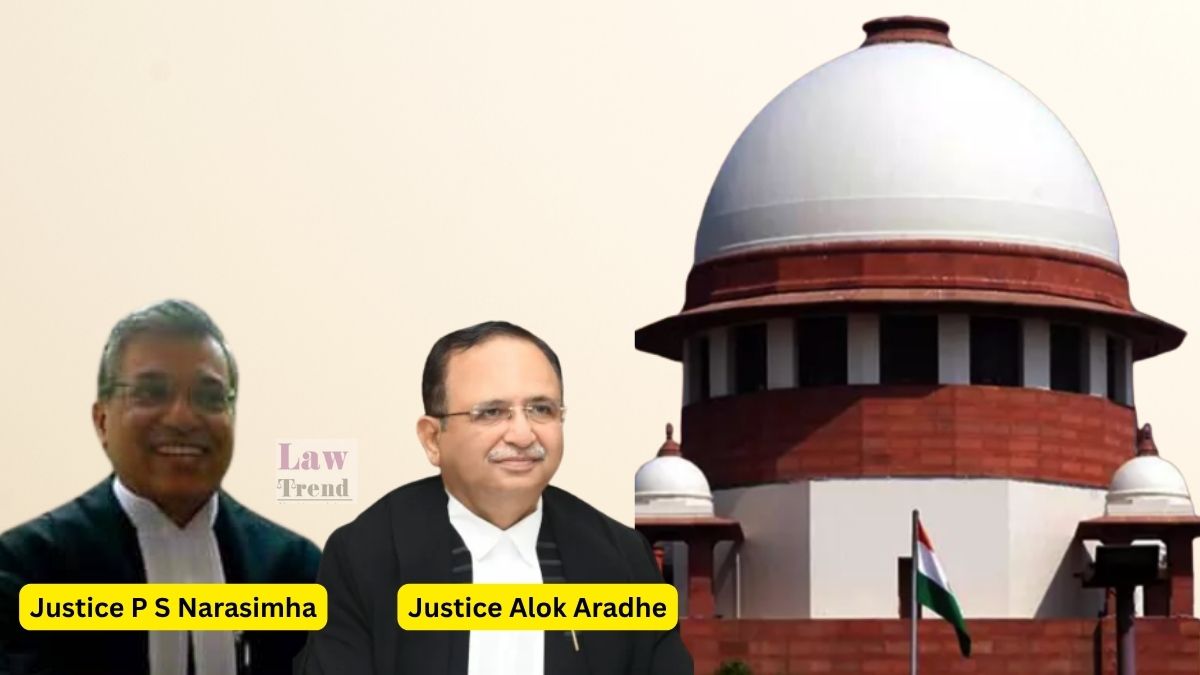
The Supreme Court of India, comprising a Bench of Justice Pamidighantam Sri Narasimha and Justice Alok Aradhe, has dismissed a batch of appeals filed by the Union of India against judicial orders granting disability pension to retired armed forces personnel. The Court held that the Entitlement Rules for Casualty Pensionary Awards, 2008, substantially reproduce the protective regime of the 1982 Entitlement Rules on causal connection, attributability, aggravation, and the burden of proof, with the sole exception that the onus shifts to the claimant if an application is lodged more than 15 years after release or discharge.
Background of the Case
The dispute arose from a batch of approximately 271 Civil Appeals and Special Leave Petitions filed by the Union of India against judgments rendered by the Armed Forces Tribunal (AFT) and various High Courts across the country. In each instance, a Release Medical Board (RMB) had assessed the disability of an ex-serviceman upon completion of engagement or retirement as “Neither Attributable to Nor Aggravated by military service” (NANA). After their departmental appeals were turned down by military authorities, the retired personnel approached the AFT or High Courts, which set aside the departmental rejections and awarded the disability element of pension.
The Supreme Court observed that the controversy was confined to the entitlement to the disability element of service pension upon retirement following normal completion of service or engagement. The governing framework historically included the Pension Regulations for the Army, 1961 (specifically Regulations 48, 53, 173, 173A, and 179), the Entitlement Rules for Casualty Pensionary Awards, 1982, and the contested Entitlement Rules for Casualty Pensionary Awards, 2008.
Submissions of the Parties
The learned Attorney General of India, appearing for the Union of India, submitted that entitlement to the disability element requires the satisfaction of two cumulative conditions: a finding that the disability is attributable to or aggravated by military service (A/A), and an accepted degree of disablement of 20 percent or more. The Attorney General contended that the Entitlement Rules 2008 made a significant departure from the 1982 Rules by removing the automatic entry-stage presumption under Rule 5 and explicitly providing that the mere onset or manifestation of a disease during service does not per se establish attributability or aggravation.
Citing past rulings including Secretary, Ministry of Defence v. A.V. Damodaran, Controller of Defence Accounts (Pension) v. S. Balachandran Nair, Union of India v. Baljit Singh, Union of India v. Dhir Singh China, Union of India v. Ajay Wahi, Union of India v. Surinder Singh Rathore, and Union of India v. Talwinder Singh, the Union argued that disease onset during service does not automatically prove causation. The Union further submitted that the landmark verdict in Dharamvir Singh v. Union of India could not be mechanically applied to claims under the 2008 Rules, particularly for constitutional, metabolic, or degenerative diseases like hypertension, diabetes mellitus, and ischaemic heart disease, and that expert opinions of Medical Boards must not be lightly supplanted by courts, referencing Ex. Gnr. Laxmanram Poonia v. Union of India and Narsingh Yadav v. Union of India.
In response, learned counsel appearing for the respondent ex-servicemen submitted that military entitlement rules have always recognized the extreme physical strain, harsh climatic conditions, and operational rigors endured by service members. They argued that the Entitlement Rules 2008 introduced changes in form rather than any substantive abrogation of existing rights. Relying on Union of India v. Rajbir Singh, Union of India v. Manjeet Singh, Union of India v. Angad Singh Titaria, Bijender Singh v. Union of India, and Rajumon T.M. v. Union of India, the respondents argued that unreasoned rejections by Medical Boards remain legally unsustainable.
The respondents also placed reliance on High Court rulings, including Union of India v. Ex Sub Gawas Anil Madso and Col. Balbir Singh v. Union of India from the Delhi High Court, and Union of India v. Bhaskaran N. from the Kerala High Court, to show that the initial burden of proof remains firmly on the establishment. Furthermore, they pointed to the 2015 Report of the Committee of Experts constituted by the Raksha Mantri, which had questioned the validity of the 2008 Regulations and recommended the withdrawal of appeals against disabled soldiers.
The Court’s Analysis
Examining the source and legal force of the Entitlement Rules 2008, the Supreme Court expressed serious concern that the Union could not produce an authentic gazetted copy or demonstrate the precise source, time, and statutory method by which the 2008 Rules repealed or superseded the 1982 Rules. Under the Allocation of Business Rules, 1961, the formulation of retirement benefit policy is allocated to the Department of Pension and Pensioners’ Welfare (DoPPW), whereas the Department of Ex-Servicemen Welfare (DESW) is tasked only with administering the existing regulations.
The Court referred to Para 2.4.8 of the 2015 Raksha Mantri Committee of Experts Report, which observed:
“The Committee hence strongly observes that the so-called ‘Pension Regulations, 2008’ or the ‘Entitlement Rules, 2010’ have no sanctity of law as far as alteration of entitlements is concerned. The same can at best be adopted to regulate procedural aspects and if there is a conflict between the same and the actual Pension Regulations 1961 or actual Entitlement Rules 1982 thereby affecting the rights of pensioners negatively, then the Regulations of 1961 and Rules of 1982 shall prevail to determine the entitlement.”
Undertaking a comparative evaluation between the 1982 and 2008 regimes, the Bench held that even though Rule 5 of the 2008 Rules removed the entry-level presumption of sound health and inserted an explicit causal requirement, the core scheme remained unaltered:
- Onus of Proof: Rule 7 of the 2008 Rules provides that ordinarily the claimant will not be called upon to prove entitlement, leaving the primary burden on the employer. The sole modification is a proviso shifting the burden to the claimant only if a claim is lodged after 15 years from discharge or release, during which period service records are routinely destroyed.
- Aggravation and Unknown Causes: Rule 11 of the 2008 Rules maintains the aggravation framework of erstwhile Rule 20. Under Rule 10(b)(iii) of the 2008 Rules, where the cause of a disease is unknown and the presumption in favor of the claimant is not rebutted, attributability must be conceded based on the clinical picture and current medical science.
- Benefit of Reasonable Doubt: Rule 7 read with Regulation 423(a) of the Regulations for the Medical Services of the Armed Forces (RMSAF) preserves the mandate that the benefit of reasonable doubt must be extended to the serviceman, whether posted in a peace station or operational area.
Summarizing its substantive findings, the Bench observed:
“In our view the Entitlement Rules 2008, assuming they otherwise have legal effect, substantially reproduce the 1982 scheme of causal connection, onus, and attributability/aggravation subject only to the limited qualification introduced by the proviso to Rule 7.”
The Court also highlighted the observations of the 2015 Raksha Mantri Report on service strains:
“While the world has moved much ahead… in India many disabled soldiers are still denied disability benefits on hyper-technical reasons… It is important to realize that there is inherent stress and strain in military service. In all democracies, disabilities arising in service or during authorized leave are considered as attributable or aggravated by military service”
The Decision
The Supreme Court dismissed the entire batch of Civil Appeals and Special Leave Petitions preferred by the Union of India, both on the grounds of delay and limitation, and on merits.
The Court laid down the following conclusions and directives:
- No case for interference was made out against the impugned decisions of the High Courts and the Armed Forces Tribunal.
- The opinion of a Medical Board deserves due weight as an expert determination and should not be substituted by a court or tribunal merely because an alternative view is possible. In pending matters, the Tribunal must closely examine the specific opinions and recorded reasons of the Medical Board before adjudicating claims.
- Where a claimant approaches the relevant court or tribunal after a period of 15 years from discharge, invalidment, or release, the proviso to Rule 7 of the Entitlement Rules 2008 applies, and the onus shifts to the applicant to establish entitlement.
The Bench ordered that there shall be no order as to costs.
Case Title: Union of India & Ors. v. Col. NC Isaac (Retd.) (with connected matters)
Case No.: Civil Appeal No. ___ of 2026 (@Special Leave Petition (C) No. 3680 of 2025)
Bench: Justice Pamidighantam Sri Narasimha, Justice Alok Aradhe
Date: September 15, 2026




