

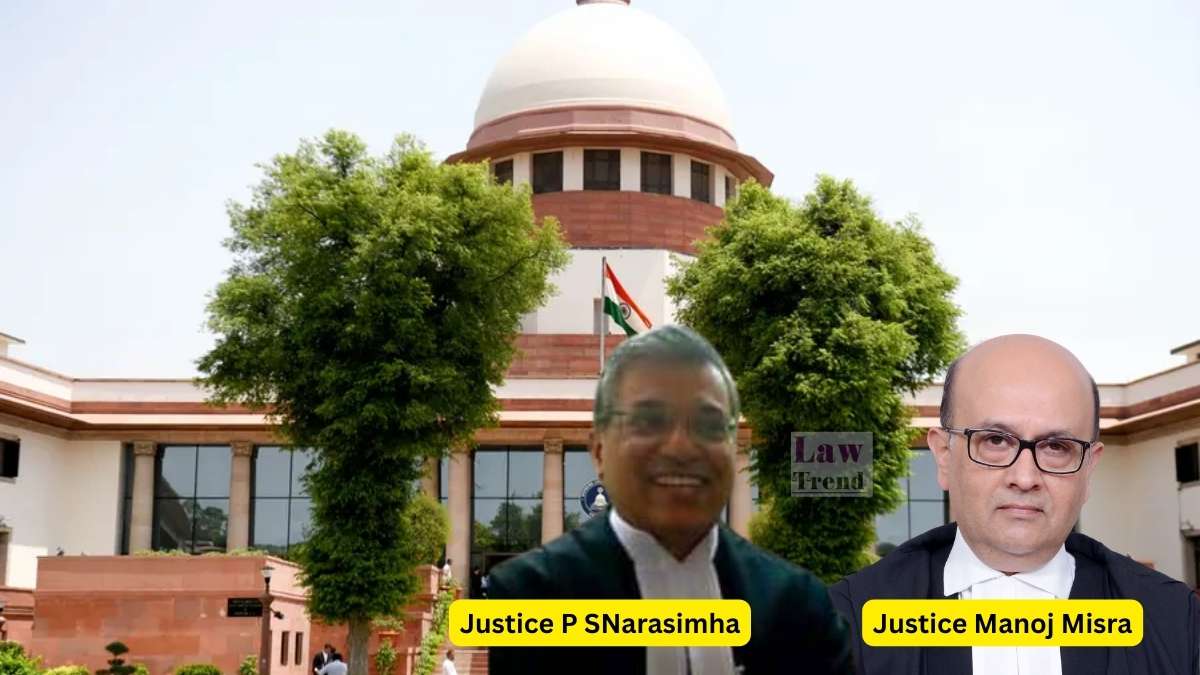
The Supreme Court of India has upheld the dismissal of a consumer complaint filed by Sant Rohidas Leather Industries and Charmakar Development Corporation Ltd. against Vijaya Bank, ruling that complex factual disputes involving allegations of fraud and forgery cannot be adjudicated in summary proceedings under the Consumer Protection Act, 1986.
A bench comprising Justice Pamidighantam Sri Narasimha and Justice Manoj Misra delivered the judgment on March 19, 2026, in a statutory appeal arising from an order of the National Consumer Disputes Redressal Commission (NCDRC) dated March 13, 2023. While the Court disagreed with the NCDRC’s specific finding that the appellant was not a “consumer” simply because the deposit earned interest, it concluded that the nature of the dispute—involving a contested pledge and alleged fraudulent overdraft—was outside the scope of consumer law.
Background of the Case
The appellant, an undertaking of the State of Maharashtra, invested ₹9 crores in a fixed deposit (FDR) with Vijaya Bank for one year starting February 28, 2014. Interest was initially credited after TDS deductions. However, on June 27, 2014, the appellant received a letter from the Bank regarding the sanction of a loan/overdraft facility of ₹8.10 crores against the FDR.
Suspecting foul play, the appellant lodged a complaint with the Economic Offences Wing (EOW), Mumbai. In March 2017, the Bank informed the appellant that the overdraft facility had been closed by adjusting the outstanding amount against the maturity value of the FDR, remitting only the remaining balance of ₹50,58,847. The appellant refused the adjustment and filed a consumer complaint seeking the full principal amount plus interest.
Arguments of the Parties
The Appellant argued that:
- Parking surplus funds in a bank does not constitute a “commercial activity” or reflect a “commercial purpose.”
- There was no direct nexus between the banking services and the generation of profit for its core business (supplying raw materials to leather industries).
- A body corporate can indeed be a “consumer” under the Act.
The Respondent-Bank contended that:
- The investment was intended to augment profits, making it a “commercial purpose” under Section 2(1)(d).
- The original FDR was pledged for a credit facility, and the document held by the appellant was allegedly forged.
- Allegations of fraud and forgery must be decided by a Civil or Criminal Court, not through the summary proceedings of the 1986 Act.
The Court’s Analysis
The Supreme Court addressed two primary issues: the definition of a “consumer” in the context of banking deposits and the maintainability of complaints involving criminal allegations.
1. On the “Commercial Purpose” of Deposits: The Court clarified that merely earning interest on a bank deposit does not automatically disqualify a person or entity from being a “consumer.”
“Accepting cash deposits from customers and paying interest thereon is the most basic of services rendered by a bank… merely because a fixed deposit receipt earns interest does not mean that the banking service availed is for a commercial purpose. To this extent, we do not agree with the view of NCDRC.”
However, the Court noted that if a deposit is used to leverage credit facilities for business augmentation, it would have a direct nexus with profit generation, potentially excluding the entity from the definition of a consumer.
2. On Fraud and Summary Proceedings: The bench emphasized that consumer forums are intended for “speedy and simple redressal” and are not equipped to handle “complex factual issues pertaining to criminal or tortious liability.”
Referring to the precedent in Chairman and Managing Director, City Union Bank Limited v. R. Chandramohan (2023), the Court observed:
“The proceedings before the Commission being summary in nature, the complaints involving highly disputed questions of facts or the cases involving tortious acts or criminality like fraud or cheating, could not be decided by the Forum/Commission under the said Act.”
In the present case, the Bank alleged that the FDR was pledged under a subsequent contract, while the appellant alleged this pledge was a fraudulent act. The Court found that determining whether a fraud was played or if documents were forged was essential to deciding if a “deficiency in service” existed.
The Decision
The Supreme Court concluded that the complaint, as framed, was not maintainable before the NCDRC due to the complex criminal allegations involved.
“In such circumstances, the complaint allegations as they stand cannot be adjudicated upon in a proceeding under the 1986 Act as those allegations could appropriately be addressed in a regular criminal or civil proceeding.”
While the appeal was dismissed, the Court clarified that this would not bar the appellant from seeking recourse through appropriate civil or criminal courts. No order as to costs was made.
Case Details:
- Case Title: Sant Rohidas Leather Industries and Charmakar Development Corporation Ltd. v. Vijaya Bank
- Case No.: Civil Appeal No. 4841 of 2023
- Bench: Justice Pamidighantam Sri Narasimha and Justice Manoj Misra
- Date of Judgment: March 19, 2026




