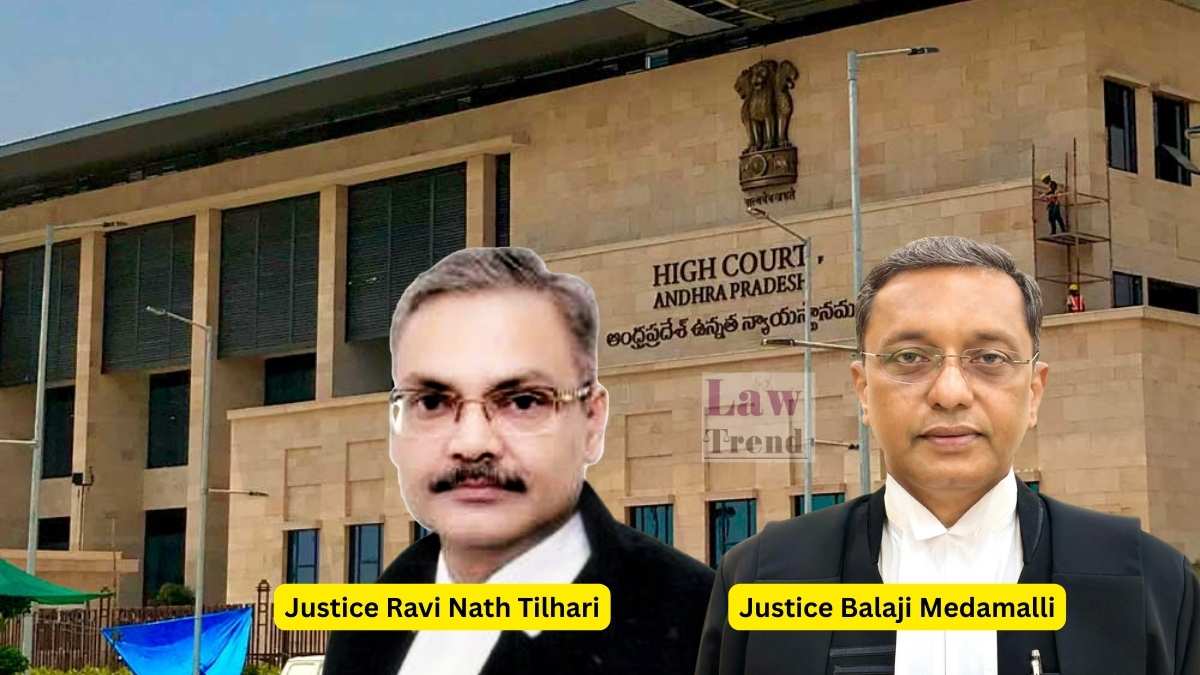
The High Court of Andhra Pradesh at Amaravati has ruled that a specific contract clause conferring exclusive jurisdiction on the Civil Courts of a particular district serves as a “contrary indicia” to restrict a designated place of arbitration from being elevated to the status of a juridical “seat.”
A Division Bench comprising Justice Ravi Nath Tilhari and Justice Balaji Medamalli set aside an order of the Special Commercial Court in Visakhapatnam, which had previously dismissed a petition filed under Section 9 of the Arbitration and Conciliation Act, 1996, on the grounds of lack of territorial jurisdiction. The High Court held that because the parties explicitly agreed to exclude all courts other than the Civil Courts of East Godavari District, the designated venue of Hyderabad remained merely a physical place for conducting arbitration proceedings, leaving the supervisory jurisdiction with the courts of East Godavari District (which fall under the jurisdiction of the Visakhapatnam Commercial Court).
Background of the Case
The appellant, Carloyn Joyce Tadamala, is the absolute owner of schedule property admeasuring Ac. 4.45 cents in Samanasa Village, Amalapuram Mandal, East Godavari District. On October 29, 2019, she entered into a registered Development Agreement-cum-General Power of Attorney (DAGPA) with the respondent, Royal City Developer Private Limited (formerly Royalmindz Infra Private Limited), for the development of the property. Subsequently, on July 27, 2022, the parties entered into an Agreement of Sale concerning 16 plots falling to the appellant’s share for a consideration of Rs. 9.20 crores.
Disputes arose when the appellant alleged that the respondent committed breaches of contract, deliberately delayed construction, and failed to hand over her allocated share within the agreed-upon period. Following legal notices and a notice terminating the DAGPA, the appellant nominated an arbitrator and approached the Special Court for Trial and Disposal of Commercial Disputes, Visakhapatnam, with an application under Section 9 of the Arbitration and Conciliation Act. She sought an interim injunction restraining the respondent from alienating or creating third-party interests in the scheduled property and a direction to deposit Rs. 9.20 crores in court pending the arbitration.
The respondent resisted the application, raising several defenses on the merits and asserting that the Visakhapatnam Commercial Court lacked territorial jurisdiction. The respondent pointed to Clause 57 of the DAGPA, which states that “arbitration proceedings shall be held in Hyderabad only.”
The Special Commercial Court at Visakhapatnam, vide its order dated December 1, 2025, dismissed the application solely on the ground of lack of territorial jurisdiction, finding that the parties had intended Hyderabad to be the seat of arbitration. Aggrieved by this decision, the appellant preferred an appeal before the High Court.
The Crucial Clauses of the DAGPA
The entire dispute regarding jurisdiction centered on the interpretation of two distinct clauses in the agreement:
- Clause 57 (Arbitration): > “…The awards of the Arbitrators shall be final and binding on the ‘PARTIES’ to the reference. The arbitration proceedings shall be held in Hyderabad only.”
- Clause 58 (Jurisdiction):
“In respect of matters / disputes arising out of in connection with or in relation to this Development Agreement cum GPA only the civil courts in East Godavari District shall have jurisdiction to the exclusion of all other courts.”
Arguments of the Parties
Appellant’s Submissions
The appellant contended that the Special Commercial Court erred in treating Hyderabad as the juridical “seat” of arbitration. It was argued that:
- The reference to Hyderabad in Clause 57 was only to specify a convenient “place” or “venue” for physical meetings and hearings.
- Clause 58 acted as a strong “contrary indicia,” explicitly ousting the jurisdiction of all other civil courts except those in East Godavari District.
- In light of the Supreme Court’s decision in BGS SGS SOMA JV v. NHPC Limited, where there is a contrary indicia, the designated venue cannot be elevated to the status of a “seat.”
- Denying jurisdiction to the East Godavari courts would render Clause 58 redundant and otiose.
The appellant relied on several High Court rulings to support this, including:
- Isgec Heavy Engineering Ltd. v. Indian Oil Corporation Limited (Delhi HC)
- Kush Raj Bhatia v. DLF Power and Services Limited (Delhi HC)
- Cravants Media Private Limited v. Jharkhand State Co-Operative Milk Producers Federation Ltd. (Delhi HC)
- Meenakshi Nehra Bhat v. Wave Megacity Centre Private Limited (Delhi HC)
- Homevista Decor and Furnishing Pvt. Ltd. v. Connect Residuary Private Limited (Calcutta HC)
- Hasmukh Prajapati v. Jai Prakash Associates Ltd. (Allahabad HC)
- KEI-Rsos Petroleum and Energy Pvt. Ltd. v. R.A.K. Ceramics (1) Pvt. Ltd. (Andhra Pradesh HC)
Respondent’s Submissions
The respondent argued that the trial court’s order was well-reasoned and legally sound:
- Designated “seat” of arbitration determines the exclusive supervisory jurisdiction of courts under the Arbitration Act, overriding any general civil jurisdiction clauses.
- Under Section 42 of the Act, once a seat is chosen, it operates as an exclusive jurisdiction clause for all subsequent court applications.
- Clause 57 and Clause 58 operate in entirely distinct fields; Clause 57 governs arbitral disputes (establishing Hyderabad as the seat), while Clause 58 applies only to non-arbitrable civil disputes.
- Designated seat at Hyderabad meant that only courts in Hyderabad possessed the jurisdiction to entertain Section 9 applications.
The respondent placed reliance on the following landmark Supreme Court judgments:
- BGS SGS SOMA JV v. NHPC Limited
- Indus Mobile Distribution Private Limited v. Datawind Innovations Private Limited
- Brahmani River Pellets Limited v. Kamachi Industries Limited
The Court’s Analysis and Observations
The High Court examined the relationship between Clause 57 and Clause 58 of the agreement, stating that the intention of the parties must be gathered by reading all clauses of the contract conjointly and not in isolation.
The Bench analyzed the legal framework established in BGS SGS SOMA JV, quoting the apex court’s key ruling:
“Whenever there is the designation of a place of arbitration in an arbitration clause as being the ‘venue’ of the arbitration proceedings, the expression ‘arbitration proceedings’ would make it clear that the ‘venue’ is really the ‘seat’ of the arbitral proceedings, as the aforesaid expression does not include just one or more individual or particular hearing, but the arbitration proceedings as a whole, including the making of an award at that place… This, coupled with there being no other significant contrary indicia that the stated venue is merely a ‘venue’ and not the ‘seat’ of the arbitral proceedings, would then conclusively show that such a clause designates a ‘seat’ of the arbitral proceedings.”
Applying this test to the case at hand, the High Court observed that Clause 58 serves as an explicit “contrary indicia.” The Bench noted:
“If both the clauses are not read together, as contended by the learned counsel for the petitioner, Clause 58 would render in otiose and no meaningful interpretation could be given to the said clause.”
The Court further held that Clause 57 and Clause 58 are dependent on each other, with Clause 58 directly covering and limiting the supervisory jurisdiction of the court:
“Therefore, Clauses 57 and 58 have to be read together and they are dependent clauses and Clause 58 covers the proceedings under Clause 57 also which would mean to include the arbitration proceedings also. That apart, clause 57 speaks that the proceedings of arbitration shall be held at Hyderabad only would mean and intend that the said proceedings shall take place at Hyderabad for the convenience of the parties. Therefore Hyderabad can be treated as place of arbitration only. The same cannot be treated as seat of arbitration.”
Thus, the Bench concluded that the exclusive jurisdiction of all civil courts other than those in East Godavari District stood excluded by the agreement. Consequently, any application under Section 9 of the Act had to be instituted in terms of Clause 57 read with Clause 58.
The Decision
Since the territorial jurisdiction over East Godavari District has been attached to the Special Judge for Trial and Disposal of Commercial Disputes, Visakhapatnam, the High Court ruled that the Visakhapatnam Commercial Court is fully vested with the territorial jurisdiction to decide the Section 9 proceedings.
The High Court allowed the appeal, setting aside the order dated December 1, 2025, passed in C.A.O.P. No. 11 of 2025 by the Special Commercial Court, Visakhapatnam. The Bench closed all pending miscellaneous applications without any order as to costs.
Case Details
- Case Title: Carloyn Joyce Tadamala v. Royal City Developer Private Limited
- Case No.: Commercial Court Appeal No. 27 of 2025 (COMCA No. 27 of 2025)
- Bench: Justice Ravi Nath Tilhari and Justice Balaji Medamalli
- Date: 07.05.2026