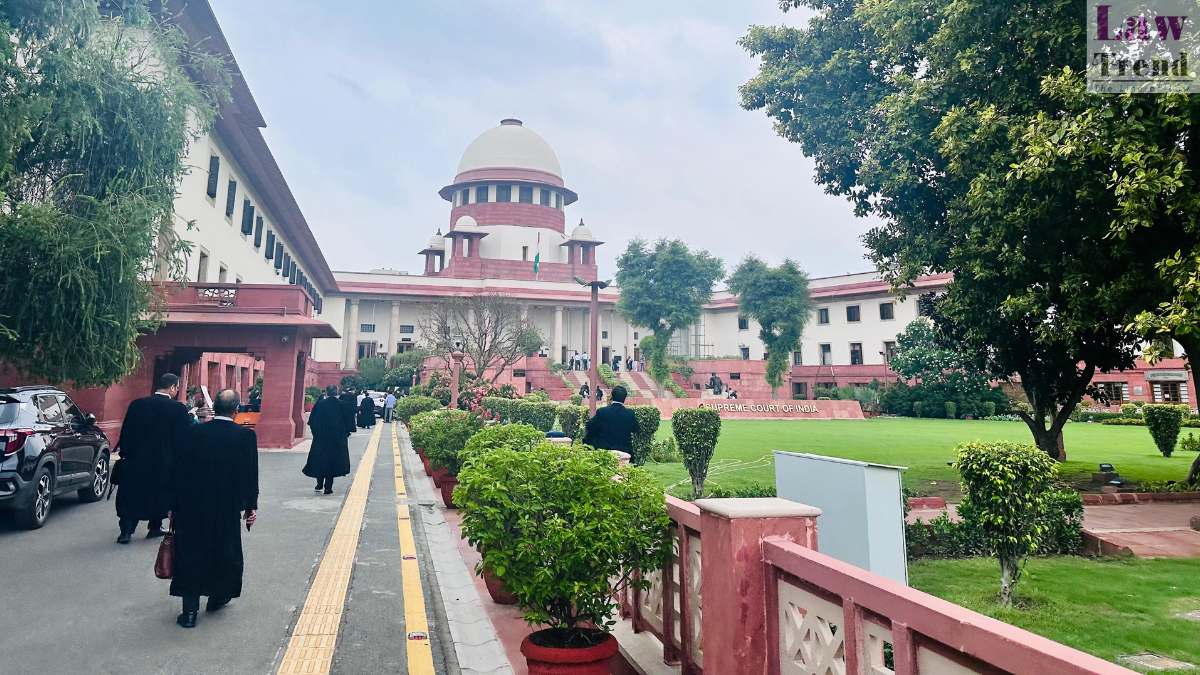
The Supreme Court of India has held that the specification and alteration of municipal limits under Section 3 of the Maharashtra Municipal Corporations Act, 1949 (MMC Act) is a legislative function and its validity cannot be adjudicated by a Civil Court through a declaratory suit. A Bench comprising Justice Prashant Kumar Mishra and Justice K.V. Viswanathan dismissed the appeals filed by the Unchgaon Village Panchayat, affirming that matters relating to municipal jurisdiction and planning control fall within the domain of public law rather than private civil rights.
Background of the Case
The dispute originated in January 2013 when the Kolhapur Municipal Corporation published a notice asserting that specific lands in Village Uchgaon fell within its municipal limits. The notice stated that certain constructions on these lands lacked permission from the Corporation and were liable for demolition.
The Unchgaon Village Panchayat, established in 1943, challenged this notice by filing Regular Civil Suit No. 193 of 2013. The Panchayat sought a declaration that the lands had not been validly included in the Corporation’s limits and a permanent injunction against demolition. While the Civil Court (Junior Division), Kolhapur, initially held it had jurisdiction and granted an interim injunction, the Bombay High Court later reversed this in February 2018. The High Court ruled that the Civil Court lacked jurisdiction as the extension of municipal limits is a legislative act.
Arguments of the Parties
For the Panchayat (Appellant): The learned counsel argued that the disputed lands fell entirely within the jurisdiction of the Panchayat and that the Corporation had no concern with them. It was contended that the Corporation failed to produce the specific 1945 notification that supposedly brought the lands under municipal limits. Furthermore, they argued that the bar under Section 149 of the Maharashtra Regional and Town Planning Act, 1966 (MRTP Act) did not apply, and the Civil Court was correct to entertain the suit to resolve mixed questions of fact and law.
For the Corporation (Respondent): The learned counsel supported the High Court’s judgment, emphasizing that the determination of municipal limits under Section 3 of the MMC Act is a legislative function. They further argued that since the notice was issued by the Corporation in its capacity as a “planning authority” under the MRTP Act, the jurisdiction of the Civil Court was expressly barred by Section 149 of the said Act.
Court’s Analysis and Observations
The Supreme Court examined the nature of the reliefs claimed and the statutory framework. The Court observed that Section 3 of the MMC Act empowers the State Government to specify and alter municipal limits. On the nature of this power, the Court stated:
“The nature of this power is not administrative in the ordinary sense but partakes the character of a legislative function, involving the declaration of municipal limits and the constitution of local bodies for governance of specified areas.”
The Court further noted that once such a determination is made, its validity cannot be the subject of a civil suit. Regarding the bar under Section 149 of the MRTP Act, the Bench observed that because the Corporation acted as a planning authority regarding unauthorized constructions, the Civil Court’s jurisdiction was expressly excluded.
Addressing the Panchayat’s argument regarding factual disputes, the Court held:
“The existence of disputed questions of fact does not, by itself, confer jurisdiction where, in law, the subject matter of the dispute lies outside the domain of the Civil Court.”
The Bench also highlighted that the inclusion of the lands was traceable to notifications dating back to 1945. The Court remarked that such legislative actions attain finality and cannot be “unsettled in collateral civil proceedings at the instance of a local Panchayat body at a much later point of time.” It further noted that the reliefs sought were directed toward invalidating statutory authority, which are “matters falling within the domain of public law.”
Decision
The Supreme Court concluded that the High Court was correct in its revisional jurisdiction. The Bench found no error in the finding that the Civil Court lacked the competence to entertain the suit. Consequently, the appeals were dismissed, and the interim status quo order dated May 3, 2018, was vacated. All pending applications and contempt proceedings were also disposed of.
Case Details
Case Title: Unchgaon Village Panchayat v. Kolhapur Municipal Corporation and Another
Case No.: Civil Appeal No. 4684 of 2026
Bench: Justice Prashant Kumar Mishra and Justice K.V. Viswanathan
Date: April 22, 2026