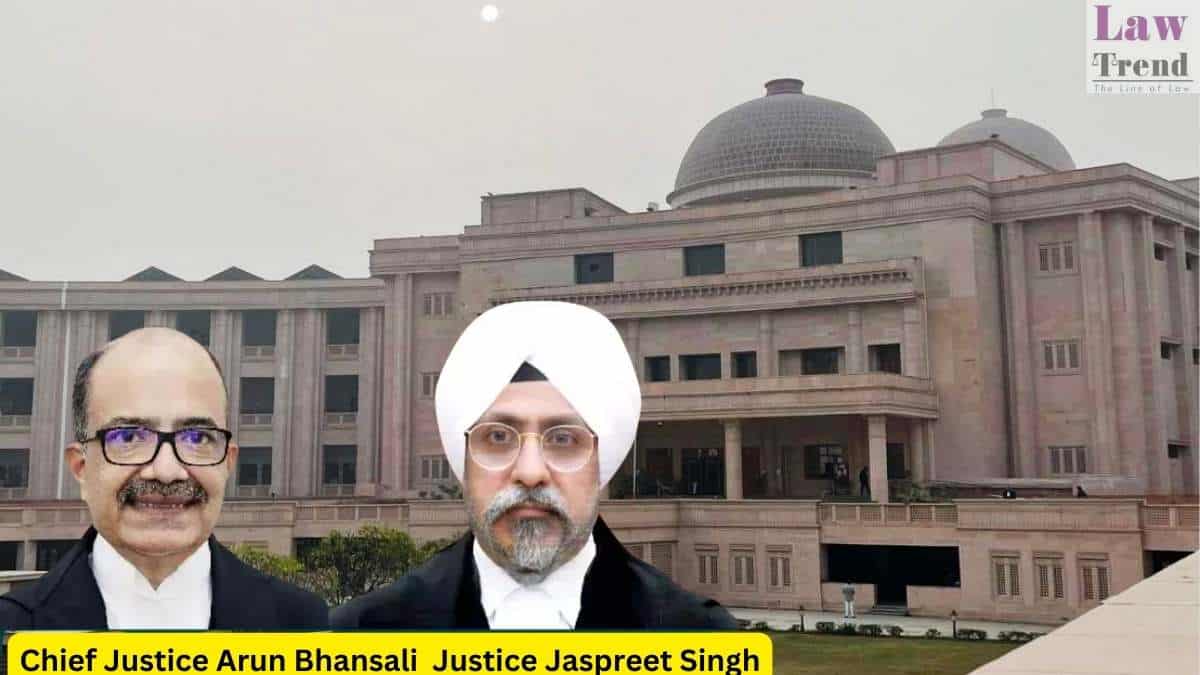
The High Court of Judicature at Allahabad, Lucknow Bench, has set aside an arbitral award and a Commercial Court judgment, ruling that a party’s consent to the appointment of an arbitrator does not constitute an “express waiver” of ineligibility under Section 12(5) of the Arbitration and Conciliation Act, 1996. The Division Bench, comprising Chief Justice Arun Bhansali and Justice Jaspreet Singh, held that the unilateral appointment of a sole arbitrator by an interested party violates the principle of equal treatment and that objections regarding such inherent lack of jurisdiction can be raised even at the appellate stage.
Background of the Case
The appellant, Laxmi Kant Pandey, was a dealer for Hindustan Petroleum Corporation Ltd. (HPCL) at ‘Pandey Filling Station’ in District Banda. On June 14, 2017, a special team inspected the outlet and found a broken seal on one of the dispensing unit nozzles. Despite the appellant’s defense that he had previously complained about the malfunctioning nozzle and that no fuel shortage was recorded, HPCL terminated the dealership agreement on July 24, 2017.
The appellant subsequently invoked the arbitration clause (Clause 66), which empowered HPCL’s Chairman and Managing Director (CMD) to act as or nominate the sole arbitrator. Following an exchange of letters, the appellant consented to HPCL appointing an arbitrator after the corporation warned that he must either consent to their employee or approach the court. HPCL appointed Sri Sanjay Verghese as the Sole Arbitrator, who ultimately dismissed the appellant’s claims on April 26, 2019. The Commercial Court-II, Lucknow, later affirmed this award on April 19, 2023, leading to the present appeal under Section 37 of the Act.
Arguments of the Parties
Appellant’s Submissions: Senior Counsel Gaurav Mehrotra argued that the appointment was “directly hit by the legislative embargo contained in Section 12(1) & (5) of the Act of 1996 read with the Fifth and Seventh Schedule.” He contended that:
- The CMD was ineligible to act as an arbitrator and, consequently, ineligible to nominate one.
- The “express waiver” required by the proviso to Section 12(5) must be a clear, written agreement made after disputes arise, which was missing here.
- The proceedings were void ab initio and could be challenged at any stage.
Respondent’s (HPCL) Submissions: Counsel Aprajita Bansal argued that the appellant had “expressly waived his right in writing” by providing a consent letter dated March 7, 2018. She emphasized that:
- The appellant participated in the proceedings without demur.
- The corporation specifically informed the appellant of the 2015 amendment and sought his written consent, which he provided.
- Allowing the appellant to resile from his consent after an adverse award would be “against public policy.”
Court’s Analysis
The Court focused on the impact of the 2015 Amendment Act, which aimed to ensure arbitrator neutrality. It noted that the Seventh Schedule lists categories of relationships that render a person “ineligible” to be an arbitrator.
On Unilateral Appointment: The Court observed that under Clause 66, the CMD—an officer of HPCL—was the named arbitrator. Relying on TRF Ltd. v. Energo Engg. Projects Ltd. and the Constitution Bench decision in Central Organization for Railway Electrification v. ECI SPIC Smo MCML (JV) (CORE-II), the Bench stated:
“Once the Chairman and the Managing Director of the Corporation was ineligible to act as an Arbitrator then for the very same reason, he was not competent to appoint any other person to arbitrate.”
On ‘Express Waiver’ under Section 12(5): The Court analyzed the exchange of letters and concluded they did not satisfy the requirement of an “express agreement in writing.” Referring to the recent Supreme Court decision in Bhadra International (India) (P) Ltd. vs. Airports Authority of India, the Bench held:
“The requirement of the waiver to be made expressly in the form of agreement in writing ensures that parties are not divested of their right to object inadvertently or by procedural happenstance.”
The Court found that the appellant’s March 7 letter was merely a “consent only permitting the Corporation to appoint an Arbitrator and not a waiver of his right.”
On Raising Objections in Appeal: The Court rejected HPCL’s contention that the objection was raised too late. It held that since the ineligibility stems from the operation of law, the arbitrator lacked “inherent jurisdiction.”
“A challenge to an arbitrator’s ineligibility could be raised at any stage because an award passed in such circumstance is non-est.”
Decision
The High Court allowed the appeal and set aside both the Commercial Court’s judgment and the arbitral award dated April 26, 2019. The Court concluded:
- The appointment violated the principle of equal treatment of parties.
- The CMD was ineligible to act or nominate an arbitrator.
- There was no “express waiver” in writing as required by law.
- The illegality goes to the root of jurisdiction and can be raised in a Section 37 appeal.
The parties are now free to seek the appointment of a fresh arbitrator in accordance with the law.
Case Details
- Case Title: Laxmi Kant Pandey v. Hindustan Petroleum Corporation Ltd.
- Case No.: Arbitration Appeal No. – 53 of 2023
- Bench: Chief Justice Arun Bhansali and Justice Jaspreet Singh
- Counsel for Appellant(s): Gaurav Mehrotra (Sr. Adv.) assisted by Anupam Mishra and Madhur Jhawar.
- Counsel for Respondent(s): Aprajita Bansal, Anilesh Tewari, Ms. Gursimran Kaur, and Ms. Shreya Pahwa.
- Date: April 23, 2026