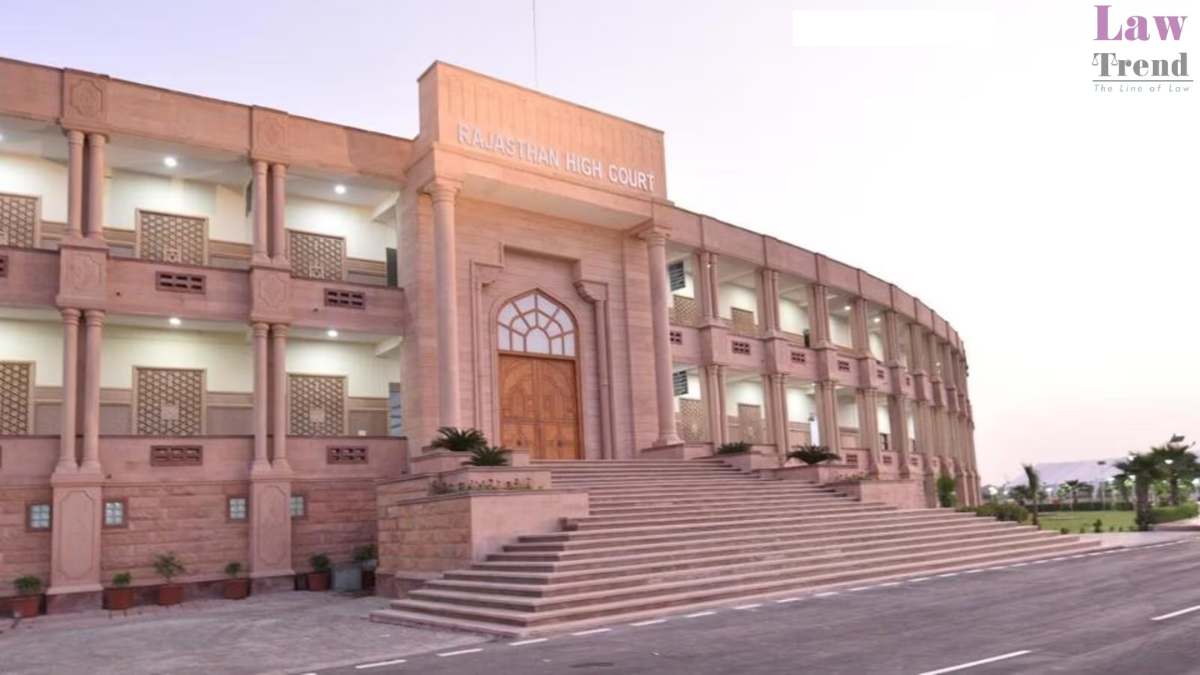
In a significant pronouncement clarifying the procedural powers of criminal courts, the Rajasthan High Court, presided over by Justice Anil Kumar Upman, held that the statutory bar under Section 362 of the Code of Criminal Procedure, 1973 (CrPC) does not restrict a court from exercising its substantive powers under Section 311 CrPC to summon, recall, or re-examine material witnesses, even after prosecution evidence has been closed. Setting aside an order of the trial court, the High Court observed that an interlocutory closure of evidence does not render a criminal court functus officio before final judgment is rendered, and ruled that both provisions operate in entirely distinct fields.
Background of the Case
The proceedings originated from FIR No. 260/2012 registered at Police Station Pahari, District Deeg, on an information lodged by the petitioner, Sattar. Following investigation, a charge-sheet was filed against accused persons Jamshed and Dilshan for offences punishable under Sections 302, 323, 341, and 34 of the Indian Penal Code, 1860 (IPC).
During the trial, the petitioner was examined as PW-1, alongside other prosecution witnesses examined as PW-2 (Imran), PW-3 (Akbar), and PW-5 (Ummed Haji). Subsequently, the trial court allowed an application filed under Section 319 CrPC (corresponding to Section 358 of the Bharatiya Nagarik Suraksha Sanhita, 2023 [BNSS]) to summon additional accused persons, namely Jameel, Mehmooda, and Haseena.
Following their appearance, charges were framed against the newly added accused for offences punishable under Sections 148, 452, 341, 323, and 302 (alternatively Section 302 read with Section 149) of the IPC. The trial court then issued bailable warrants to secure the presence of the petitioner and other witnesses—namely Imran, Anisha, and Ummed Haji—for their examination with regard to the additional accused. However, the warrants were never served, and on July 11, 2025, the trial court closed the prosecution evidence on the ground that the witnesses had failed to appear.
Aggrieved by this closure, the petitioner moved an application under Section 311 CrPC (corresponding to Section 348 BNSS) seeking the re-summoning and examination of himself and the other material witnesses. On March 18, 2026, the Additional District & Sessions Judge, Kaman, District Deeg, dismissed the application on two grounds: first, that having closed the evidence, the court could not exercise powers under Section 311 CrPC to re-summon witnesses; and second, that entertaining such a plea would amount to reviewing its own closure order, which is impermissible under Section 362 CrPC (corresponding to Section 403 BNSS). The petitioner then invoked the inherent jurisdiction of the High Court under Section 528 BNSS.
Arguments of the Parties
Mr. Anuj Rohila, counsel appearing for the petitioner, submitted that Section 311 CrPC confers an independent and substantive power upon the court to summon or recall a witness at any stage of inquiry or trial whenever the evidence is essential to reach a just decision. He argued that the exercise of this power does not amount to a review of the earlier closure order, nor does Section 362 CrPC operate as an absolute prohibition during trial pendency. It was further urged that the witnesses were material prosecution witnesses whose warrants were never served, and no prejudice would be caused to the accused as they would have a full and fair opportunity to cross-examine them.
Mr. Vivek Choudhary, appearing on behalf of the respondent State, did not oppose the submissions advanced by the petitioner’s counsel.
Court’s Analysis and Precedents
Examining the ambit of Section 311 CrPC, Justice Upman observed that the provision confers wide discretionary power to ensure all material evidence necessary for arriving at a just decision is brought on record. The Court noted that the governing consideration is not merely the stage at which the application is preferred, but whether the evidence appears essential for just adjudication.
The Court referred to the Supreme Court’s judgment in Vijay Kumar v. State of Uttar Pradesh & Anr. (2011), reiterating that powers under Section 311 must be exercised judicially whenever evidence is germane or was omitted due to inadvertence. Addressing whether the closure of prosecution evidence divests the court of this authority, the bench cited the Supreme Court’s ruling in Mohanlal Shamji Soni v. Union of India (1991), which settled that criminal courts retain ample authority to summon or re-examine witnesses even after evidence on both sides is closed.
The High Court also drew support from the Supreme Court’s ruling in Varsha Garg v. State of Madhya Pradesh & Ors. (2022), citing the following observation:
“The power of the court is not constrained by the closure of evidence. Therefore, it is amply clear from the above discussion that the broad powers under Section 311 are to be governed by the requirement of justice. The power must be exercised wherever the court finds that any evidence is essential for the just decision of the case. The statutory provision goes to emphasise that the court is not a hapless bystander in the derailment of justice. Quite to the contrary, the court has a vital role to discharge in ensuring that the cause of discovering truth as an aid in the realization of justice is manifest.”
Examining the interplay between Section 311 and Section 362 CrPC, the Court noted that while Section 362 bars a criminal court from altering or reviewing its judgment or final order disposing of a case after signing (except for clerical or arithmetical errors), it does not restrain the court during the pendency of the trial from exercising substantive powers under Section 311.
In this regard, the Court relied on its coordinate bench decision in Jagdish Prasad Sharma v. State of Rajasthan (2018), which cited the Punjab and Haryana High Court’s ruling in Jai Singh v. Soma @ Som Nath (2006) to emphasize that an order directing closure of evidence is neither a judgment nor a final order, and does not render the court functus officio. Reference was also made to Suresh Kumar v. State of Haryana (2019), where the Punjab and Haryana High Court affirmed that summoning a witness after the closure of evidence does not constitute an impermissible review.
Harmonising both provisions, the High Court held:
“Consequently, during the pendency of the trial and before the final judgment is pronounced and signed, the Court is not rendered functus officio merely because the evidence of a particular witness had earlier been closed. The provisions of Sections 311 and 362 Cr.P.C. operate in distinct fields and are required to be harmoniously construed. Hence, Section 362 Cr.P.C. cannot be invoked as an absolute bar against exercise of power under Section 311 Cr.P.C. to summon, recall or re-examine a witness whose evidence had earlier been closed, where the Court is satisfied that such evidence is essential for arriving at a just decision in the case.”
Applying these principles to the facts, the Court observed that the witnesses were neither strangers nor newly introduced, but primary prosecution witnesses whose testimonies gained enhanced importance after additional accused were summoned under Section 319 CrPC. Emphasizing that procedural closures cannot defeat substantial justice, the bench remarked:
“It is clear that the power under Section 311 Cr.P.C. is an independent statutory power and its exercise in the facts of the present case does not amount to review of the earlier order and the same can be considered even after closing of the evidence.”
Decision of the Court
The High Court allowed the petition and quashed the trial court’s order dated March 18, 2026. The trial court was directed to summon and examine/re-examine PW-1 (Sattar), PW-2 (Imran), PW-3 (Anisha), and PW-5 (Ummed Haji) strictly in accordance with law, while counsel for the petitioner was directed to secure their presence.
The Court further ordered that the accused persons be granted a full and effective opportunity to cross-examine these witnesses before the trial proceeds, clarifying that its observations were confined solely to the petition and expressed no opinion on the merits of the case.
Case Title: Sattar v. State of Rajasthan
Case No.: S.B. Criminal Miscellaneous (Petition) No. 4401/2026
Bench: Justice Anil Kumar Upman
Date: 19/08/2026