

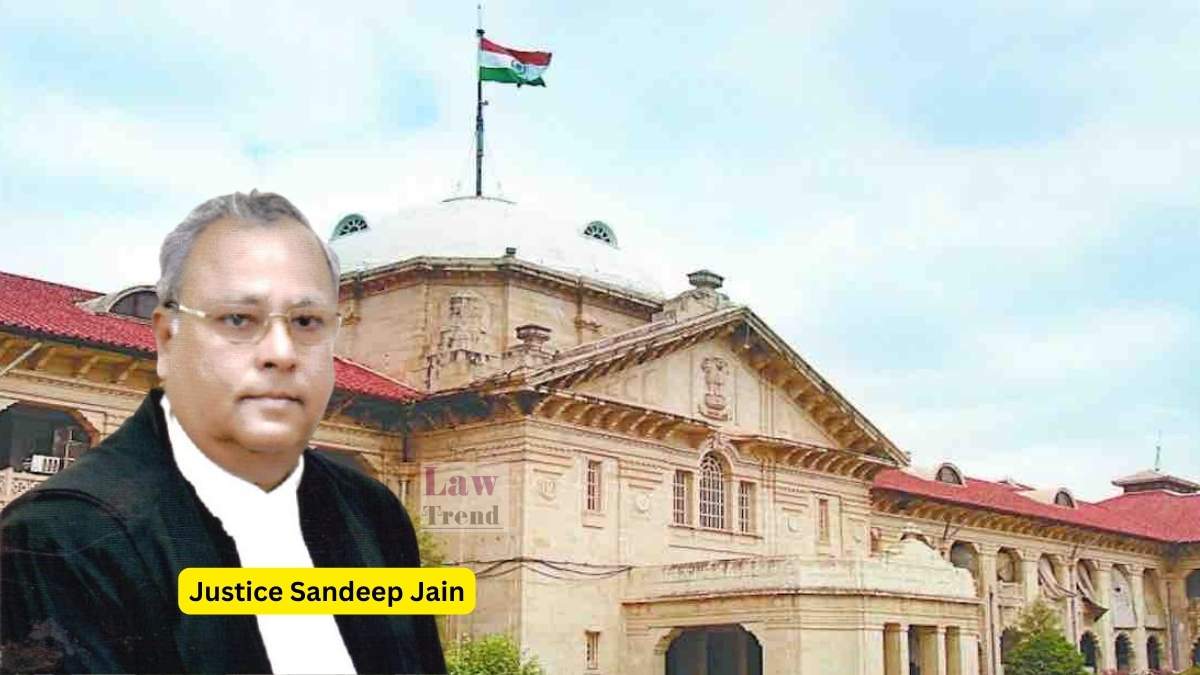
The Allahabad High Court has set aside a trial court’s order that dismissed a former bank manager’s suit against IndusInd Bank for lack of jurisdiction. The Court clarified that while a civil court cannot grant reinstatement in cases of purely contractual private employment, it possesses the inherent jurisdiction to examine the legality of a dismissal and award damages if the termination is found to be wrongful.
The ruling was delivered by Justice Sandeep Jain in a First Appeal filed by Mr. Puneet Sachdeva, who challenged the dismissal of his original suit (O.S. No. 180 of 2015) by the Additional Civil Judge (Senior Division), Allahabad.
Background of the Case
The appellant, Mr. Puneet Sachdeva, joined IndusInd Bank in 2008 and was promoted to Branch Manager of the Allahabad Branch in June 2011. During his tenure, a fraud amounting to approximately ₹41 lakhs was allegedly committed by a subordinate employee, Mrs. Suchitra Prajapati.
The Bank alleged that the fraud occurred due to the appellant’s “lax supervision” and failure to reconcile internal accounts or check daily reports. Consequently, the appellant was suspended on September 30, 2013, and following a disciplinary inquiry, he was dismissed from service on May 19, 2014. After his departmental appeal was rejected, he filed a civil suit seeking a declaration that his termination was null and void, a mandatory injunction for reinstatement, and back wages.
The Trial Court dismissed the suit on July 10, 2023, concluding it lacked inherent jurisdiction. It relied on a proviso to Order 39 Rule 2(2) CPC (as amended by U.P. Act No. 57 of 1976), which bars courts from granting injunctions to stay orders of dismissal or removal of employees.
Arguments of the Parties
Counsel for the Appellant: Sri Anshul Kumar Singhal argued that IndusInd Bank is a private entity not falling under the definition of “State” under Article 12 of the Constitution. Therefore, the appellant could not invoke Writ jurisdiction. He contended that since the service was governed by private rules (Executive Staff Service Rules, 1994) rather than statutory rules, and departmental remedies were exhausted, the Civil Court was the only forum available to redress the grievance.
Counsel for the Respondent (IndusInd Bank): Sri Saurabh Raj Srivastava argued that the dismissal had attained finality and could not be set aside by a civil court. He maintained that a contract of personal service is not specifically enforceable under Section 14 of the Specific Relief Act. He further argued that even if the termination were illegal, the court could only award damages, which the plaintiff had initially failed to claim.
Court’s Analysis
The High Court examined the distinction between public and private employment. Citing the Supreme Court in State Bank of India vs. S.N. Goyal (2008), the Court noted that there are three exceptions where reinstatement can be granted:
- Removal of a civil servant in contravention of Article 311.
- Wrongful termination of a workman under the Industrial Disputes Act.
- Breach of mandatory statutory rules by a statutory body.
The Court observed:
“It is apparent that in the instant case the plaintiff was posted as Branch Manager… his employment was purely contractual… which are not statutory. Neither the defendants fall in the definition of ‘State’ as mentioned in Article 12 of the Constitution of India nor the service conditions of the plaintiff were governed by the statutory rules.”
Regarding jurisdiction, the Court referred to Dhruv Green Field Ltd. vs. Hukum Singh (2002), stating that the jurisdiction of civil courts is expansive under Section 9 CPC unless expressly or impliedly barred.
The Court found that the Trial Court erred in its interpretation of the U.P. amendment to Order 39 Rule 2(2) CPC. While that provision prevents a court from staying a dismissal order via an injunction, it does not bar a suit for damages. The Court noted:
“It is true that he cannot be reinstated in the service of the defendant Bank and his only remedy is to claim damages from the Bank, for which, the civil court has the jurisdiction. In view of this, the civil court had the jurisdiction for examining the above facts and for awarding the relief of damages.”
The Court also criticized the Trial Court for failing to dispose of an amendment application filed by the plaintiff to specifically claim damages, calling it “carelessness of the trial court.”
Decision
The High Court allowed the appeal and set aside the judgment dated July 10, 2023. It restored O.S. No. 180 of 2015 to its original number and held that the Trial Court has the jurisdiction to try the suit.
The Court directed the Trial Court to decide the matter on its merits within six months, specifically regarding the legality of the dismissal and the potential award of damages. The High Court clarified that it expressed no opinion on the actual legality of the dismissal itself.
Case Details:
- Case Title: Mr. Puneet Sachdeva vs. IndusInd Bank and 3 Others
- Case No: First Appeal No. 273 of 2026
- Bench: Justice Sandeep Jain
- Judgment Date: April 7, 2026




