

Capital Punishment Can Only Be Awarded In Very Exceptional And Rarest Of Rare Cases: Chhattisgarh High Court Commutes Death Sentence To Life Imprisonment Without Remission
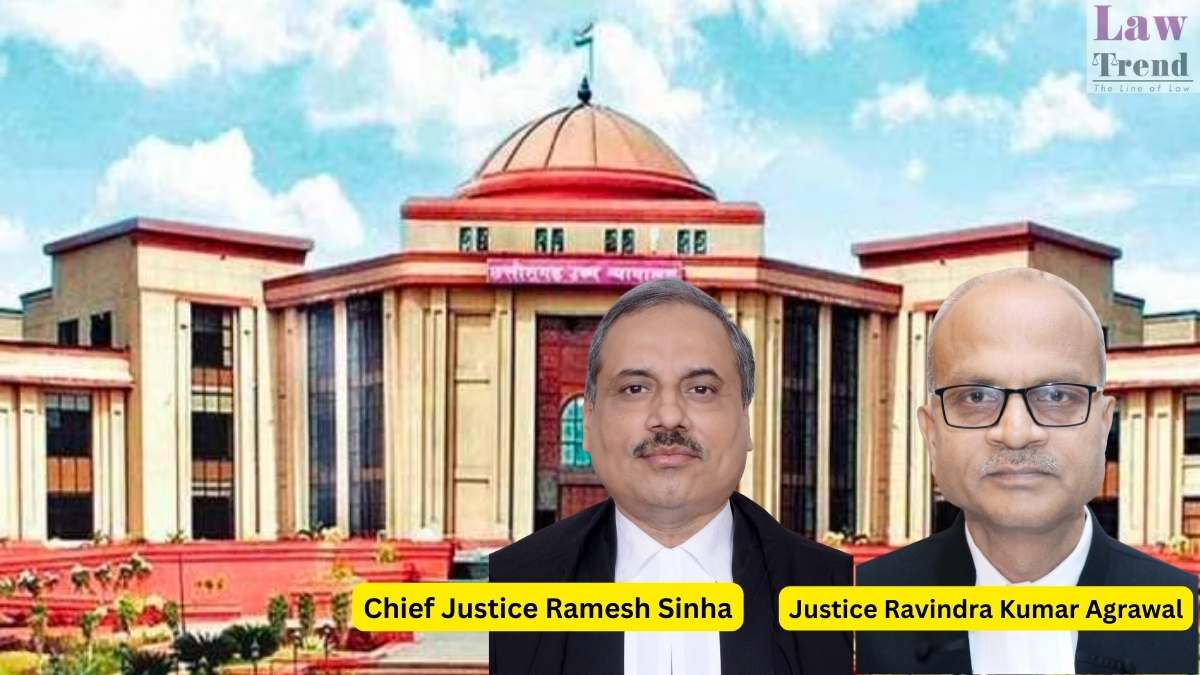

In a significant ruling on capital sentencing jurisprudence, the High Court of Chhattisgarh at Bilaspur, comprising Chief Justice Ramesh Sinha, and Justice Ravindra Kumar Agrawal, has held that capital punishment can only be awarded in very exceptional and rarest of rare cases. Evaluating the death reference along with the convict’s criminal appeal, the Division Bench affirmed the conviction of a man for the triple murder of his wife, infant daughter, and an acquaintance, but commuted his death sentence to imprisonment for the remainder of his natural life without statutory remission.

Background of the Case

The case arises from an incident on January 21, 2020, at Quarter No. 20-N, Parijat Colony, Talpuri, Bhilai. The complainant, Rajesh Suryavanshi, reported to Police Station Bhilai Nagar that at approximately 5:30 a.m., an unknown caller using the phone of his mother, Kala Suryavanshi, called his family and stated that they should go to Talpuri to see that their daughter and son-in-law were on fire.

Upon reaching the rented apartment, family members found the outer door locked from the outside. Inside the smoke-filled room, they discovered Manju Sharma and her one-and-a-half-month-old daughter, Baby Nisha Sharma, dead on the bed. Beside the bed, a fire was burning over a gas stove, containing the partially burnt body of an unidentified male whose face, hands, and legs were bound with adhesive tape. The victim was later identified as N. Raju, a daily wage labourer.

A chalk message written above the bedroom door claimed that a person named “Sanjay” committed the murders because his brother had committed suicide due to Manju. However, police investigations revealed that Manju’s husband, Ravi Sharma, had administered sleeping pills (Alprax 0.5) to the victims, bound their mouths, hands, and legs with adhesive tape, and caused their deaths by asphyxia. Sharma then placed N. Raju’s body over the fire to fake his own death, staged the scene, wrote the misleading chalk message, and fled the premises.

The police registered Crime No. 36/2020 under Sections 302 and 201 of the Indian Penal Code (IPC). Upon trial, the 3rd Additional Sessions Judge, Durg, convicted Ravi Sharma under Section 302 (three counts) and Section 201 IPC on April 23, 2026, awarding him the death sentence.

READ ALSO  Whether on the Basis of Compromise, Offence U/S 376 I.P.C. and POCSO Act Be Quashed? Allahabad HC Answers

Arguments of the Parties

Senior Advocate Prafull N. Bharat, assisted by Advocates Keshav Dewangan and Rishi Rahul Soni, appeared for the appellant Ravi Sharma. They argued that the trial court erred in convicting the appellant based on incomplete circumstantial evidence without establishing an unbroken chain of facts. The defense highlighted that no independent neighborhood witnesses were examined, seizure witnesses turned hostile, and contradictions existed between the ocular assertions and medical opinions regarding strangulation. Citing Sharad Birdhichand Sarda v. State of Maharashtra (1984) and Manoj @ Manu & Ors. v. State of Madhya Pradesh (2022), the counsel contended that capital punishment was mechanically imposed without evaluating mitigating factors such as the appellant’s age of 37 years, clean criminal record, and potential for rehabilitation.

Additional Advocate General Ashish Shukla, alongside Advocate Rishi Rahul Soni for the State, countered that the prosecution successfully proved a complete chain of circumstantial evidence. The State pointed out that calls informing the family about the fire originated from the deceased wife’s mobile phone, which was recovered directly from Sharma upon his arrest in Rourkela. Forensic Science Laboratory (FSL) reports verified that the adhesive tape and sleeping tablet wrappers recovered from Sharma matched the crime scene materials, and handwriting experts confirmed that the writing on the door matched Sharma’s handwriting sample. Citing Trimukh Maroti Kirkan v. State of Maharashtra (2006) and Nizam v. State of Rajasthan (2016), the State submitted that Sharma failed to offer any plausible explanation under Section 109 of the Bharatiya Sakshya Adhiniyam, 2023, regarding events inside his matrimonial home, justifying the capital sentence given the brutal nature of the crime.

Court’s Analysis

The High Court conducted an extensive examination of the medical, forensic, and testimonial evidence. Relying on post-mortem evaluations by Dr. B.N. Dewangan and Dr. Shravan Doneria, the Court held that all three victims suffered homicidal deaths caused by asphyxia due to smothering and airway obstruction prior to the fire being lit.

Evaluating the legal standards governing circumstantial evidence, the Court referenced established precedents including Hukam Singh v. State of Rajasthan (1977), Eradu v. State of Hyderabad (1956), Earabhadrappa v. State of Karnataka (1983), State of U.P. v. Sukhbasi (1985), Balwinder Singh v. State of Punjab (1987), Ashok Kumar Chatterjee v. State of M.P. (1989), Bhagat Ram v. State of Punjab (1954), C. Chenga Reddy v. State of A.P. (1996), Padala Veera Reddy v. State of A.P. (1990), and State of U.P. v. Ashok Kumar Srivastava (1992). The Bench observed that the prosecution successfully established every link in the chain:

  1. Calls were made to the victim’s family from the deceased wife’s phone immediately after the crime.
  2. The deceased’s mobile phone, a railway ticket dated January 21, 2020 (Durg to Tatanagar), adhesive tape, and tablet wrappers were recovered from Sharma’s possession.
  3. Scientific matching confirmed the tape’s physical characteristics and verified Sharma’s handwriting on the door.
  4. Sharma falsely claimed under Section 313 CrPC that he had left for Bihar on January 16, 2020, which was disproved by the recovery of the railway ticket dated January 21, 2020.
READ ALSO  Approach Controlling Authority Under Section 7(4)(b) of Payment of Gratuity Act 1972: Allahabad HC Refuses Intervention Under Article 226

On the question of sentencing, the Court examined precedents governing capital punishment and life imprisonment without remission, including Machi Singh v. State of Punjab (1983), Ravji v. State of Rajasthan (1996), Swamy Shraddananda (2) v. State of Karnataka (2008), Raj Kumar v. State of Madhya Pradesh (2014), Selvam v. State (2014), Tattu Lodhi v. State of MP (2016), Sachin Kumar Singhraha v. State of MP (2019), and Mohd. Firoz v. State of Madhya Pradesh (2022).

Framing the overarching principle in its head-note, the High Court observed:

“Capital punishment can only be awarded in very exceptional and rarest of the rare cases, which is lacking in present case, accordingly, death sentence awarded to the appellant is commuted to imprisonment for life by directing that the life sentence must extend to the imprisonment for remainder of the appellant’s natural life without remission.”

Addressing the strict criteria for capital punishment, the High Court stated:

READ ALSO  Sec 52 T.P. Act | Injunction Restraining Property Sale Can Be Granted Despite Doctrine of Lis Pendens: Allahabad HC

“The death penalty is to be imposed only when the alternative option of life imprisonment is unquestionably foreclosed and the possibility of reformation or rehabilitation is completely ruled out.”

Evaluating the balance between aggravating and mitigating circumstances, the Bench noted:

“Having considered the aggravating and mitigating circumstances in their entirety, this Court is of the view that although the crime is exceptionally heinous and displays considerable planning and brutality, the circumstances do not justify the irreversible punishment of death.”

Substituting the capital sentence with a non-remissible life term, the Court held:

“In the peculiar facts and circumstances of the present case, this Court is satisfied that the interests of justice would be adequately served by substituting the sentence of death with imprisonment for life for the remainder of the appellant’s natural life, without remission or premature release, subject only to any constitutional powers exercisable under Articles 72 and 161 of the Constitution of India.”

Decision of the Court

The High Court affirmed the conviction of Ravi Sharma under Section 302 (three counts) and Section 201 of the IPC. However, it modified the sentence of death awarded under Section 302 IPC to imprisonment for life for the remainder of his natural life without statutory remission or premature release.

The sentence imposed under Section 201 IPC, along with the fine and default stipulations, was maintained, with all substantive sentences ordered to run concurrently. Consequently, the State’s death reference (CRREF No. 2/2026) was answered in the negative and rejected, while the convict’s appeal (CRA No. 1699/2026) was partly allowed to the extent of sentence modification.

Case Title: Ravi Sharma v. State of Chhattisgarh (with connected reference)
Case No.: CRA No. 1699 of 2026 & CRREF No. 2 of 2026
Bench: Chief Justice Ramesh Sinha and Justice Ravindra Kumar Agrawal
Date: July 31, 2026

Law Trend
Law Trendhttps://lawtrend.in/
Legal News Website Providing Latest Judgments of Supreme Court and High Court

Related Articles

Latest Articles

