

Remand Order Founded Upon Illegal Detention Cannot Be Sustained; Judicial Remand Does Not Cure Illegality Of Initial Arrest: Chhattisgarh High Court
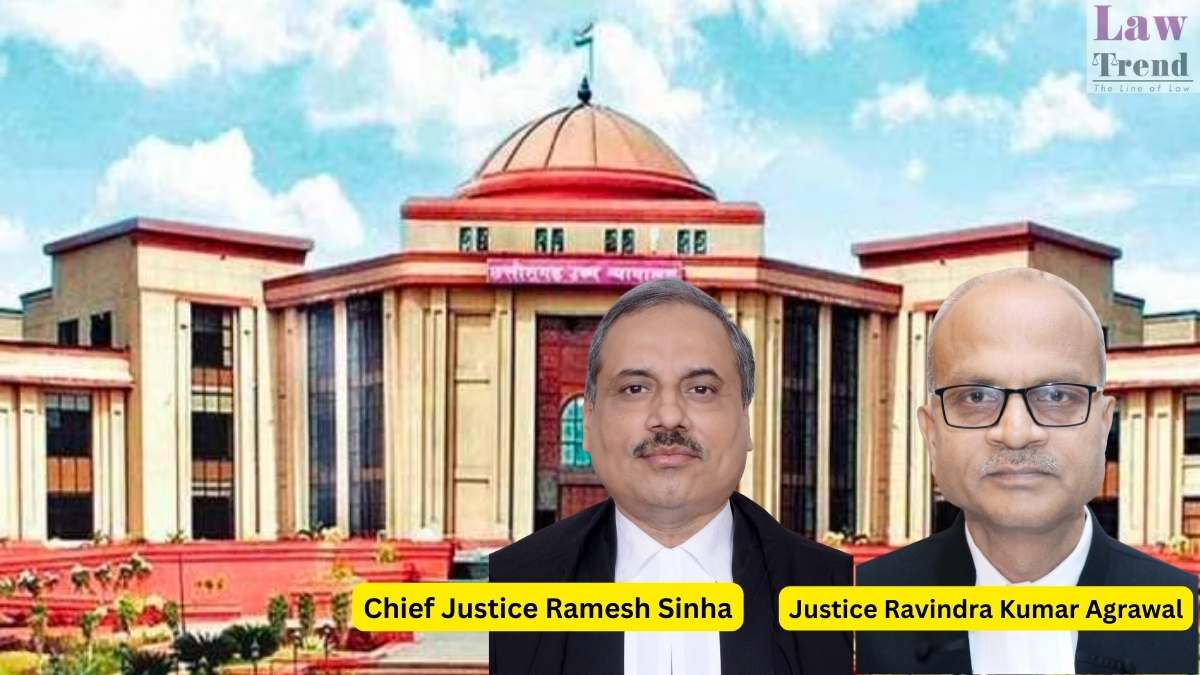

The High Court of Chhattisgarh, comprising Chief Justice Ramesh Sinha and Justice Ravindra Kumar Agrawal, has held that a remand order founded upon an illegal or unconstitutional detention cannot be sustained in law, clarifying that subsequent judicial remand does not cure initial illegalities in arrest. Quashing the detention and remand orders passed against petitioner Jitesh Anand @ Jitu, the High Court declared his detention from June 28, 2026, to June 30, 2026, violative of Articles 21 and 22 of the Constitution of India and the Bharatiya Nagarik Suraksha Sanhita, 2023 (BNSS), and directed his immediate release on bail.

Background of the Case

The case stems from Crime No. 3/2025 registered on July 22, 2025, at Cyber Police Station, Range Surguja, Ambikapur, for offences under Sections 318(4) and 3(5) of the Bharatiya Nyaya Sanhita (BNS), 2023, and Section 66D of the Information Technology (Amendment) Act, 2008. The complainant, Ravi Mohan Goswami, alleged that unknown persons lured him to invest in the share market via mobile applications “Money Trade 365” and “Skytrade”, defrauding him of Rs. 21,11,500 across 84 installments.

On June 28, 2026, police officials picked up the petitioner from his residence in Rohtak, Haryana, without informing him or his family of the grounds for his apprehension. He was taken to City Thana Police Station in Rohtak, brought to New Chhattisgarh Bhawan in Delhi overnight, and kept under police custody. Although an advocate engaged by his family waited at the Dwarka Court Complex on June 29, 2026, expecting his production, the petitioner was not produced before any court in Delhi.

Instead, police issued a notice under Section 35(3) of the BNSS on June 29, 2026, directing him to appear on July 5, 2026, but simultaneously transported him by road across multiple State boundaries—from Delhi through Uttar Pradesh to Chhattisgarh—without obtaining a transit remand from a Magistrate. On June 30, 2026, at 10:55 a.m., his formal arrest was recorded at Range Cyber Police Station, Ambikapur. He was produced before the Judicial Magistrate First Class (JMFC), Ambikapur, at 4:50 p.m., who remanded him to judicial custody on June 30, 2026, and subsequently granted two days of police custody on July 3, 2026. The petitioner challenged both remand orders before the High Court through a writ petition under Article 226 of the Constitution read with Section 528 of the BNSS.

Arguments of the Parties

Senior Advocate Amit Chadha, appearing for the petitioner, submitted that the petitioner’s liberty was unlawfully curtailed starting the evening of June 28, 2026. He argued that transporting the petitioner across State borders for over 48 hours without obtaining a transit remand violated Section 187 of the BNSS and Article 22(2) of the Constitution. It was further asserted that no written grounds of arrest were communicated to the petitioner or his family at the time of apprehension, rendering the initial detention illegal. The defense contended that the notice under Section 35(3) BNSS was a colourable exercise of power issued to legitimize unlawful custody, and that allegations of corruption and extortion regarding investigating officers in the same FIR were already subject to proceedings before the Special Judge (PC Act) CBI, Rouse Avenue Courts, Delhi.

READ ALSO  Rape Degrades the Very Soul: Chhattisgarh High Court Upholds Convictions in POCSO Case

Countering the plea, Additional Advocate General Praveen Das, representing the State of Chhattisgarh, argued that the petitioner was not illegally arrested on June 28, 2026, but was subjected to a lawful field-tracking procedure involving a syndicate that defrauded victims of over Rs. 1000 crore. The State contended that the petitioner voluntarily accompanied the police team from Delhi to Chhattisgarh due to his own financial and logistical constraints, endorsing his consent in writing on the Section 35(3) BNSS notice receipt. The State submitted that formal arrest was effectuated at Ambikapur on June 30, 2026, at 10:55 a.m. under Section 35(1)(c) and Section 47 of the BNSS after finding strong evidence connecting him as a primary hawala cash carrier for co-accused persons. Consequently, his production before the JMFC, Ambikapur, at 4:50 p.m. on the same day fell within the 24-hour statutory requirement.

Court’s Analysis and Explicit Precedents

The High Court observed that the core issue was whether the petitioner was deprived of his personal liberty on June 28, 2026, or had voluntarily accompanied the police team until June 30, 2026.

Rejecting the State’s argument of voluntary travel, the Court noted that a citizen confronted by police officers investigating a serious offense occupies an unequal position, and a mere handwritten endorsement made while under police control cannot establish true voluntariness. The Court affirmed that constitutional protection under Article 22(2) becomes operative as soon as liberty is substantially curtailed, irrespective of when formal arrest documentation is drawn up.

Holding that the failure to obtain a transit remand from the nearest Magistrate before transporting the petitioner across State borders invalidated the detention, the Court remarked:

READ ALSO  Victim Cannot be Penalized for Procedural Irregularities Committed by Investigating Officer: Kerala High Court

“The constitutional guarantee contained in Article 22(2) cannot be defeated by postponing the formal preparation of an arrest memo. The expression ‘arrest’ occurring in Article 22(2) cannot be construed in a narrow or technical sense. The constitutional protection becomes operative from the point of time when an individual’s liberty is substantially curtailed and he is placed under the control of the police.”

The Court examined key precedents explicitly discussed during the proceedings:

  1. Vihaan Kumar v. State of Haryana: Reaffirming the principle laid down in Prabir Purkayastha v. State (NCT of Delhi), the Court noted that Article 22(1) mandates communicating grounds of arrest, quoting: “The right to be informed about the grounds of arrest flows from Article 22(1) of the Constitution of India and any infringement of this fundamental right would vitiate the process of arrest and remand. Mere fact that a charge-sheet has been filed in the matter, would not validate the illegality and the unconstitutionality committed at the time of arresting the accused and the grant of initial police custody remand to the accused.”
  2. Mihir Rajesh Shah v. State of Maharashtra & Another: The Court highlighted the statutory duty to supply written grounds of arrest when an accused is under police supervision following a notice under Section 35(3) BNSS / Section 41A CrPC, citing: “In case of non-compliance of the above, the arrest and subsequent remand would be rendered illegal and the person will be at liberty to be set free.”
  3. Manubhai Ratilal Patel v. State of Gujarat & Others: Emphasizing that ordering remand is a judicial function requiring active application of mind, the Court cited: “The act of directing remand of an accused is fundamentally a judicial function. The Magistrate does not act in executive capacity while ordering the detention of an accused. While exercising this judicial act, it is obligatory on the part of the Magistrate to satisfy himself whether the materials placed before him justify such a remand or, to put it differently, whether there exist reasonable grounds to commit the accused to custody and extend his remand.”

Addressing the effect of an initial unlawful arrest on subsequent custody orders, the High Court observed:

“Judicial remand cannot cure an illegal arrest or validate an unconstitutional detention. Once the initial detention is found to be unlawful, every consequential order founded thereon becomes legally unsustainable.”

The Court further rejected the defense that the severity of cyber fraud allegations justified bypassing statutory procedure, stating:

“The gravity of the allegations may justify a thorough investigation but cannot justify departure from the mandatory safeguards enacted to protect personal liberty. Constitutional rights are not contingent upon the nature of the accusation.”

Decision of the Court

The High Court allowed the writ petition and quashed the impugned remand orders dated June 30, 2026, and July 3, 2026, passed by the Judicial Magistrate First Class, Ambikapur.

The Court declared that the petitioner’s detention from June 28, 2026, to June 30, 2026, was illegal and violative of Articles 21 and 22 of the Constitution of India as well as the BNSS. The Court directed that the petitioner be released from custody in connection with Crime No. 3/2025 upon furnishing a personal bond of Rs. 5,00,000 with two solvent sureties of like amount (one local surety and one family member), subject to surrendering his passport and cooperating with the investigation. The Court clarified that its findings were strictly limited to the legality of the arrest and detention and did not reflect on the merits of the FIR allegations.

READ ALSO  306 IPC | No Compromise Can be Made With a Dead Man: P&H HC Refuses to Quash FIR on the basis of Compromise

Case Title: Jitesh Anand @ Jitu v. State Of Chhattisgarh & Ors.
Case No.: WPCR No. 388 of 2026
Bench: Chief Justice Ramesh Sinha and Justice Ravindra Kumar Agrawal
Date: August 03, 2026

Law Trend
Law Trendhttps://lawtrend.in/
Legal News Website Providing Latest Judgments of Supreme Court and High Court

Related Articles

Latest Articles

