

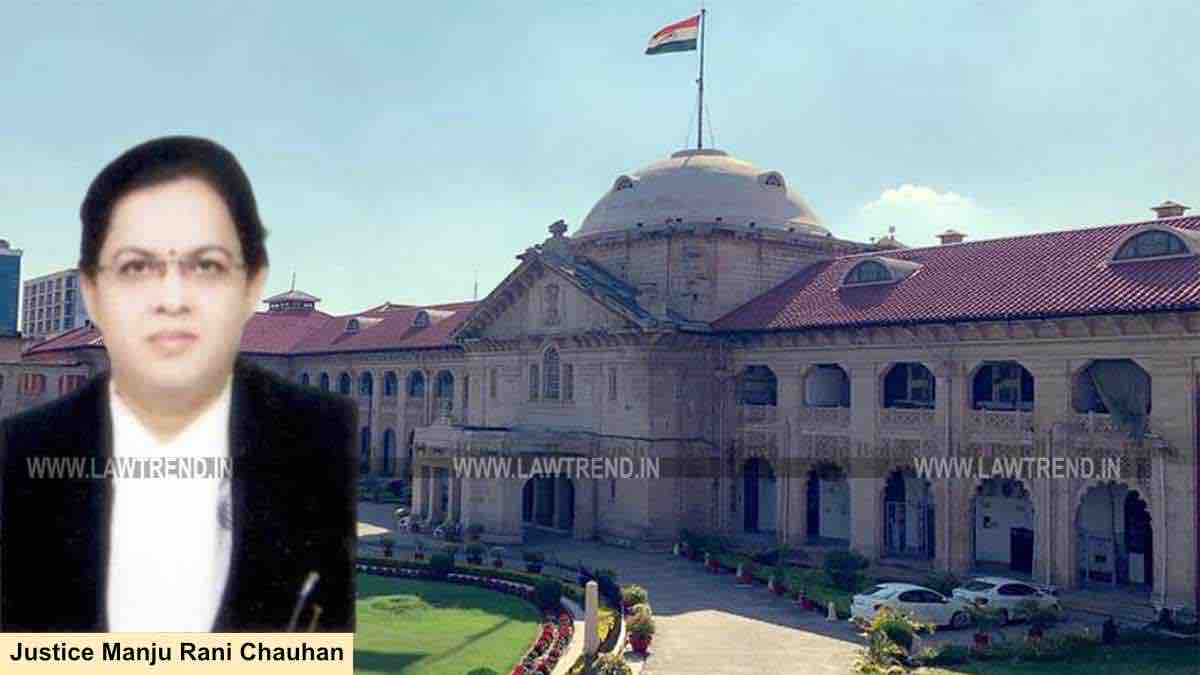
The High Court of Judicature at Allahabad has quashed a series of orders passed by state authorities that had declared the appointments of two Assistant Teachers void nearly two decades after they joined service. The Court ruled that long and uninterrupted service creates a legitimate equity in favor of employees and that appointments should not be unsettled on technical objections after many years, especially when no fraud is involved.
The judgment was delivered by Justice Manju Rani Chauhan, in the matter of Smt. Meenakshi Sharma and another vs. State of U.P. and 3 others (Writ – A No. 18434 of 2025).
Background of the Case
The petitioners, Smt. Meenakshi Sharma and another, were appointed as Assistant Teachers in Ram Singh Vishwa Chaitanya Kanya Junior High School, an aided institution in District Gautam Buddha Nagar, in late 2006. Their appointments followed a selection process that included prior permission from the District Basic Education Officer, public advertisements, and interviews by a duly constituted Selection Committee.
While the institution was brought under the grant-in-aid list in December 2006, the petitioners faced a long struggle for salary disbursement from the State Exchequer. After several representations and a previous round of litigation, the Regional Approval Committee approved their salary payments in August 2018, effective from December 2014. However, the petitioners were denied salary for the period between 2014 and 2018.
Following a direction from a Division Bench in a Special Appeal (No. 488 of 2024) to consider the claim for arrears, the Secretary, Basic Education, passed an order on August 26, 2025, declaring the petitioners’ original 2006 appointments void. This led to subsequent orders restraining them from their duties and canceling previous approvals.
Arguments of the Parties
The petitioners argued that their appointments were made in accordance with the rules prevailing in 2006 before the institution came under the grant-in-aid list. They contended that the authorities exceeded their jurisdiction by reopening the validity of their appointments, which had already been scrutinized and approved by the Regional Approval Committee in 2018. They further alleged a gross violation of the principles of natural justice, as the adverse orders were passed without notice or an opportunity for a hearing.
The State Respondents contended that the 2006 advertisement failed to specify minimum qualifications, violating the U.P. Recognized Basic Schools (Junior High School) (Recruitment and Conditions of Service of Teachers) Rules, 1978. They argued that the petitioners possessed B.Ed. degrees, which were not a recognized minimum qualification for Assistant Teachers until an amendment in 2008. Consequently, they maintained the appointments were illegal from the outset.
Court’s Analysis
The Court observed that the respondent authorities had acted beyond the mandate of the Hon’ble Division Bench. The Division Bench had directed the Secretary to consider the limited issue of “payment of salary and arrears,” not to re-examine the validity of the appointments themselves.
The Court noted:
“It is, therefore, manifest that the respondent authorities exceeded their jurisdiction in seeking to reopen the question relating to the validity of the petitioners’ selection, which had already attained finality upon due consideration and was found to be in accordance with law.”
On the issue of long-term service and technical irregularities, the Court relied on several precedents. Citing District Basic Education Officer, Mau v. Jagdamba Singh, the Court emphasized:
“Where the appointment has either been expressly approved or the incumbent has been permitted to continue for years without objection, it is not open to the authorities to subsequently turn around and invalidate such appointment on grounds which were very much available at the time of appointment but were not raised.”
Regarding the B.Ed. qualification, the Court highlighted that the Hon’ble Apex Court has previously protected teachers with B.Ed. degrees appointed before the 2008 amendment. It cited Vikas Pratap Singh vs. State of Chhattisgarh, noting that a “sympathetic view” is required when an irregular appointment occurs without fault or fraud by the appointee, especially after significant length of service.
The Court further found the impugned orders to be “patently arbitrary” and “violative of the principles of natural justice” because they were passed ex-parte and without conducting an inquiry.
Decision of the Court
The High Court allowed the writ petitions and quashed the orders dated August 26, 2025, August 30, 2025, September 1, 2025, and September 8, 2025. The Court directed that all benefits to which the petitioners are entitled be provided.
Case Details Block:
- Case Title: Smt. Meenakshi Sharma and another vs. State of U.P. and 3 others
- Case No.: Writ – A No. 18434 of 2025 (along with Writ – A No. 14225 of 2025)
- Bench: Justice Manju Rani Chauhan
- Date: April 13, 2026




