

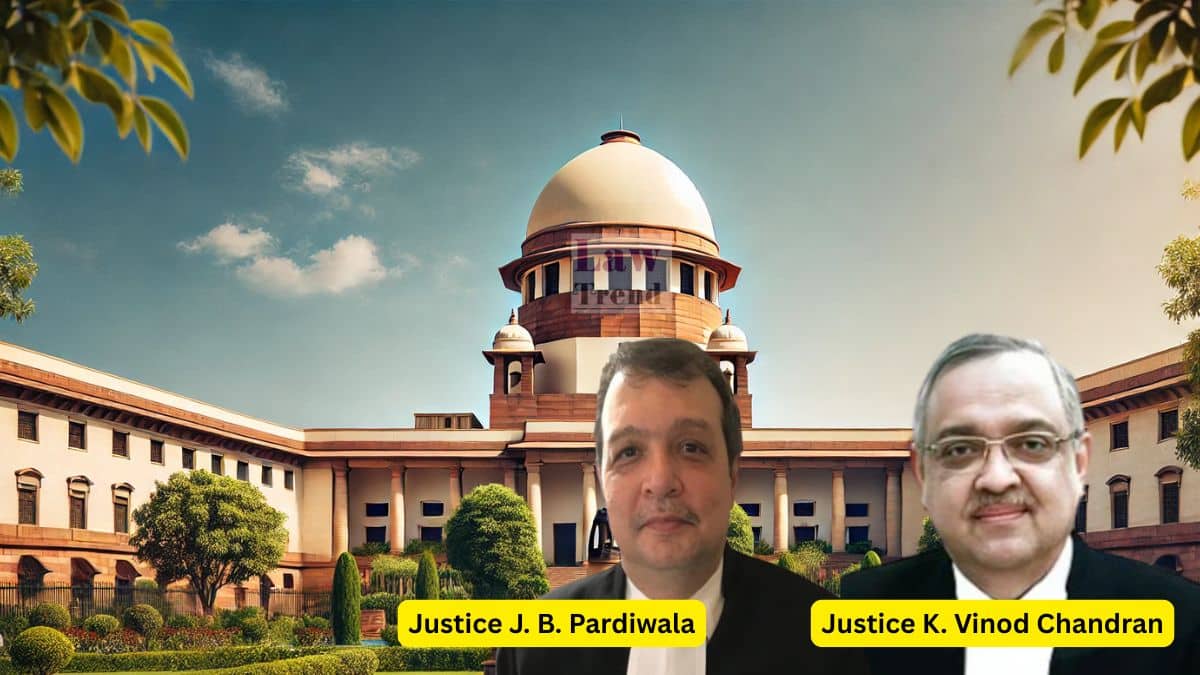
The Supreme Court has quashed a land acquisition carried out in Karnataka for a cooperative housing society. It held that fraud and colourable exercise of power in the acquisition cannot be ignored on grounds of delay or res judicata. A Bench of Justice J.B. Pardiwala and Justice K. Vinod Chandran set aside a Karnataka High Court Division Bench judgment and restored a Single Judge’s order. The Court also directed that possession of the land be returned to the original landowners.
The judgment, authored by Justice Vinod Chandran, opens with a principle on the limits of eminent domain: “However just the compensation be, if the authority of law is lacking or the public purpose is absent, there can be no eminent domain exercised.”
Background
The acquisition covered lands in Nelakadiranahalli Village, Bangalore North Taluk, for the 4th respondent Society.
- 21.09.1984: The Society entered into an agreement with Bhagya Enterprises. This was three days before Section 3(f)(vi) of the Land Acquisition Act, 1894 came into force on 24.09.1984 and made housing schemes of cooperative societies a “public purpose”.
- 13.11.1987: The Government conveyed its approval for acquiring 97 acres.
- 22.11.1988: The Section 4(1) notification was issued for 79 acres 25 guntas.
- 04.12.1989: The Section 6 declaration was issued, reducing the area to 59 acres 6 guntas.
The appellants are the legal representatives of four landowners. The landowners had approached the High Court in 2007, when attempts were made to interfere with their possession. A Single Judge found fraud, quashed the acquisition, issued contempt notice to an Under Secretary over a false affidavit, and imposed costs. A Division Bench reversed that order on grounds of delay and res judicata. It relied on an earlier High Court ruling in Karithimmaiah, which had upheld the same acquisition.
Arguments
Senior Counsel Kiran Suri and Senior Counsel Basava Prabhu S. Patil, appearing for the appellants, argued four main points:
- The housing scheme was never approved; approval was granted only on the basis of area-wise extent.
- The agreement with Bhagya Enterprises showed a colourable exercise of power.
- Delay must yield to a categoric finding of fraud.
- Possession had never actually been taken, since no mahazar was prepared.
Senior Counsel Vikas Singh, for the Society, said the proposal had been scrutinised by the Three-Men Committee and the State Level Coordination Committee, and then approved by the Government. He described the third party as a mere service provider. He also pointed out that the writ petitions were filed about 19 years later, and that Karithimmaiah was binding.
Senior Counsel Sanjay Hegde appeared for the State, assisted by Additional Advocate General Omar Hoda. He relied on the Karnataka Government (Transaction of Business) Rules, 1977 and urged res judicata based on Karithimmaiah.
Court’s Findings
The agreement with the third party
The Court rejected the claim that the third party was a mere service provider. Under the agreement, it had undertaken to ensure that the lands were acquired as government land for the Society. The commission payments were linked to the stages of the Section 4 and Section 6 proceedings, which the Bench called “a sure manifestation of the attempted fraud.”
No layout plan approved
On Section 3(f)(vi), the Court held that the Government must approve the actual scheme, not just a requisition:
“It should be for the scheme; not one in contemplation but, forma et descriptio (the layout and the blueprint), placed before the appropriate authority.”
No layout plan was placed before the Government. The Bench found the committees’ consideration “lackadaisical and without any application of mind.” It described the approval of 13.11.1987 as a cryptic order, not expressed in the name of the Governor as Rule 18 of the 1977 Rules requires.
Payment of compensation
Government file notings showed that the Society deposited only part of the balance amount. A sum of ₹19,60,000 had been paid directly to landowners, and the authorities accepted these private payments in place of a full deposit. The Court held this was clearly in violation of the Act.
Possession
The presumption under Section 16(2) was held to be rebuttable. The Society’s own documents showed that Section 47 had been invoked, contrary to the Division Bench’s finding.
Res judicata and delay
The Court found that Karithimmaiah had presumed approval of the scheme without verifying the records, and the agreement had not been before the Court then. Since the special leave petition against it was simply dismissed, the Bench said that ruling “does not have the sheen of a precedent of this Court.”
Relying on S.P. Chengalvaraya Naidu and A.V. Papayya Sastry, the Court said: “‘Fraud vitiates all solemn acts’ is a principle which cannot be reduced to providing a mere lip service.”
It held that the grounds of res judicata and delay “pale into insignificance, especially in the teeth of the established allegations of illegal acquisitions through fraud and undue influence.”
The Court also noted the G.V.K. Rao Committee’s findings on the Society:
- Membership records had been carried away by a former employee.
- Huge amounts had been paid to agents.
- Office bearers had stated that bribes were paid to government officials.
Outcome
The appeals were allowed and the Single Judge’s order was restored, with these directions:
- Contempt: The direction for contempt proceedings was deleted owing to the passage of time.
- Costs: Raised to ₹50,000 for each petitioner or set of legal representatives.
- Possession: To be restored to all landowners, whether or not they had challenged the acquisition.
- Refund: Landowners must refund any compensation received from the Government, without interest. Amounts received in private transactions are not to be refunded.
- The Society: It shall have no claim over the lands.
- Unreturned land: Land not taken back by the owners is to be auctioned by the Revenue Authorities, under the supervision of a Judicial Officer not below the rank of District Judge (Selection Grade). The proceeds will go towards victim compensation, as directed by the Chief Justice of the High Court in consultation with the Karnataka Legal Services Authority.
Case Title: N. Arasappa v. State of Karnataka & Ors.
Case No.: Civil Appeal Nos. 13744-13747 of 2015 (with connected appeals)
Bench: Justice J.B. Pardiwala and Justice K. Vinod Chandran
Date: October 26, 2026


