

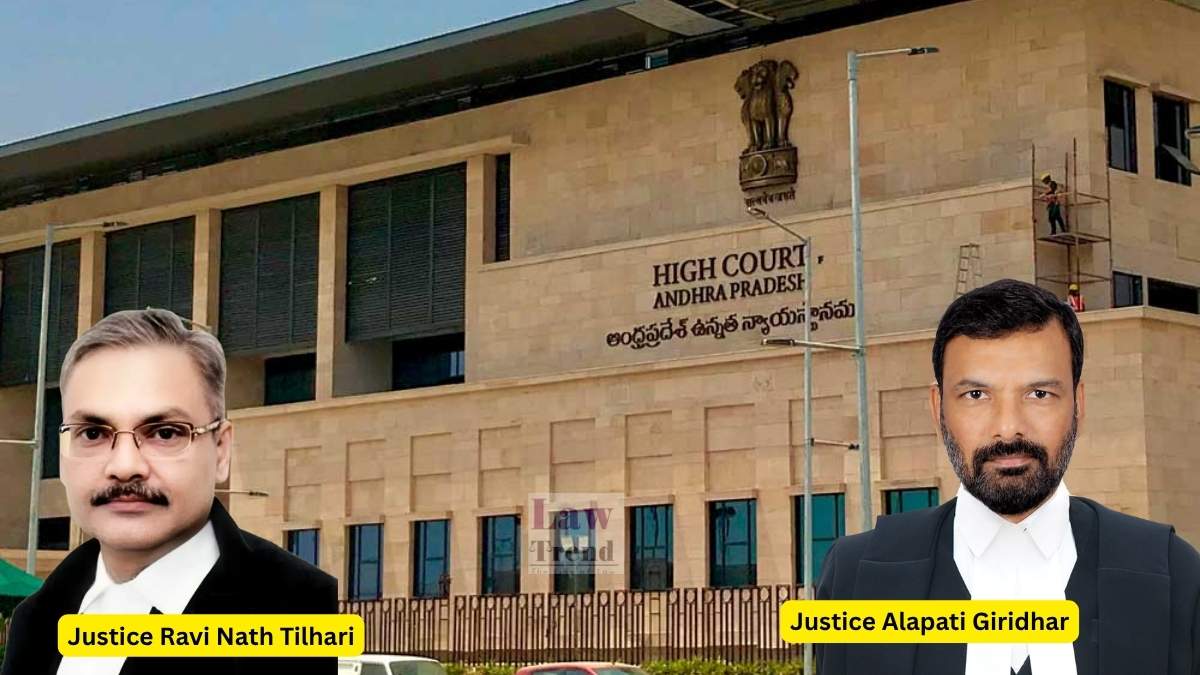
The Andhra Pradesh High Court has upheld a contempt finding against a police inspector who wrote to the electricity department asking it to remove a power meter from a disputed plot. A writ court had earlier directed the police not to interfere in the civil dispute over that land. The Division Bench dismissed the inspector’s contempt appeal and held that once such a direction had been issued, he had no business seeking the disconnection.
A Bench of Justice Ravi Nath Tilhari and Justice Alapati Giridhar dismissed the appeal filed by K Raja Reddy, Inspector of Police, Nandyal II Town. The appeal challenged a Single Judge’s order of July 3, 2026, which had fined him ₹1,000 for contempt.
Background: Writ Court Told Police to Stay Out of Civil Dispute
Koneti Prakash had filed a writ petition alleging that the police were pressuring him to settle civil and criminal disputes over his land in Sy. No. 408/2 at NGO’s Colony, Viswa Nagar, Nandyal. The State told the Court that the police had visited the site only to maintain law and order, and that a criminal case over the land was under investigation.
The writ petition was disposed of with a direction to the police not to interfere with the civil dispute. The order also made clear that the police could still investigate the registered case or act in accordance with law if any incident occurred in future.
On March 11, 2024, the inspector wrote to the Assistant Engineer of APSPDCL, Nandyal. Citing the pending criminal case and a possible law and order problem, he asked for the electric service meter at the disputed site to be removed. The electricity was then disconnected. Koneti Prakash filed a contempt case. The Single Judge held that the inspector had wilfully and intentionally violated the order and fined him ₹1,000.
Arguments Before the Division Bench
Advocate T.M.K Chaitanya, appearing for the appellant, argued that contempt proceedings are quasi-criminal, that no charge had been framed, and that the appellant did not get ample opportunity to defend himself. Relying on the Supreme Court’s decision in Sahdeo @ Sahdeo Singh v. State of U.P., he contended that the order could not stand without a charge being framed. He also submitted that the letter was written in good faith, in view of the ongoing investigation and to maintain peace.
Advocate Ravula Nagarjuna, appearing for the respondent, submitted that the inspector himself had written the letter seeking disconnection and that the power supply was in fact cut. He argued that this interfered with his client’s civil rights despite the Court’s clear direction, and that the conviction and punishment were justified.
Court’s Findings: No Charge Needed Under AP Rules
The Bench distinguished Sahdeo, noting that it dealt with criminal contempt under Allahabad High Court Rules that expressly required charges to be framed. Under Rule 18 and Form I of the Contempt of Courts (Andhra Pradesh High Court) Rules, 1980, the notice need only briefly state the nature of the contempt. The Court held that “framing of a specific charge by the Court is not necessary, but statement of the nature of the contempt is sufficient.”
The Court found that the contempt petition clearly described the alleged violation, and that the inspector had filed a counter affidavit denying and justifying his action. It noted that he chose not to appear at the final hearing. The Bench concluded that “even if charge was required to be framed but was not specifically framed, no prejudice has been caused to the appellant.”
On the merits, the Court said the date of the electricity connection was not relevant, since connecting or disconnecting a supply is a civil matter. It observed:
“once there was a clear direction to the Police not to interfere with the civil dispute, the appellant had no business to write the letter to the Electricity Department for the disconnection.”
The Bench also held that the case diary and other papers the appellant relied on were not relevant to the contempt case, and that Section 14 of the Contempt of Courts Act, 1971 did not bear on the point involved.
Outcome
The Division Bench held that the Single Judge had rightly found the appellant guilty of contempt and imposed the punishment, and dismissed the appeal. It directed the Registrar (Judicial) to proceed as per law to ensure compliance with the July 3, 2026 order after three weeks, if there is no stay or contrary order.
Case Title: K Raja Reddy v. Koneti Prakash
Case No.: Contempt Appeal No. 14 of 2026 in Contempt Case No. 1936 of 2024
Bench: Justice Ravi Nath Tilhari and Justice Alapati Giridhar
Date: November 11, 2026


