

The Madras High Court has held that referring a cheque for handwriting expert opinion is unnecessary when the accused has admitted the signature on the cheque and such examination would serve no useful purpose in adjudicating the dispute. The Court observed that applications seeking expert opinion merely to prolong proceedings under Section 138 of the Negotiable Instruments Act cannot be entertained.
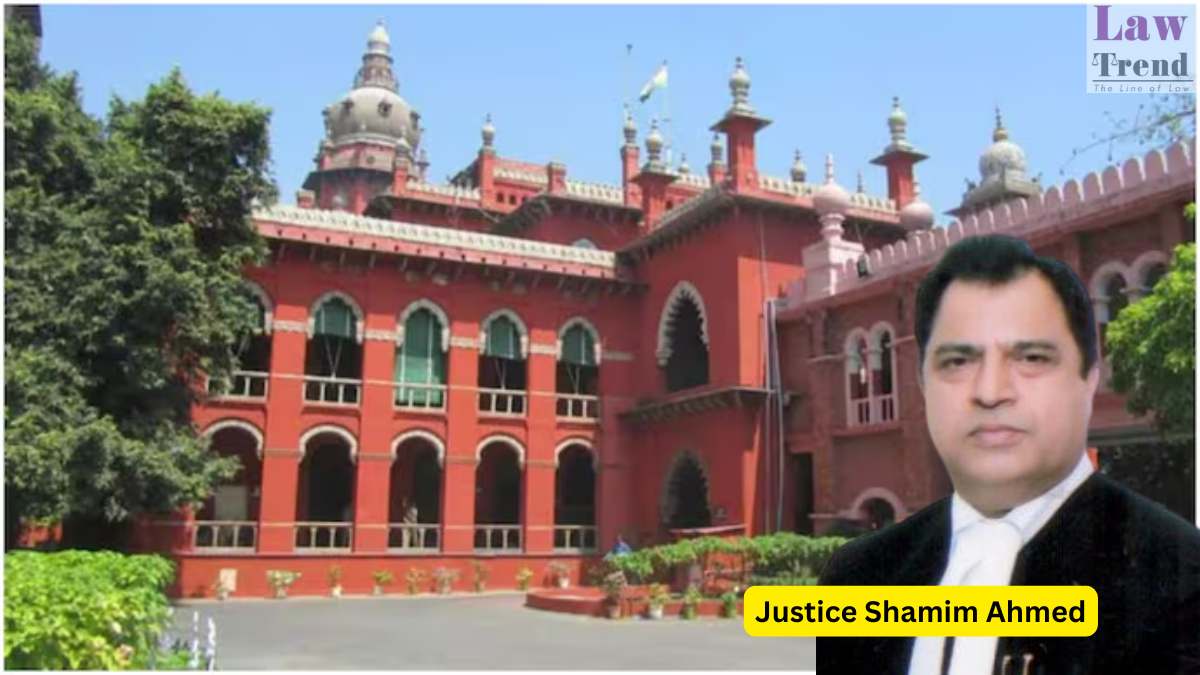
A Single Judge Bench of Justice Shamim Ahmed, in its judgement dated November 24, 2026, dismissed a criminal revision petition challenging the trial court’s refusal to send a cheque and an acknowledgement letter for expert examination. The Court also directed the trial court to conclude the proceedings expeditiously.
Background
The petitioners, M/s Allites Life Science Pvt. Ltd. and its director, Muthukrishnan Narayanasamy, were engaged in the business of selling medicines and pharmaceutical products and had business transactions with the respondent, M/s Royal Agency.
The respondent instituted a complaint under Section 138 of the Negotiable Instruments Act following the dishonour of a cheque dated May 30, 2024, for ₹30 lakh.
During the proceedings, the accused filed an application under Section 39(1) of the Bharatiya Sakshya Adhiniyam, 2023, seeking expert examination of the disputed writings contained in the cheque and an acknowledgement letter dated December 7, 2022.
On December 10, 2025, the Metropolitan Magistrate, Fast Track Court No. I, Egmore, Chennai, dismissed the application, prompting the accused to approach the High Court.
Arguments of the Parties
Advocate V. Arvind Rajagopal, appearing for the petitioners, submitted that the cheque had been issued only as security and was subsequently misused by the complainant. He argued that the director had not filled in the particulars contained in the cheque and the acknowledgement letter.
It was contended that admitting the signature on a cheque did not render every other disputed fact concerning the instrument irrelevant. Expert examination would assist the court in determining the genuineness of the disputed writings.
Advocate A. Gopinath, appearing for Advocate A. Damodaran on behalf of the respondent, argued that the application was intended to delay the trial. He submitted that once the signature on the cheque was admitted, the statutory presumption operated in favour of the complainant, and the accused was required to rebut it by adducing cogent evidence.
Court’s Observations
The High Court observed that expert opinion cannot substitute substantive evidence and that a party cannot insist upon producing expert evidence unless such assistance is necessary for the court to form an opinion.
The Court noted:
“Therefore, a party to a proceeding cannot be permitted to adduce expert opinion as evidence, unless it is necessary for the court to form an opinion on such aspect.”
The Bench noted that the accused had not denied the signatures on either the cheque or the acknowledgement letter during the cross-examination of the complainant’s witness. The accused had also admitted executing and delivering the cheque to the complainant.
Further, no document containing admitted handwriting or signatures had been produced for comparison with the disputed documents.
The Court also took into consideration that the proceedings had reached the stage of commencing arguments.
“In the instant case, this Courts is of the view that the expert opinion sought to be required does not have any bearing on the issue, as this Court feels that there is no necessity to form an opinion with an assistance of an expert, that too, when there are categorical findings of the Trial Court, available.”
Admission of Signature Triggers Statutory Presumption
The High Court relied upon the Supreme Court’s judgement in Rangappa v. Sri Mohan, (2010) 11 SCC 441, which held that the statutory presumption operates in favour of the complainant once the accused admits the signature on the cheque.
The Court also referred to Bir Singh v. Mukesh Kumar, AIR 2019 SC 2446, wherein the Supreme Court held that filling in the amount and other particulars of a voluntarily delivered signed blank cheque by the payee does not invalidate the instrument.
The burden remains upon the accused to establish through evidence that the cheque was not issued towards the discharge of a debt or liability.
The High Court concluded that the application seeking expert examination was intended to prolong the proceedings and divert the case from its principal issue.
Decision
Finding no illegality or perversity in the trial court’s order, the High Court dismissed the criminal revision petition without imposing costs.
The Court further directed:
“The Trial Court is directed to conclude the trial, without giving any unnecessary adjournment to either of the parties, expeditiously, in accordance with law.”
Case Details:
Case Title: M/s Allites Life Science Pvt. Ltd. & Anr. v. M/s Royal Agency
Case Number: CRL RC No. 2569 of 2026
Bench: Justice Shamim Ahmed
Date of Judgement: November 24, 2026


