

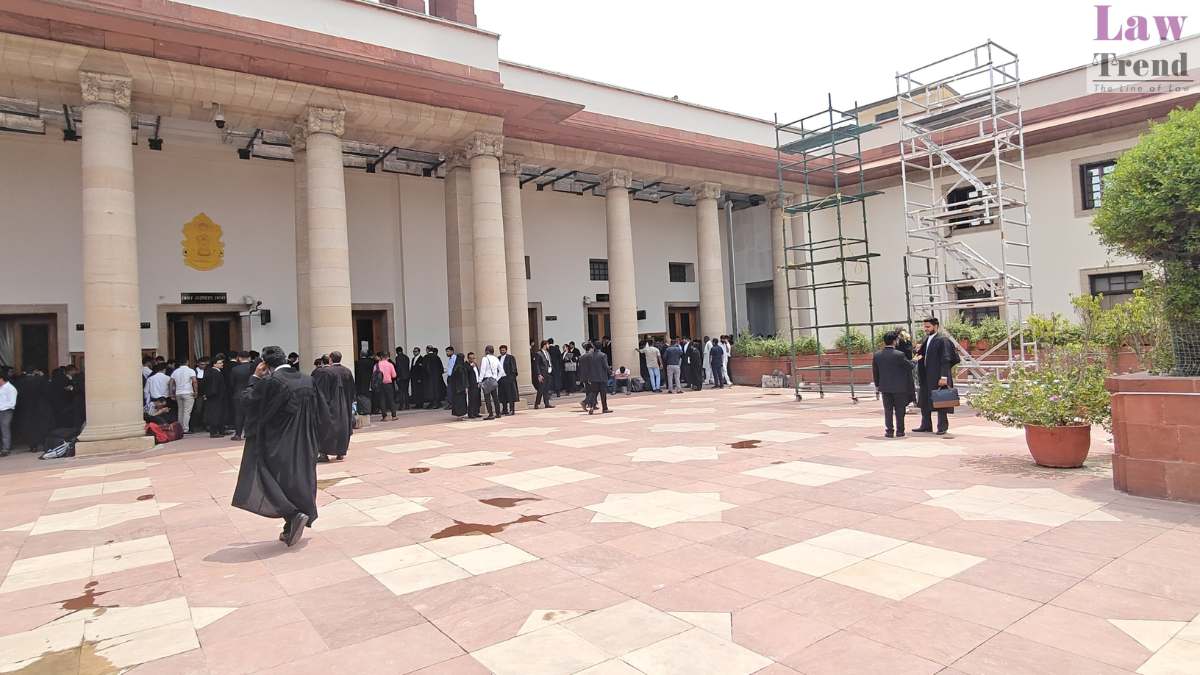
The Supreme Court on Thursday held that the Adjudicating Authority under the Prevention of Money Laundering Act, 2002 (PMLA), cannot undertake final adjudication or confirm property attachment orders without the participation of a Judicial Member.
A Bench comprising Chief Justice of India Surya Kant, Justice Joymalya Bagchi and Justice V. Mohana upheld the constitutional validity of Sections 6(5)(b) and 6(7) of the PMLA while mandating the presence of a Judicial Member in proceedings involving adjudication under Sections 8(2) and 8(3) of the Act.
The Court clarified that a single non-Judicial Member may issue show-cause notices and discharge administrative functions but cannot independently undertake final adjudication concerning the attachment, retention or freezing of properties.
Background
The judgement arose from a batch of appeals challenging decisions of the Delhi, Calcutta and Telangana High Courts concerning the composition and functioning of the Adjudicating Authority under the PMLA.
The lead case originated from an Income Tax Department investigation into the affairs of M/s SRS Mining in December 2016. Searches resulted in the recovery of cash exceeding ₹132.73 crore and 128.495 kilograms of gold valued at ₹36.72 crore.
Following the registration of an FIR by the Central Bureau of Investigation (CBI), the Enforcement Directorate (ED) initiated money laundering proceedings and provisionally attached movable properties worth ₹8.57 crore belonging to J. Sekar.
Sekar challenged the show-cause notice issued by the Adjudicating Authority, which at the relevant time consisted solely of a Technical Member.
The Delhi High Court held in January 2018 that there was no statutory prohibition against a single non-Judicial Member discharging the functions of the Authority. Similar questions subsequently arose before other High Courts.
Arguments of the Parties
Senior Advocates Vikram Chaudhri, Gopal Sankaranarayanan, S. Niranjan Reddy and Siddharth Agarwal, along with Advocates Mahfooz Ahsan Nazki, Jatin Sehgal and Shubhankar Nag, appeared for the private parties.
They argued that the Authority performs quasi-judicial functions involving statutory interpretation, appreciation of evidence and determination of substantial property rights. Consequently, such functions could not be entrusted exclusively to Administrative or Financial Members.
Additional Solicitor General Anil Kaushik and Senior Advocate Zoheb Hossain, appearing for the Union of India and the ED, contended that Section 6 of the PMLA did not mandate the participation of a Judicial Member in every proceeding. They also relied on the availability of statutory appellate remedies.
Court’s Analysis
Judicial Member Indispensable for Final Adjudication
The Supreme Court distinguished between the administrative and adjudicatory functions of the Authority.
While receiving and preserving documents and reasons recorded by ED officers is essentially administrative, determining whether a property is involved in money laundering requires legal expertise.
The Bench observed:
“The lifetime of experience of the Administrative and Financial Members in the AA would undoubtedly render them to be exceptional experts in their fields, but impartial and legally sound adjudication necessitates judicial temperament and training.”
The Court emphasised that confirmation of an attachment could deprive a person of possession and enjoyment of property for a considerable period, even before the offence of money laundering is proved.
It accordingly held:
“The Bench that undertakes the hearing and final adjudication under Sections 8(2) and 8(3) must necessarily include the Judicial Member.”
The Court extended this requirement to determinations under Sections 9, 20(4) and 21(4) of the PMLA.
Appellate Remedy Cannot Cure Absence of Judicial Member
Rejecting the Centre’s argument regarding the availability of appellate remedies, the Supreme Court held that judicial scrutiny at a subsequent stage cannot substitute objective decision-making at the original adjudicatory stage.
“An appellate forum may correct the errors in a decision; it cannot supply what the original forum lacked.”
The Court further clarified that final adjudication may be undertaken by a single-member Bench, provided that the sole member is a Judicial Member.
However, there is no legal requirement that the Chairperson of the Adjudicating Authority must necessarily possess a judicial background.
Supreme Court Recommends Multiple Adjudicating Authorities
Expressing concern over the increasing workload, the Supreme Court noted that provisional attachment orders issued by the ED increased from 185 in 2020-21 to 712 in 2025-26.
The Court observed that the existence of a single Adjudicating Authority, coupled with the statutory timeline of 180 days for completing adjudication, could lead to hurried decisions and adversely affect access to justice.
It recommended that the Centre consider repealing the 2009 amendment to the PMLA and restoring the original statutory framework providing for multiple Adjudicating Authorities.
Decision
The Supreme Court directed the Chairperson of the Adjudicating Authority to issue an administrative circular ensuring the participation of a Judicial Member in every Bench passing orders under Section 8(3) of the PMLA.
The Court disposed of the civil and criminal appeals, modified the concerned High Court judgements, partly allowed the writ petition and vacated all interim orders.
However, it clarified that its ruling would not provide a ground to challenge the jurisdiction of Benches that passed orders before November 26, 2026. Aggrieved parties remain entitled to challenge such orders on their merits through statutory appeals.
Case Details
Case Title: Union of India and Others v. J. Sekar
Case Number: Civil Appeal No. 1548 of 2024 and Connected Matters
Bench: Chief Justice of India Surya Kant, Justice Joymalya Bagchi and Justice V. Mohana
Date of Judgement: November 26, 2026


