

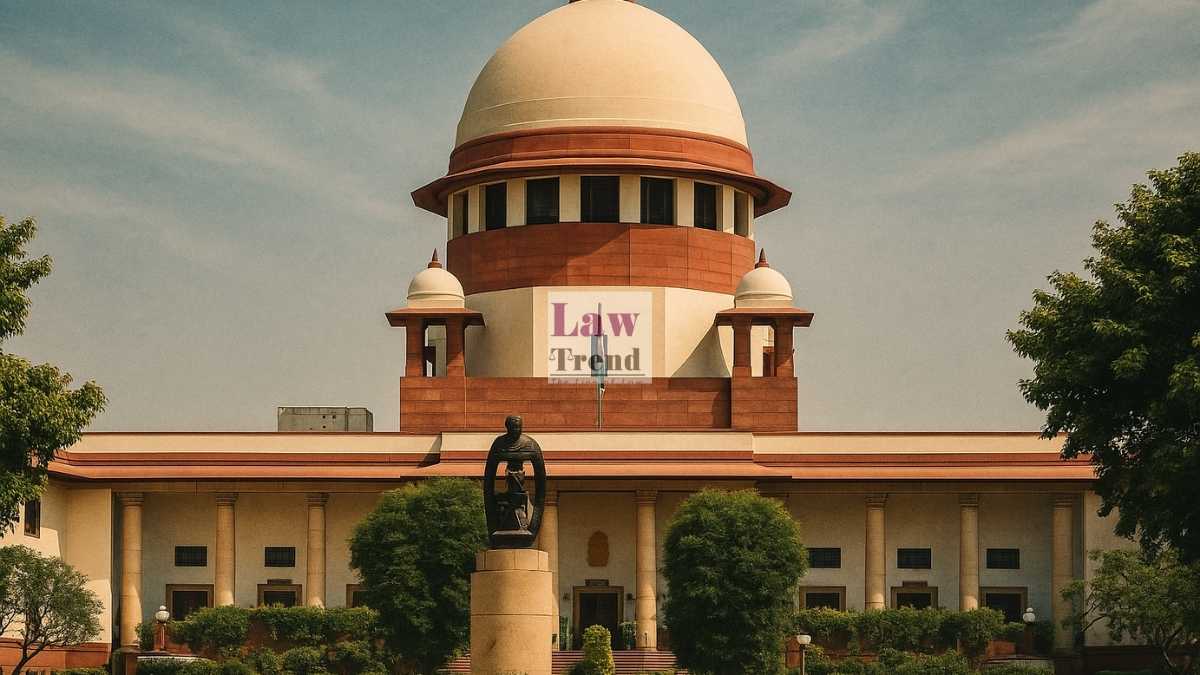
The Supreme Court has held that merely acquiring the requisite academic qualifications does not confer a right upon an employee to claim absorption in service when no sanctioned post is available. The Court clarified that eligibility is only a qualifying condition and cannot independently create a right to absorption.
A Bench comprising Justice Vikram Nath and Justice Aparesh Kumar Singh, in its judgement dated November 25, 2026, dismissed an appeal challenging a Jharkhand High Court judgement that rejected a lecturer’s claim for retrospective absorption in university service from December 5, 1987, instead of June 1, 2003.
Background
The appellant, Brij Kumar Mishra, was appointed as a Hindi Lecturer at S.J.S.N. College, Garhwa, on February 22, 1986, against the fifth post in the Hindi department. At the time of his appointment, he did not possess the minimum academic qualifications required to become a university teacher. He subsequently acquired the requisite qualifications on December 5, 1987.
Meanwhile, the college was converted into a constituent college of Ranchi University, with March 31, 1987, as the cut-off date.
Only three posts of Hindi Lecturer had been sanctioned by the cut-off date, while a fourth post was sanctioned on November 13, 1987. All four posts were occupied by teachers appointed before the appellant.
The Justice S.C. Agrawal Commission, appointed by the Supreme Court to examine disputes concerning the absorption of teaching and non-teaching staff, identified the appellant as academically eligible for consideration for absorption from December 5, 1987.
Subsequently, the Justice S.B. Sinha Commission, constituted to examine unresolved individual claims, found that the fifth post had not been recommended by the University to the State Government before the cut-off date.
The Commission upheld the appellant’s absorption with effect from June 1, 2003, when a sanctioned post became vacant following the retirement of another lecturer.
The appellant challenged the University’s notification fixing his date of absorption before the Jharkhand High Court. A Single Judge ruled in his favour and directed the University to reconsider his date of absorption from December 5, 1987.
However, a Division Bench reversed the Single Judge’s judgement on May 8, 2025, prompting the appellant to approach the Supreme Court.
Arguments Before the Supreme Court
The appellant contended that he was entitled to absorption from the date on which he acquired the requisite qualifications, in accordance with the recommendations of the Justice Agrawal Commission accepted by the Supreme Court.
He argued that fixing his date of absorption from June 1, 2003, instead of December 5, 1987, was arbitrary and violated Articles 14 and 16 of the Constitution.
He further contended that the findings of the Justice Sinha Commission could not override the recommendations of the Justice Agrawal Commission.
The University’s stand was that the appellant had been appointed against an unsanctioned fifth post and could not claim absorption merely on the basis of his academic eligibility. His absorption became possible only when one of the four sanctioned posts fell vacant in 2003.
Supreme Court’s Observations
Eligibility Alone Does Not Create a Right to Absorption
The Supreme Court examined the annexures of the Justice Agrawal Commission’s report and found that the inclusion of the appellant’s name in Annexure IV-A merely established his academic eligibility for consideration for absorption.
The Court observed:
“Eligibility is merely a qualifying condition and cannot create a right where no post exists. Annexure IV-A merely records the academic eligibility of the teachers for the purpose of consideration of absorption and does not determine the category of the post against which each teacher was appointed.”
The Bench noted that Annexure IV-A contained the names of six Hindi teachers, although only four sanctioned posts existed in the department.
The appellant’s placement above another lecturer in the list reflected his earlier date of acquiring academic eligibility and did not establish his entitlement to retrospective absorption.
No Right to Absorption Against Posts Not Recommended Before Cut-Off Date
Referring to its earlier decision in State of Bihar & Ors. vs. Bihar Rajya MSESKK Mahasangh & Ors., the Supreme Court reiterated that employees appointed against posts for which recommendations were sent after the prescribed cut-off date, or for which no recommendations were sent, could not claim a right to absorption under the applicable framework.
The Court found that the college had submitted a proposal for additional posts to the University on January 20, 1987. However, the University forwarded the proposal to the State Government only on July 11, 1987, after the cut-off date of March 31, 1987.
The Bench also noted that the Justice Sinha Commission had found that forged and fabricated documents had been submitted by the claimants, including the appellant, in support of their claims for absorption against additional posts.
Single Judge Failed to Consider Availability of Sanctioned Posts
The Supreme Court held that the Single Judge had erroneously relied upon the appellant’s academic eligibility without adequately considering the availability of sanctioned posts.
The Bench observed:
“The Appellate Court has correctly observed that appellant herein could not claim to be absorbed on the fifth post on the basis of eligibility alone as only four posts were sanctioned as on 05.12.1987 when the appellant herein attained the minimum qualifying marks for eligibility.”
The Court also noted that the appellant had not challenged the findings of the Justice Sinha Commission before the Single Judge.
Decision
The Supreme Court upheld the judgement of the Division Bench of the Jharkhand High Court and dismissed the appeal.
Consequently, the appellant’s absorption in university service with effect from June 1, 2003, when a sanctioned post became vacant, remained undisturbed.
Case Details
Case Title: Brij Kumar Mishra vs. Nilamber Pitambar University & Ors.
Case No.: Civil Appeal arising out of SLP (Civil) No. 18222 of 2025
Date of Judgement: November 25, 2026


