

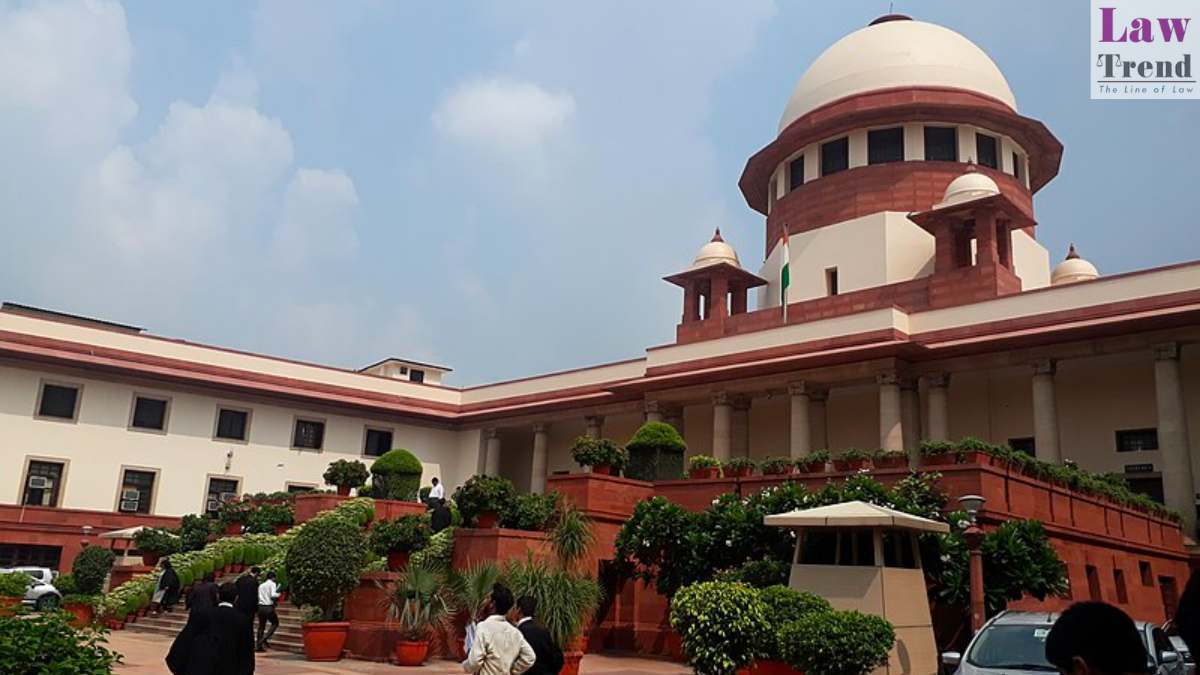
The Supreme Court has held that mesne profits are compensatory and that their assessment, being based on appreciation of evidence, does not ordinarily call for appellate interference unless it is manifestly arbitrary, unsupported by the record or based on an error of law. It upheld the Delhi High Court’s determination of mesne profits payable by Goodyear India Ltd. for premises at Daryaganj, New Delhi.
A Bench of Justice Prashant Kumar Mishra and Justice N.V. Anjaria dismissed the appeals of the landlords, the legal representatives of Bharat Bhushan Jain, against the High Court’s judgment of 11.08.2011.
A Dispute Dating Back to 1989
Goodyear India’s tenancy of the premises at 1, Ansari Road, Daryaganj, was terminated with effect from 31.12.1989. In 1990, the landlords sued for possession and claimed damages of ₹1,47,500 per month with 15% interest. In 1998, the trial court decreed possession and ordered a separate inquiry into mesne profits under Order XX Rule 12 CPC. The decree for possession became final in 2001, when the Supreme Court dismissed the tenant’s SLP.
In the inquiry, the trial court in 2004 fixed mesne profits at ₹22 per sq. ft. per month for the ground floor and ₹11 per sq. ft. for the mezzanine, with 15% interest. It relied largely on rent paid by Vijaya Bank for premises at 2/10, Ansari Road.
The First Appellate Court set this aside as speculative and limited mesne profits to the admitted rent. It noted that the suit premises were an old building from the 1950s used as a godown, whereas the bank premises were built in 1972 and used for banking. The landlords had sought ₹30 and ₹15 per sq. ft. on covered area, with interest calculated month to month.
In second appeal, the High Court fixed mesne profits at ₹7 per sq. ft. for the ground floor and ₹5 per sq. ft. for the mezzanine. It awarded simple interest at 7.5% per annum from the month each payment fell due, reduced to 6% if paid within two months.
Mesne Profits Have No Rigid Formula
The Supreme Court said, “It is well settled that mesne profits are compensatory in nature and are intended to recompense the true owner for the loss occasioned by the continued wrongful occupation of his property.” It added, “Their assessment is not governed by any rigid or inflexible formula.”
Relying on Martin and Harris Pvt. Ltd. v. Rajendra Mehta, the Court said courts must reach a fair and reasonable estimate based on the nature and location of the property, the prevailing rent, the evidence and the circumstances of each case.
Tenant’s Own Witness Decided the Range
The Court noted that the First Appellate Court had overlooked an admission by the tenant’s own witness, DW-1 P.V. Ramani, that when the tenancy ended, rents in the locality ranged from ₹5 to ₹8 per sq. ft. per month. It held, “The omission to consider a material piece of evidence having a direct bearing on the determination of mesne profits was rightly regarded by the High Court as giving rise to a substantial question of law requiring correction.”
The Bench said the High Court neither treated this admission as conclusive nor relied on the Vijaya Bank comparison. Instead, it evaluated the material as a whole. The Court held, “The rate so determined falls within the evidentiary range disclosed by the respondent’s own witness and cannot be characterised as arbitrary, speculative or based on no evidence so as to warrant interference by this Court.”
Interest Part of Mesne Profits
On interest, the Court held, “‘Interest’ forms an integral component of mesne profits and is intended to compensate the owner for being deprived of the beneficial enjoyment of the property during the period of wrongful occupation.” It found no reason to interfere with the 7.5% simple interest, with the reduced rate of 6% on prompt payment.
Time for Finality
The Court noted that the tenancy was terminated in 1989, the possession decree became final in 2001, and the appeals had been pending before it for nearly 15 years, while the evidence remained the same throughout. It held that “the interests of justice would be better served by according finality to a litigation which has engaged the parties for more than three decades.”
Finding no perversity or misapplication of law, the Court dismissed the appeals.
Case Title: Bharat Bhushan Jain (Dead) Through LRs. and Others Etc. v. M/s Goodyear India Ltd. and Another
Case No.: Civil Appeal Nos. 9668-9669 of 2013
Bench: Justice Prashant Kumar Mishra and Justice N.V. Anjaria
Date: November 18, 2026


