

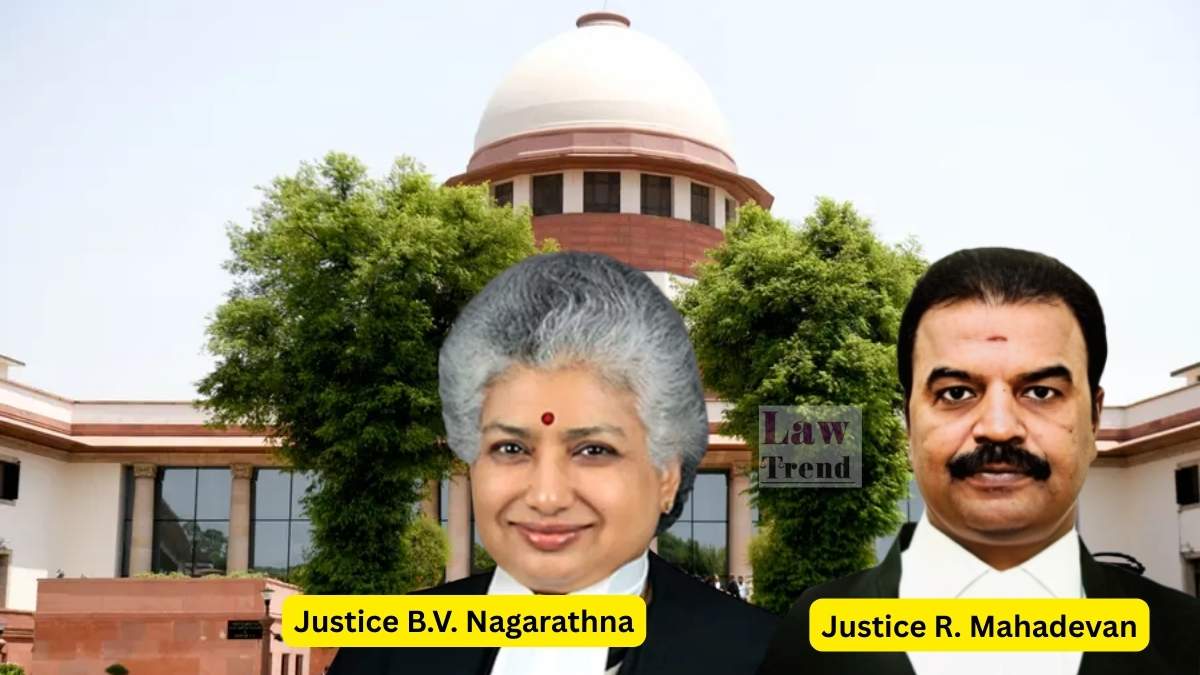
The Supreme Court has held that a woman who continued to cohabit with a man even after learning of his earlier marriage cannot claim that he deceitfully induced her to believe she was his lawfully wedded wife. Setting aside orders of the Kerala High Court and the Trial Court, the Court discharged the accused of offences under Sections 376, 420, 493, 494 and 495 of the IPC.
A Bench of Justice B.V. Nagarathna and Justice R. Mahadevan observed that the case was “evidently one of consensual relationship that perhaps was camouflaged in a marriage for the sake of avoiding scrutiny or stigma, which eventually came to an end.”
Background
According to the complainant, the appellant represented himself as a bachelor and offered to marry her. In 1996, the two travelled to Mysuru, where they were married at a temple, and lived together until 2003.
In 2008, alleging neglect, the complainant approached a Magistrate under the Protection of Women from Domestic Violence Act, 2005. During those proceedings, the appellant disclosed that he was already married with two children. The complaint was dismissed on 31.08.2009, and the appeal against it also failed.
A private complaint under Sections 376, 420, 493, 494 and 495 of the IPC was then dismissed for non-prosecution on 04.04.2011. A second complaint with similar allegations was referred to the police under Section 156(3) of the CrPC, leading to registration of FIR No.503/2011 at Kadirur Police Station.
On 09.01.2015, the Trial Court rejected the appellant’s discharge petition. The Kerala High Court, by its order dated 21.05.2025, upheld that decision, holding that consent given under a misconception of fact would amount to rape.
Arguments
Senior Advocate R. Basant, appearing for the appellant, submitted that the relationship was consensual and that the complainant had, in the earlier proceedings, recorded that the appellant’s brother told her within nine months of the alleged marriage that the appellant was already married. He argued that she could not even identify the temple where the marriage took place, and that the prosecution was an abuse of process aimed at revenge and financial pressure.
Advocate-on-Record K. Rajeev, appearing for the complainant, contended that the first complaint was not dismissed on merits, so there was no bar to a second one. He argued that the complainant continued the relationship on the appellant’s reassurances that he was not married, pointing to IVF treatment records where the appellant signed as “husband”, a lease agreement bearing his signature, and a joint Post Office savings account.
Supreme Court’s Findings
Examining Section 493 of the IPC, the Court noted that the complainant had admitted learning of the appellant’s earlier marriage within six months of cohabitation in 1996, yet made no attempt to withdraw from his company.
The Court held that it is “untenable and incredulous that she continued to believe herself to be appellant’s legal wife solely on the basis of his alleged oral reassurances to the contrary.” It added that “This conduct is highly suggestive of the consensual nature of the relationship between the appellant and respondent No.2, that it was not in the nature of any legally recognised marriage.”
On the documents relied upon by the complainant, the Bench said they “do not on their own imply the existence of any sort of a marriage, instead they only suggest the existence of a long-standing personal relationship.”
The Court found that no prima facie case of a valid marriage was made out under Sections 494 and 495, and that nothing on record showed the complainant had delivered any property or altered any valuable security, as required under Section 420.
On the rape charge under Section 376(2)(n), the Court held that the repeated sexual acts were part of the ongoing relationship and could not be artificially severed from it. It flagged “a worrying trend in recent years wherein consensual relationships that have come to an end are retrospectively combed with a fine tooth so as to identify what can post-facto be construed as violence and sexual assault.”
The Bench also cautioned that genuine cases must be pursued with vigour, while stressing that “the justice system must not be turned into a tool of vengeance when relationships fail.” It further remarked that “Criminal law cannot be used as munitions to settle personal scores, exact revenge or coerce an individual to act in any particular way.”
Outcome
Holding that the High Court proceeded on a “completely misconceived basis”, the Supreme Court applied the principles laid down in Union of India vs. Prafulla Kumar Samal and Sajjan Kumar vs. Central Bureau of Investigation. It allowed the discharge application, set aside the orders of the High Court and the Trial Court, and discharged the appellant.
Case Title: Santhosh Kumar N.P. vs. State-Station House Officer, Kadirur Police, Tellicherry, Kannur District & Another
Case No.: Criminal Appeal Nos. ___ of 2026 (Arising out of SLP (Crl.) Nos. 10173-10174 of 2025)
Bench: Justice B.V. Nagarathna and Justice R. Mahadevan
Date: October 30, 2026


