

The Supreme Court has held that under the Insolvency and Bankruptcy Code, 2016 (IBC), a withdrawal of an insolvency application can only be sought until the Committee of Creditors (CoC) approves the resolution plan, and once the plan is placed before the Adjudicating Authority, neither the application nor the approved plan can be withdrawn. The Court declined to interfere with an NCLAT order that had rejected the CoC’s bid to withdraw its approval of a resolution plan.
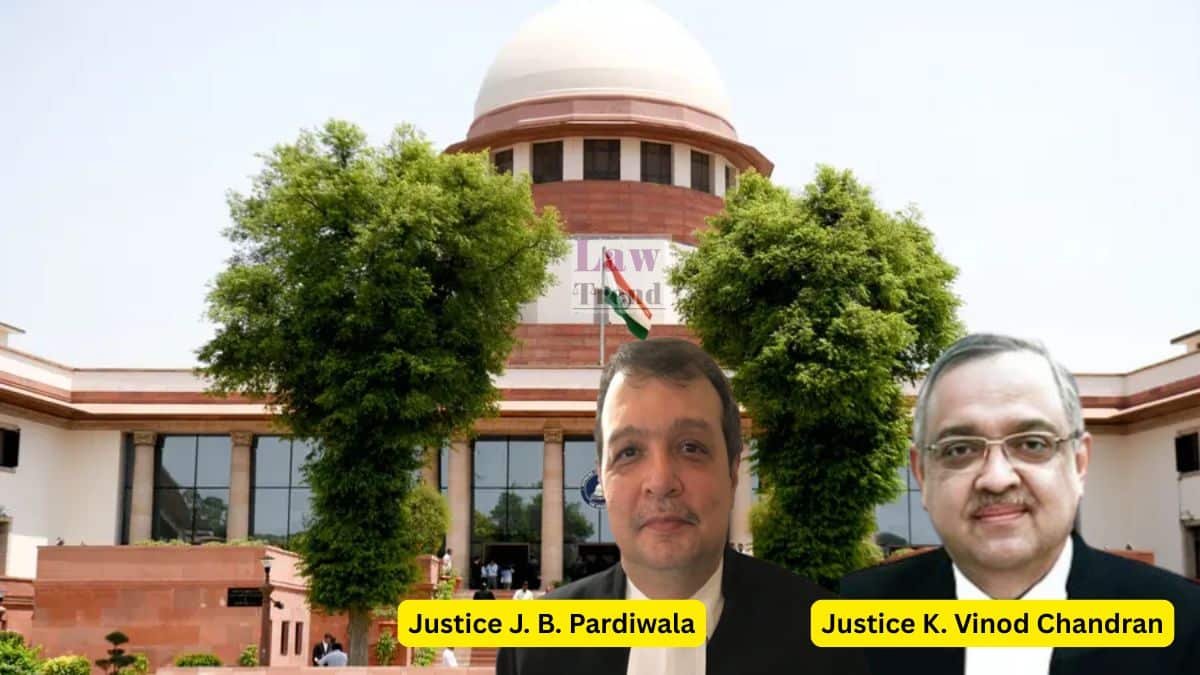
A Bench of Justice J.B. Pardiwala and Justice K. Vinod Chandran disposed of an appeal filed by Bank of India and five other members of the CoC.
Background
The CoC had approved a resolution plan submitted by a consortium, the Successful Resolution Applicant (SRA). Before the NCLT confirmed it, the CoC unanimously sought withdrawal of the plan, contending that the Corporate Debtor’s financial position had improved considerably while it was under the Resolution Professional’s management, and the SRA would get a windfall gain.
The NCLT allowed the withdrawal. The NCLAT reversed this, holding that the CoC had no jurisdiction to decide on withdrawal of the resolution plan, and revived the RP’s application for confirmation of the plan along with an application filed by the holding company of the Corporate Debtor. The Court noted that the delay in implementation was occasioned by a stay granted by the Supreme Court in earlier proceedings.
Arguments
Senior Counsel Gopal Sankarnarayan, appearing for the appellants, submitted that the resolution plan proposed ₹172.55 crore when the Corporate Debtor had an opening balance of ₹30 crore, which had risen to ₹165 crore by the time the earlier SLP was dismissed. He argued this conferred a windfall on the SRA, and that the CD’s toll collection business on National Highway 45 had suffered due to the Covid-19 pandemic when the plan was approved. He relied on the primacy of the CoC’s commercial wisdom and on Kalyani Transco v. Bhushan Power & Steel Ltd.
Senior Counsel Nidhesh Gupta, appearing for the SRA, relied on Ebix Singapore (P) Ltd. v. Committee of Creditors of Educomp Solutions Ltd. to contend that the CoC is bound by its approval, and that the improvement in financial position was already contemplated in the plan.
Senior Counsel Nikhhil Nayyar, appearing for the holding company, submitted that if the One-Time Settlement (OTS) were implemented, the CIRP itself could be closed.
Supreme Court on withdrawal of resolution plan under IBC
The Court held that though Ebix Singapore dealt with withdrawal sought by the SRA, “the dictum applies squarely to the CoC too.”
Reading Section 12-A together with Sections 30 and 31 of the IBC, the Court held:
“Read together, we are of the opinion that the withdrawal of an application can only be till the CoC approves the plan and after it is placed before the Adjudicating Authority, there can be no withdrawal either of the application or the approved Resolution Plan.”
On Kalyani Transco, the Court held that the finding that the CoC continues to exist till implementation does not detract from the essential binding nature of a resolution plan approved by the CoC.
The Court also took note of the SRA’s contention, observing that “The SRA’s contention that the CoC has turned turtle not because of its commercial wisdom but only due to a shortsighted opportunism revealing institutionalized rapacity also cannot be ignored.”
Outcome
The Court directed the NCLT to consider the plan while verifying the Corporate Debtor’s present financial position and cash balance against the terms of the plan, adding: “The improved profitability alone cannot be a reason to refuse approval if the Resolution Plan meets the requirements under sub-section (2) of Section 30”
Clarifying that, except on the binding nature of the plan vis-à-vis the CoC and the SRA, its observations were prima facie, the Court requested the NCLT to take up both pending applications together and decide them expeditiously.
Case Title: Bank of India & Ors. v. S.M. Kamal Pasha & Ors.
Case No.: Civil Appeal No. 12045 of 2026
Bench: Justice J.B. Pardiwala and Justice K. Vinod Chandran
Date: October 26, 2026


