

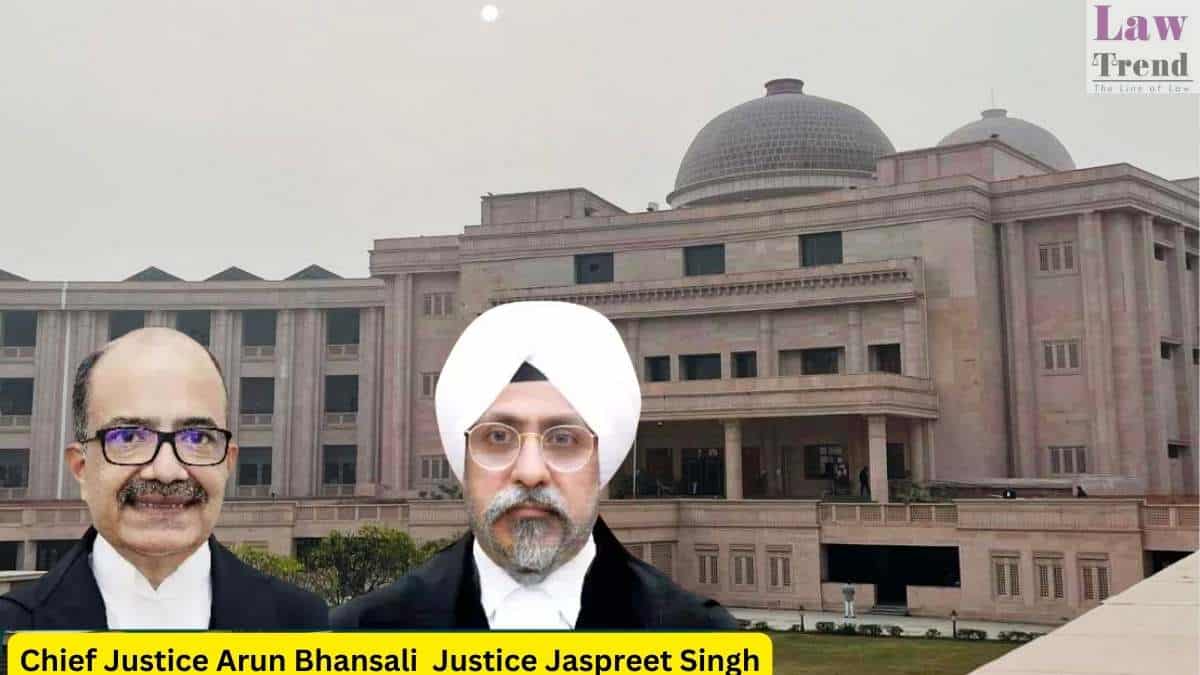
The Allahabad High Court at Lucknow has held that an arbitral tribunal has no power to grant compound interest, or interest with annual rest, when the contract between the parties contains no stipulation for it. The Court modified an arbitral award in a road construction dispute, replacing annually compounded interest with simple interest, while upholding the rest of the award.
A Division Bench of Chief Justice Arun Bhansali and Justice Jaspreet Singh partly allowed the State of Uttar Pradesh’s appeal under Section 37 of the Arbitration and Conciliation Act, 1996.
Background
The dispute arose from a contract for widening and strengthening the Raya-Math Road in District Mathura. The contractor, M/s Apex Construction Company, claimed that it completed the work on 31.08.2009 and later sought ₹23,79,90,727 from the State before a three-member Arbitral Tribunal.
By its award dated 30.07.2017, the Tribunal found that the contractor had completed 11.8 km of road, not 12 km as claimed. It held the contractor’s final bill to be false and misleading and rejected its claim for 5% annual escalation. It, however, held the contractor entitled to ₹1,56,79,034.65, with 14% interest compounded annually from 01.09.2009 until realisation, along with ₹10 lakh as costs. A sum of ₹1,39,619 on the State’s counter-claim, with 14% interest, was to be deducted.
The State’s petition under Section 34 was dismissed by Commercial Court No. 1, Lucknow, on 09.02.2023, leading to the present appeal.
Arguments
Senior Counsel and Additional Advocate General Pritish Kumar, along with Additional Chief Standing Counsel Tushar Verma, appearing for the State, argued that no completion certificate had been issued under Clause 48.1 of the contract, and the Tribunal’s finding that the work was complete amounted to rewriting the contract. He further submitted that the contract was silent on interest, and Section 3(3)(c) of the Interest Act, 1978, which includes an arbitrator within the meaning of “court”, bars the award of interest upon interest.
Advocates Akshat Kumar, Durgendra Kumar Tiwari, Sanjay Kumar Srivastava and K.K. Arora, appearing for the respondents, contended that the Tribunal’s findings on completion of work were pure findings of fact based on evidence. They argued that Section 31(7) of the 1996 Act empowers the Tribunal to grant interest, and that interest with annual rest is consistent with banking practice.
Completion Certificate Not Decisive
Rejecting the State’s first contention, the Court noted that the State never issued any notice to the contractor about incomplete work, poor workmanship or substandard material. It also noted that the reports of the CRRI and the U.P. Public Works Department did not find that the work was incomplete.
The Court held that “merely because the completion certificate was not issued by the appellant it would not mean that the work was incomplete.”
Compound Interest Barred Without Contractual Stipulation
On interest, the Court held that since the contract was silent, Section 31(7) of the 1996 Act was attracted, and the Tribunal had the power to grant interest for both the pre-reference and the pendente lite and future periods. It found the 14% rate unobjectionable, noting the commercial nature of the contract.
However, relying on the Constitution Bench ruling in Central Bank of India v. Ravindra, the Court observed, “It is now too well settled to be disputed that the compound interest cannot be granted unless there is a stipulation in the contract.”
Referring to Section 2(a) and Section 3(3)(c) of the Interest Act, 1978, the Court held that interest compounded annually is a species of compound interest. After examining the Supreme Court’s decision in HLV Ltd. v. PBSAMP Projects (P) Ltd., which considered Hyder Consulting, Morgan Securities, S.A. Builders and S.L. Arora, the Bench concluded that “in absence of any specific stipulation, compounding of interest/interest on interest is not permissible.”
Award Modified, Not Set Aside
Drawing on the Constitution Bench decision in Gayatri Balasamy v. ISG Novasoft Technologies Limited, the Court declined to set aside the entire award, stating that “the ends of justice can be met by correcting and modifying only part of the award relating to grant of interest.”
The Court directed that ₹1,56,79,034.65 will carry 14% per annum simple interest from 01.09.2009 till 31.01.2016, the date of filing of the claim. The aggregate of principal and interest crystallised on that date will then carry 14% per annum simple interest from 01.02.2016 till actual payment. The counter-claim sum of ₹1,39,619, with 14% per annum simple interest from 01.09.2009, will be deducted.
Subject to this modification, the award, including the rate of interest, was affirmed. The appeal was partly allowed with no order as to costs.
Case Title: State of U.P. through Additional Chief Secretary, Public Works Department, Government of U.P., Lucknow and others v. M/s Apex Construction Company, Mathura through Director/Proprietor Sri Jagdish Chowdhary and another
Case No.: Appeal under Section 37 of Arbitration and Conciliation Act 1996 No. 62 of 2023
Bench: Chief Justice Arun Bhansali and Justice Jaspreet Singh
Date: 24.10.2026


