

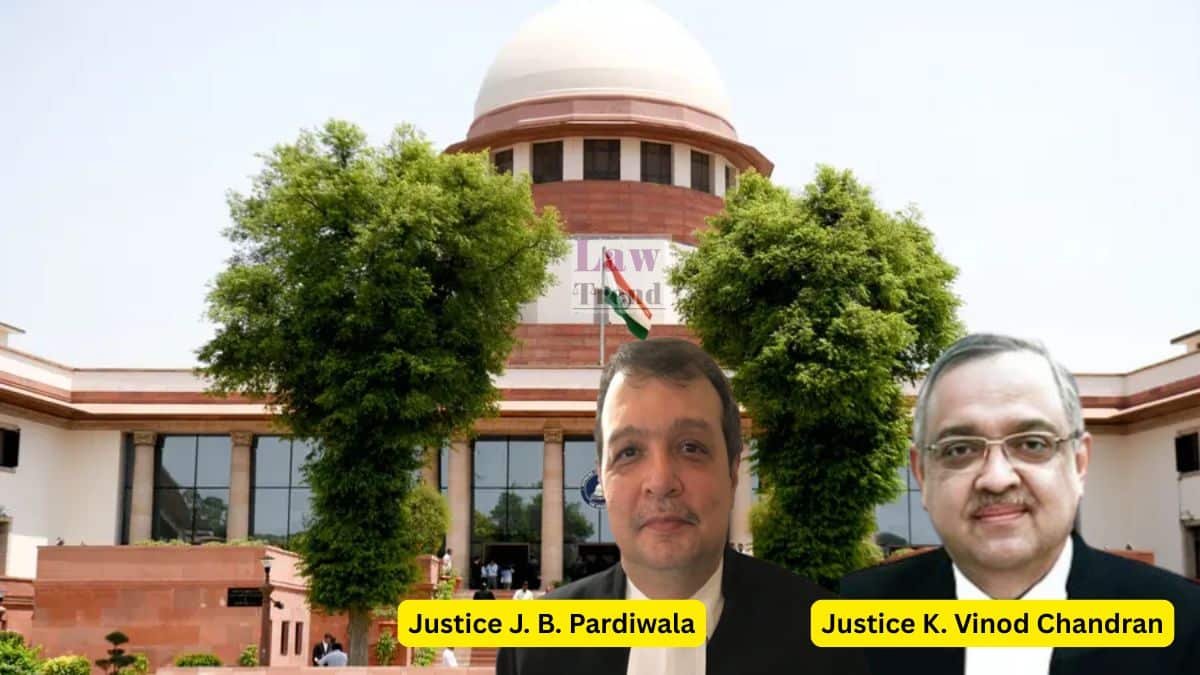
The Supreme Court has held that a member of a co-operative society can obtain the society’s construction agreement and general body meeting minutes under the Right to Information Act, 2005 through the Registrar of Co-operative Societies. A Bench of Justice J.B. Pardiwala and Justice K. Vinod Chandran dismissed the appeals filed by The Muppathadam Service Co-Operative Bank Ltd. and directed the Registrar to supply the documents within two weeks.
Background
The 4th respondent, a member of the appellant-Bank, filed an RTI application before the Joint Registrar (General) of Co-operative Societies seeking two documents: the construction agreement between the Bank and a Labour Co-operative Society entrusted with constructing a building, and the minutes of the Bank’s last General Body Meeting.
His first application was rejected up to the State Information Commissioner, and a Single Judge of the High Court upheld the rejection, but the Division Bench directed reconsideration. In the second round, the State Information Commissioner, the Single Judge and the Division Bench all affirmed his right to the documents. The Bank challenged the Division Bench’s judgment before the Supreme Court.
Arguments
Senior Counsel S.P. Chaly, appearing for the appellant-Bank, relied on Thalappalam Service Cooperative Bank Limited v. State of Kerala to argue that the Bank is not a “public authority”. He submitted that under Sections 65 and 66 of the Kerala Co-operative Societies Act, 1969, the Registrar gets access to a society’s documents only after recording a subjective satisfaction to conduct an inquiry, and no such satisfaction had been entered.
Counsel Abhilash M.R., appearing for the State Information Commissioner, argued that the absence of a pending inquiry was inconsequential when the statute permits access, and that the Registrar’s supervisory power under Section 66 supplies a distinct route of access.
The 4th respondent, appearing in person, pointed to amendments inserting sub-sections (4A) and (11) into Section 66, and contended that Thalappalam was not applicable.
Supreme Court RTI Ruling on Co-operative Society Records
Interpreting Section 2(f) of the RTI Act, the Court said:
“Hence, it is not only the material, physically available with a public authority but also such material relating to a private body, which can be accessed by a public authority, on the strength of statutory powers conferred, would fall under the definition of information.”
Rejecting the Bank’s contention on prior satisfaction, the Court noted that Section 65(2) gives the Registrar free access to the society’s books and documents at all reasonable times. It held:
“Access simpliciter, thus cannot be conditioned with a prior satisfaction, since without such access, the Registrar cannot enter upon a satisfaction.”
On the exemptions under Section 8(1)(d) and (j), the Court found that the documents involved no trade secret, intellectual property or commercial confidence, since the bid was over and the contract had already been awarded. It added that the position would differ if an unconnected third party made the request, but observed:
“However, a Member of the Society cannot be denied such information on the ground that it is personal to the Society or that it does not involve any public activity or interest.”
The Court also noted that Thalappalam preserves the Registrar’s right to seek information from societies under his supervision, and that the information sought in that case concerned members’ bank deposits, which was exempt under Section 8(1)(j).
Outcome
Holding that the Division Bench’s judgment was in accordance with law and the decisions cited, the Court dismissed the appeals. It directed the Joint Registrar to call for the two documents immediately, and in any event within two weeks, and supply them to the 4th respondent.
Case Title: The Muppathadam Service Co-Operative Bank Ltd. v. The State Chief Information Commissioner & Ors.
Case No.: Civil Appeal No. 13906 of 2026 with Civil Appeal No. 13907 of 2026
Bench: Justice J.B. Pardiwala, Justice K. Vinod Chandran
Date: October 26, 2026


