

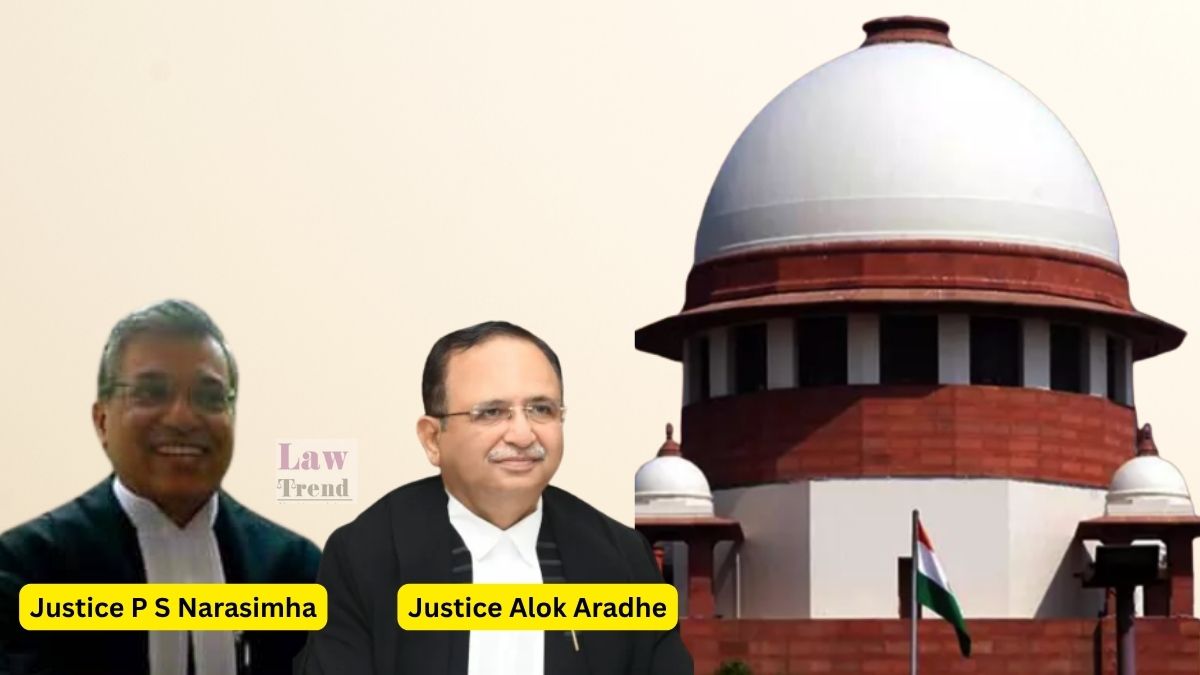
A Supreme Court bench comprising Justice Pamidighantam Sri Narasimha and Justice Alok Aradhe has held that a homebuyer seeking a refund due to non-delivery of an apartment cannot recover the entire sale consideration funded by a lending bank when the loan remains unpaid, as doing so would amount to impermissible unjust enrichment. The Court ruled that the homebuyer is entitled to recover only the amount actually paid out of his own pocket.
Modifying an order of the National Consumer Disputes Redressal Commission (NCDRC), which had directed the builder to refund the entire amount of over Rs 2.19 crore directly to the buyer, the apex court restricted the buyer’s entitlement to Rs 1,27,34,726 with 12 percent simple interest per annum. In addition, the Court awarded Rs 15 lakh as composite compensation, upheld a Rs 2 lakh fine against Housing Development Finance Corporation Limited (HDFC) for deficiency of service, and directed the balance amount deposited by the builder to remain in an interest-bearing account subject to the outcome of the bank’s recovery appeal pending before the High Court.
Factual Background
In 2009, M/s Lodha Healthy Constructions and Developers Private Limited launched a residential project called “Lodha Bellezza” at Kukatpally, Hyderabad. On August 8, 2009, the complainant, Mr. K. Madhusudhan Rao (now Madhu Kudapa), booked an apartment for a total sale consideration of Rs 2,30,73,876. Between August and September 2009, the buyer paid Rs 51,11,576 from his own funds—amounting to 22 percent of the sale consideration. An Agreement for Sale was executed on October 21, 2009.
To finance the balance, the borrower secured a housing loan of Rs 2 crore from HDFC. A Tripartite Agreement was executed on January 30, 2010, followed by a Loan Agreement on February 1, 2010. Between February 2010 and July 2011, the bank disbursed Rs 1,68,80,531 directly to the builder in thirteen tranches, bringing the developer’s receipt to about 95 percent of the total sale price.
Under Clause 24 of the Agreement for Sale, the builder was obligated to deliver possession on or before June 30, 2011, with a six-month grace period. However, possession was repeatedly delayed. Between October and December 2012, the builder offered possession for “fit-outs,” which the buyer refused as both the Occupancy Certificate and Fire Department No-Objection Certificate (NOC) were lacking; the fire NOC was obtained only in May 2013. Meanwhile, the bank debited pre-EMI interest, of which the buyer paid Rs 26,23,150 up to March 2013.
On May 13, 2013, the borrower approached the NCDRC (CC No. 150 of 2013) seeking a refund of Rs 2,19,92,107 with interest, rental reimbursement of Rs 7,97,895, reversal of loan interest debits, and compensation of Rs 15 lakh for mental trauma and harassment. During the pendency of the complaint, the bank recalled the loan and instituted a recovery suit before the Commercial Court. The borrower paid further sums of Rs 20 lakh and Rs 30 lakh in mid-2021, bringing his total direct payments to the bank to Rs 76,23,150. Together with the Rs 51.11 lakh paid directly to the builder, the borrower spent a total of Rs 1,27,34,726 out of pocket.
The Commission’s Ruling and Subsequent Proceedings
On July 1, 2022, the NCDRC held that the builder had defaulted on delivery and rejected its force majeure plea. It observed that the bank had failed to verify the progress of construction prior to loan disbursals as required under Recital (H) of the Tripartite Agreement and Clause 2.4 of the Loan Agreement, holding the bank deficient in service and directing it to pay Rs 2,00,000 to the borrower. The Commission further directed the builder to refund the entire deposited sum of Rs 2,19,92,107 to the borrower with 9 percent interest per annum within three months, failing which 12 percent interest would apply. It did not grant the borrower’s prayers for rent reimbursement or general compensation.
The bank’s review petition was dismissed on December 7, 2022. The builder complied with the order without appealing, depositing Rs 4,43,24,510 before the Commission on February 1, 2023, which grew with accrued interest to Rs 5,65,43,411 as of October 8, 2026. On December 10, 2024, the Commercial Court dismissed the bank’s recovery suit on maintainability in light of the NCDRC’s findings, which the bank appealed before the High Court. Both the borrower and the bank approached the Supreme Court in appeal.
Submissions of the Parties
Senior counsel Amit Anand Tiwari, appearing for the borrower, argued that the bank disbursed nearly 80 percent of the funds collusively without construction progress verifications when the builder did not even have permission to construct. He contended that the borrower was entitled to the refund of the entire sum, 18 percent interest based on Clause 19 of the agreement and Rajnesh Sharma v. Business Park Town Planners Ltd., litigation costs of Rs 35 lakh, and actual rent running into Rs 38,000 to Rs 65,000 per month as claimed in a rejoinder affidavit.
Senior counsel Gaurav Agarwal and counsel Rahul Kripalani, appearing for the builder, submitted that the developer had accepted the NCDRC order and deposited the full amount to end the dispute. They proposed that the Rs 1.27 crore paid by the buyer from his pocket be refunded with reasonable interest, and the remaining proceeds be disbursed to the bank to settle all proceedings, relying on Experion Developers (P) Ltd. v. Sushma Ashok Shiroor and DLF Homes Panchkula (P) Ltd. v. D.S. Dhanda.
Ms. Suhasini Sen, counsel for the bank, submitted that the Commission erred in ordering the refund of the entire bank-financed sum to the borrower in breach of Clauses 16 and 17 of the Tripartite Agreement, reducing a secured creditor to the position of an unsecured creditor. She resisted the finding of deficiency, opposed the builder’s settlement formula, and asserted that the dismissal of its recovery suit on maintainability did not trigger res judicata on the merits.
Court’s Analysis and Findings
Examining whether the borrower was entitled to the full refund, the Supreme Court invoked the statutory provisions of Chapter V of the Indian Contract Act, 1872 (Sections 64, 65, 70, and 72) and the common law doctrine of unjust enrichment (nemo debet locupletari ex aliena jactura), citing Mahabir Kishore v. State of Madhya Pradesh, Sahakari Khand Udyog Mandal Ltd. v. Commissioner of Central Excise, Indian Council for Enviro-Legal Action v. Union of India, and Mafatlal Industries Ltd. v. Union of India.
The Court observed:
“First, the doctrine is part of our law, both by statute and as a principle of equity. Second, it looks at the person who holds a benefit and asks whether, in conscience, he may keep it. Third, it is a doctrine of correction and not of reward. Restitution restores. It does not redistribute. It returns value to the person at whose expense it was received. It does not confer value on a person merely because he has been wronged.”
Addressing the legal fiction regarding disbursals under tripartite financing, the bench observed:
“That fiction, however, serves a limited purpose. It fastens the obligation to repay the loan on the Borrower, though the money never passed through his hands. It does not convert borrowed money, which remains unpaid, into the Borrower’s own money.”
The Court held that handing the entire Rs 2.19 crore to the buyer while the bank’s loan remained unpaid would constitute impermissible unjust enrichment. It ruled that the borrower was entitled, in his own right, only to the refund of Rs 1,27,34,726.
On the question of interest, the bench rejected the borrower’s claim of 18 percent, noting that Clause 24 of the Agreement for Sale specifically stipulated a 12 percent rate upon default and termination. Applying Ghaziabad Development Authority v. Balbir Singh, DLF Homes Panchkula Pvt. Ltd. v. D.S. Dhanda, and Greater Mohali Area Development Authority v. Anupam Garg, the Court held that contractual stipulations governing delay require strong reasons to depart from, awarding simple interest at 12 percent per annum from the date of each deposit.
Turning to the claim for rent and compensation under Section 14(1)(d) of the Consumer Protection Act, the Court referred to Lucknow Development Authority v. M.K. Gupta, Bangalore Development Authority v. Syndicate Bank, Fortune Infrastructure v. Trevor D’lima, and Irrigation Department, Government of Orissa v. G.C. Roy. It rejected the claim for separate rent reimbursement, stating:
“Secondly, the award of rent in addition to interest on the full refund would amount to double compensation for the same default. Interest at 12% per annum is awarded precisely because the Borrower was deprived of the use of his money. Had that money been with him, he could have applied it to secure a home of his own.”
“To award him both, the return on the money which would have bought him a home and the rent which he paid for want of one would be to compensate him twice for the same loss.”
The bench pointed out that by choosing to terminate the agreement and demand a refund on May 13, 2013, the buyer had elected his remedy under Clause 24, after which housing costs could no longer be treated as a direct loss resulting from non-delivery. Nevertheless, recognizing that the borrower had been kept out of both money and shelter for over fifteen years and lost the benefit of property price appreciation, the Court awarded a composite compensation of Rs 15,00,000 in full and final settlement of all claims regarding rent, mental agony, harassment, and litigation expenses.
On the bank’s deficiency, citing Ravneet Singh Bagga v. KLM Royal Dutch Airlines and SGS (India) Ltd. v. Dolphin International Ltd., the Court upheld the NCDRC’s finding that HDFC failed to produce evidence of conducting stage-wise physical inspections before releasing thirteen tranches, sustaining the Rs 2,00,000 compensation. The Court clarified that inter-se contractual recovery claims between the bank and the borrower could not be adjudicated within consumer proceedings and must be decided on merits by the High Court in the pending appeal.
Decision and Directions
Disposing of the appeals and modifying the NCDRC order, the Supreme Court directed:
- The Commission shall release Rs 1,27,34,726 to the borrower along with simple interest at 12 percent per annum calculated from the dates of respective deposits till payment.
- The Commission shall release an additional sum of Rs 15,00,000 as compensation to the borrower from the deposited amount within one month.
- The remaining balance of the builder’s deposit shall remain in an interest-bearing account under the NCDRC, abiding by the High Court’s final decision in the bank’s recovery appeal.
- The High Court shall decide the pending appeal independently on its merits.
Case Details:
Case Title: Madhu Kudapa (formerly known as K. Madhusudhan Rao) v. M/s Lodha Healthy Constructions and Developers Private Limited (LHCPL) & Anr. (with connected appeals)
Case No.: Civil Appeal No. 8994 of 2022 with Civil Appeal Nos. 4622-4623 of 2023
Bench: Justice Pamidighantam Sri Narasimha and Justice Alok Aradhe
Date: October 15, 2026




