

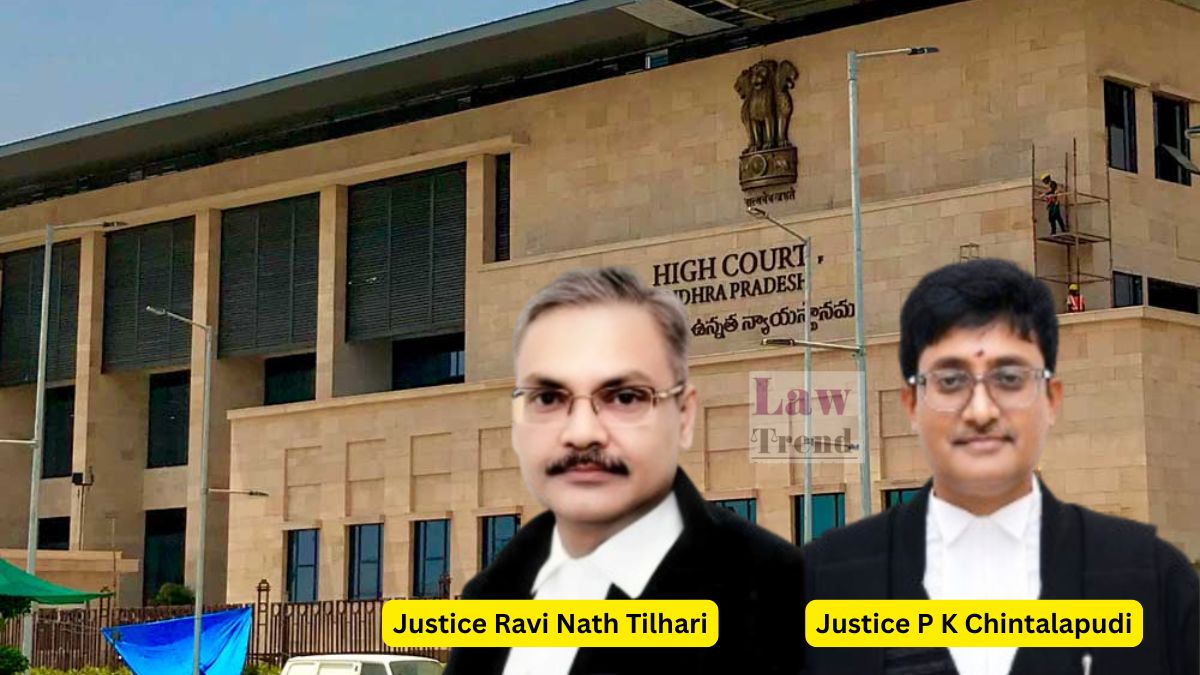
The High Court of Andhra Pradesh, comprising Justice Ravi Nath Tilhari and Justice Purushottam Kumar Chintalapudi, has set aside an order of the Central Administrative Tribunal (CAT), Hyderabad Bench, ruling that courts and tribunals cannot interfere with public service transfer orders merely on grounds of personal hardship or non-statutory executive guidelines. Deciding a writ petition filed by the Union of India, the Division Bench held that judicial review of an administrative transfer is permissible only where there is an infraction of a statutory provision or demonstrable mala fides. The Court also affirmed its territorial jurisdiction to entertain the challenge under Article 226(2) of the Constitution, holding that because the employee was transferred from Guntakal within Andhra Pradesh and the original application was filed at the CAT Circuit Bench in Vijayawada, an essential part of the cause of action arose within the State.
Background of the Case
The respondent, Kunda Pradeep Babu, was appointed to the Indian Railway Accounts Service (IRAS) in December 2015. While serving in the Guntakal Division in Andhra Pradesh, he was apprehended alongside several other railway personnel by the Central Bureau of Investigation (CBI) during a trap operation registered under RC No. 2182024A0013/CBI/AC-III/New Delhi. He faced charges under Section 61(2) of the Bharatiya Nagarik Suraksha Sanhita (BNSS), 2023, for criminal conspiracy, as well as Sections 7, 8, 9, 10, and 12 of the Prevention of Corruption Act.
Following detention exceeding 48 hours, Babu was placed under deemed suspension from July 5, 2024. The High Court of Andhra Pradesh granted him conditional bail in August 2024, restraining him from accessing his office and office records, and directing him to mark periodic attendance before the investigating agency.
On August 26, 2025, upon the recommendation of the Review Committee, the Railway Board revoked Babu’s suspension. Three days later, on August 29, 2025, the Railway Board issued an order transferring him from South Central Railway (SCR) to North Eastern Railway (NER) against an existing vacancy. He was relieved from duty on September 1, 2025.
Babu challenged the transfer order before the CAT Hyderabad Bench (numbered as O.A. No. 933 of 2025). The Tribunal initially declined interim relief, prompting Babu to approach the Telangana High Court, which directed CAT to dispose of the stay application within two weeks and ordered his retention in Guntakal in the interim. Babu reported to the Office of the Principal Financial Adviser, SCR, Secunderabad, on October 17, 2025, requesting posting to a non-sensitive post.
On January 28, 2026, the CAT allowed Babu’s application, setting aside the transfer order and directing the Railway authorities to retain him at Secunderabad. The Tribunal held that forcing Babu to move to NER would cause severe personal and domestic hardship, citing health issues, the birth of his child in August 2025, and the lack of complaints regarding tampering with the CBI investigation. Aggrieved, the Union of India and Railway authorities approached the High Court of Andhra Pradesh.
Arguments of the Parties
Appearing for the Union of India, Additional Solicitor General Challa Dhananjay, assisted by Central Government Counsel Jupudi V.K. Yagnadutt, argued that transfer is an incidence of service. Babu, as an IRAS Group-A officer, possessed an all-India transfer liability. The authorities transferred him to avoid any risk of hampering the ongoing CBI probe or influencing witnesses.
The petitioners contended that the CAT exceeded its powers by quashing the transfer solely on domestic and medical grounds, relying on the Supreme Court’s ruling in Sri Pubi Lombi v. State of Arunachal Pradesh (2024) to argue that personal inconvenience does not confer a justiciable right. Counsel added that under S.C. Saxena v. Union of India (2006), an employee must first report to the transferred posting before ventilating grievances administratively. On jurisdiction, the Union pointed out that Babu was transferred out of Guntakal in Andhra Pradesh and had instituted the original proceeding before the Vijayawada Circuit Bench.
Opposing the writ petition, learned counsel T. Sreedhar raised a preliminary objection regarding the territorial jurisdiction of the Andhra Pradesh High Court under Article 226. He argued that the CAT order was passed in Hyderabad, Telangana, and that the Union had previously submitted to the jurisdiction of the Telangana High Court without demurring. Citing Lt. Col. Khajoor Singh v. Union of India (1961), Union of India v. Alapan Bandyopadhyay (2022), and Baksish Ahmad v. Union of India (2026), counsel urged that jurisdiction lay exclusively where the Tribunal and authorities were situated.
On merits, Babu’s counsel argued that the transfer breached Railway Board circulars mandating that Group-A officers should not be transferred out of their allotted zones prior to attaining Selection Grade, and violated guidelines providing sympathetic consideration for dependents suffering serious illnesses. He also invoked parity, claiming that a co-accused officer had obtained relief from the Tribunal.
Court’s Analysis
The Bench formulated two core issues: whether the Andhra Pradesh High Court held territorial jurisdiction under Article 226, and whether the CAT’s order interfering with the transfer was legally sustainable.
Addressing the jurisdictional challenge, the Court observed that reliance on the unamended interpretation in Lt. Col. Khajoor Singh was misplaced because the introduction of Clause (1-A) by the 15th Constitutional Amendment (subsequently renumbered as Clause (2) of Article 226) expressly incorporated the concept of cause of action.
Reviewing landmark rulings including Navinchandra N. Majithia v. State of Maharashtra (2000), Oil and Natural Gas Commission v. Utpal Kumar Basu (1994), Union of India v. Adani Exports Ltd. (2002), Kusum Ingots & Alloys Ltd. v. Union of India (2004), Nawal Kishore Sharma v. Union of India (2014), and State of Goa v. Summit Online Trade Solutions (P) Ltd. (2023), the Court reiterated that if even an integral fraction of the cause of action arises within a High Court’s territorial limits, the petition is maintainable. Examining the constitutional supervisory framework expounded in L. Chandra Kumar v. Union of India (1997) and reaffirmed in State of H.P. v. Yogendera Mohan Sengupta (2024), the Bench held:
“An O.A. relating to Andhra Pradesh though decided by Central Administrative Tribunal at Hyderabad, the judgment in such an O.A., can be challenged in Andhra Pradesh. The CAT at Hyderabad for such case shall be within the territorial jurisdiction of High Court of Andhra Pradesh. The same shall be the position if the part of cause of action arises within the territorial jurisdiction of the A.P High Court.”
Turning to the merits of the transfer, the Bench observed that the CAT had interfered purely on sympathetic and personal grounds:
“A reading of the impugned order shows that, what prevailed is only inconvenience, due to the order of transfer. Legally, on such ground an order of transfer should not be interfered with. In every transfer there is bound to be some inconvenience. It is well settled that the judicial review of an order of transfer is permissible, only on grounds of violation of the statute or mala fide.”
The Court reiterated the Supreme Court’s principles laid down in Union of India v. S.L. Abbas (1993) and Sri Pubi Lombi v. State of Arunachal Pradesh (2024), underscoring that executive transfer guidelines are directory rather than statutory:
“There is no right for enforcement of the guidelines on transfer unless those guidelines are statutory in nature. Based on the inconveniences or hardship, it is for the applicant to file application for consideration of his case by the competent departmental authorities.”
Citing S.C. Saxena v. Union of India, the Court underscored that an employee holding a transferable post cannot refuse to join duty and bypass administrative channels to seek judicial relief directly.
Decision of the Court
The High Court allowed the writ petition and quashed the CAT order dated January 28, 2026.
The Bench concluded that it possessed full territorial jurisdiction to hear the matter because the transfer originated in Guntakal and the proceedings had been instituted within Andhra Pradesh before the Circuit Bench. On merits, the Court held that the Tribunal had acted illegally by interfering with an administrative transfer in the absence of statutory infractions or mala fides.
No order was made as to costs, and all pending miscellaneous petitions were closed.
Case Title: The Union of India and Others v. Kunda Pradeep Babu and Others
Case No.: Writ Petition No. 16397 of 2026
Bench: Justice Ravi Nath Tilhari and Justice Purushottam Kumar Chintalapudi
Date: September 29, 2026




