

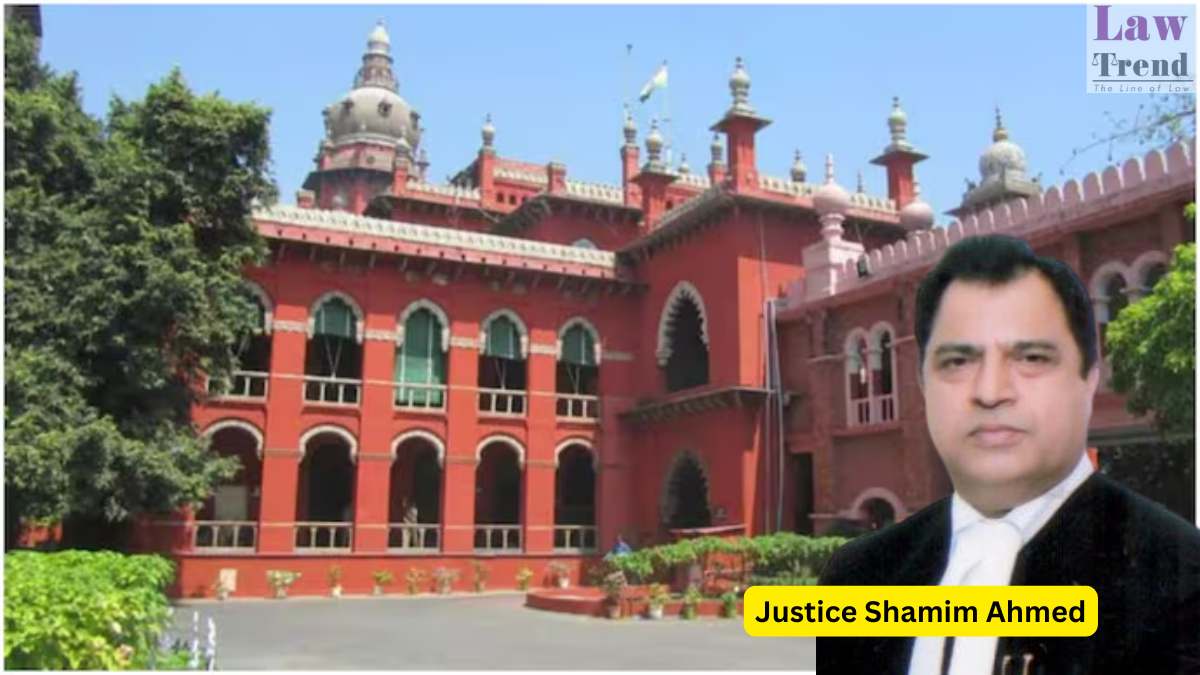
The Madras High Court, presided over by Justice Shamim Ahmed, has partly allowed a criminal revision petition by maintaining the conviction of an accused under Section 326 of the Indian Penal Code (IPC) but modifying the substantive sentence of three years’ imprisonment to release on probation of good conduct under Section 4 of the Probation of Offenders Act, 1958. Emphasizing the reformative purpose of penology, the Court ruled that the statutory benefit could be extended to a first-time offender whose trial and proceedings had stretched over 12 years without any subsequent criminal antecedents.
Background of the Case
The case against the revision petitioner, V. Jayabalan, originated from an incident on January 13, 2014. The petitioner and the complainant, Mustafa Ali, were co-workers in the Railways. During December 2013, Mustafa Ali lodged a complaint alleging that Jayabalan was not working properly. On January 13, 2014, at around 11:30 a.m., while Mustafa Ali was eating near the SR Shop, Jayabalan verbally abused him and assaulted him on the head with an iron rod. The injured co-worker was admitted to the Railway Hospital as an inpatient, having sustained two head injuries.
Upon receiving information, the Sub-Inspector of Police from the K-7 I.C.F. Police Station recorded the injured victim’s statement and registered Crime No. 34 of 2014 under Sections 294(b), 324, and 506(ii) of the IPC. Following an investigation, a charge sheet was submitted under Sections 294(b), 326, 341, and 506(ii) of the IPC.
During the trial before the V Metropolitan Magistrate, Egmore, Chennai (CC No. 2708 of 2015), the prosecution examined five witnesses (PW.1 to PW.5) and marked exhibits Exs. P1 to P10 along with material object M.O.1. In his examination under Section 313 of the Code of Criminal Procedure (Cr.P.C.), the accused pleaded total denial and claimed false implication, leading no defence evidence.
On August 1, 2019, the trial court convicted Jayabalan under Section 326 of the IPC, sentencing him to three years’ imprisonment alongside a fine of Rs. 500 (with a default simple imprisonment of one month), while acquitting him of charges under Sections 341, 294(b), and 506(ii) of the IPC. The XXI Additional Sessions Judge, City Civil Court, Chennai, dismissed the appeal (CA No. 304 of 2019) on February 28, 2022, confirming the conviction and sentence. Jayabalan subsequently approached the High Court in revision.
Arguments Before the High Court
Counsel for the revision petitioner, Mr. H. Maruthiraj, submitted that the petitioner did not press the revision case on merits. He contended that the incident occurred 12 years prior, the petitioner was a first-time offender with no previous convictions or subsequent criminal antecedents, and the prolonged delay had compromised his right to a speedy trial. Citing the Supreme Court’s decision in Mohd. Hashim v. State of U.P., counsel urged that the court exercise its discretion to extend the benefits of Section 4 of the Probation of Offenders Act, 1958.
The Government Advocate (Criminal Side), Mr. M. Dinesh, submitted that there was no material irregularity or illegality in the concurrent findings of the lower courts, maintaining that the conviction and sentence were justified based on the evidence. However, the State conceded that the benefit of Section 4 of the Act of 1958 could be extended to the petitioner subject to specified stipulations.
The Court’s Analysis and Precedents
In analyzing the applicability of Section 4 of the Probation of Offenders Act, Justice Shamim Ahmed noted that the provision empowers the court to release an offender on probation for offences not punishable with death or life imprisonment, having regard to the nature of the offence, the circumstances of the case, and the offender’s character. The Court emphasized that Section 4 does not create distinctions among categories of offenders.
The Court referred to the landmark ruling in Ratan Lal v. State of Punjab (AIR 1965 SC 444), wherein the Supreme Court observed:
“The Act is a milestone in the progress of the modern liberal trend of reform in the field of penology. It is the result of the recognition of the doctrine that the object of criminal law is more to reform the individual offender than to punish him. Broadly stated the Act distinguishes offenders below 21 years of age and those above that age, and offenders who are guilty of having committed an offence punishable with death or imprisonment for life and those who are guilty of a lesser offence. While in the case of offenders who are above the age of 21 years, absolute discretion is given to the court to release them after admonition or on probation of good conduct, subject to the condition laid down in the appropriate provision of the Act, in the case of offenders below the age of 21 years an injunction is issued to the court not to sentence them to imprisonment unless it is satisfied that having regard to the circumstances of the case, including the nature of the offence and the character of the offenders, it is not desirable to deal with them under Ss. 3 and 4 of the Act.”
The Court also took note of Ved Prakash v. State of Haryana (AIR 1981 SC 643), where the Supreme Court underscored the humanizing mission of sentencing:
“We must emphasise that sentencing an accused person is a sensitive exercise of discretion and not a routine or mechanical prescription acting on hunch. The Trial Court should have collected materials necessary to help award a just punishment in the circumstances. The social background and the personal factors of the crime-doer are very relevant although in practice Criminal Courts have hardly paid attention to the social milieu or the personal circumstances of the offender… Indeed members of the bar also do not pay sufficient attention to these legislative provisions which relate to dealing with an offender in such manner that he becomes a non offender. We emphasise this because the legislation which relate to amelioration in punishment have been regarded as ‘Minor Acts’ and, therefore, of little consequence. This is a totally wrong approach and even if the Bar does not help, the Bench must fulfil the humanising mission of sentencing implicit in such enactments as the Probation of offenders Act.”
Addressing the duty of subordinate courts, the High Court cited the Allahabad High Court’s decision in Subhash Chand v. State of U.P. (2015 Law Suit (All) 1343), which cautioned judicial officers against overlooking the statute:
“It appears that the aforesaid beneficial legislation has been lost sight of and even the Judges have practically forgotten this provision of law. Thus, before parting with the case, this Court feels that I will be failing in discharge of my duties, if a word of caution is not written for the trial courts and the appellate courts. The Registrar General of this Court is directed to circulate copy of this Judgement to all the District Judges of U.P., who shall in turn ensure circulation of the copy of this order amongst all the judicial officers working under him and shall ensure strict compliance of this Judgement…”
The Court further referenced State of Maharashtra v. Jagmohan Singh Kuldip Singh Anand (2004) 7 SCC 659, noting:
“The prayer made on behalf of the accused seems to be reasonable. The accident is more than ten years old. The dispute was between the neighbours over a trivial issue of claiming of drainage. The accident took place in a fit of anger. All the parties educated and also distantly related. The accident is not such as to direct the accused to undergo sentence of imprisonment. In our opinion, it is a fit case in which the accused should be released on probation by directing them to execute a bond of one year for good behaviour.”
Regarding judicial discretion across appellate and revisional stages, the Court cited Sitaram Paswan and Anr v. State of Bihar (AIR 2005 SC 3534):
“For exercising the power which is discretionary, the Court has to consider circumstances of the case, the nature of the offence and the character of the offender. While considering the nature of the offence, the Court must take a realistic view of the gravity of the offence, the impact which the offence had on the victim… This power can be exercised by the Courts while finding the person guilty and if the Court thinks that having regard to the circumstances of the case, including the nature of the offence and the character of the offender, benefit should be extended to the accused, the power can be exercised by the Court even at the appellate or revisional stage…”
Reiterating Mohd. Hashim v. State of U.P. (AIR 2017 SC 660), the Court noted that exceptions had historically been carved out where probation was denied due to gravity and motive, citing Smt. Devki v. State of Haryana (1979 3 SCC 760, abduction and sexual assault of a teenage girl) and State of Maharashtra v. Natwar Lal Damodar Das Soni (1980 4 SCC 669, gold smuggling). Conversely, the Court observed that probation had been upheld in Jagat Pal Singh and others v. State of Haryana (AIR 2000 SC 3622) under Sections 323, 452, and 506 IPC, and by the Allahabad High Court in Virendra Kumar v. State of U.P. (2022 (120) ACrC 392) under Section 7 read with Section 16 of the Prevention of Food Adulteration Act.
Decision of the Court
Applying these principles to the facts, the Court observed that the incident took place in 2014, the petitioner had suffered through proceedings for 12 years, had no prior convictions, and had maintained clean antecedents.
Consequently, the High Court partly allowed the revision case with the following directions:
- The conviction recorded under Section 326 of the IPC by the trial court and confirmed by the appellate court was maintained.
- The sentence of imprisonment was modified: instead of serving custodial prison time, the petitioner was granted the benefit of Section 4 of the Probation of Offenders Act, 1958. He was directed to execute a personal bond along with two sureties of Rs. 20,000 each before the concerned District Probation Officer within three months, furnishing an undertaking to maintain peace, demonstrate good behavior, and refrain from committing any offence for a period of six months.
- In the event of a breach of any condition, the petitioner shall be taken into custody to serve out the original substantive sentence imposed by the courts below.
Case Details:
Case Title: V. Jayabalan v. The State Rep By Inspector Of Police, K.7.I.C.F. Police Station
Case No.: CRL RC No. 585 of 2022
Bench: Justice Shamim Ahmed
Date: 06-10-2026




