

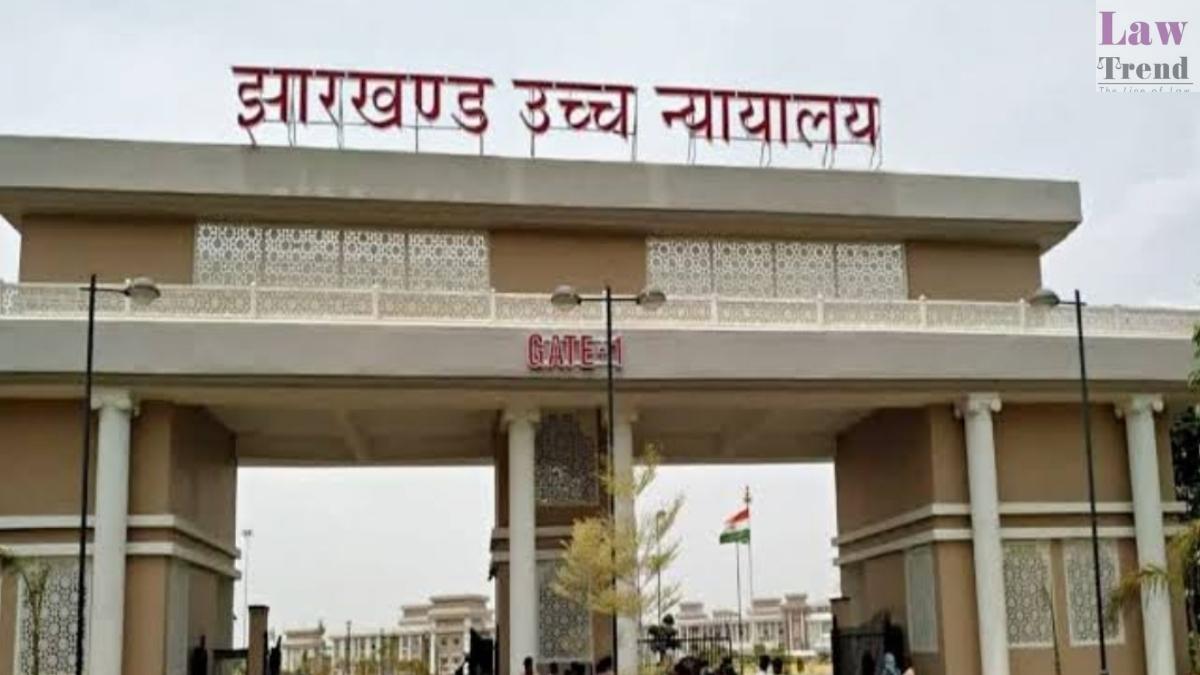
The Jharkhand High Court has quashed an executive notification rejecting the premature release of a life convict who has spent over 26 years in actual physical custody, holding that executive authorities cannot deny remission solely on the ground of the heinous nature or gravity of the original offence. Justice Rongon Mukhopadhyay, while allowing the criminal writ petition, ruled that the State Sentence Review Board had acted mechanically through repetitive rejection orders without assessing post-conviction conduct, reduced criminal potentiality, or reformative progress. Setting aside the rejection notification dated March 25, 2026, the High Court remanded the matter back to the Board with a peremptory direction to reconsider the convict’s plea and pass a detailed, reasoned order in its next scheduled meeting in line with established judicial precedents.
Background of the Case
The petitioner was prosecuted in connection with Lower Bazar P.S. Case No. 12/99 over allegations that, while lodged in Birsa Munda Central Jail, Ranchi, he along with other accused persons committed an assault resulting in the death of a fellow inmate, Sudhir Singh alias Bhoma. Following the conclusion of the trial in Sessions Trial No. 443/99, the trial court convicted him under Sections 302/34 and 307/34 of the Indian Penal Code on March 22, 2002, and sentenced him to death.
On appeal, the High Court confirmed the conviction on November 29, 2002, but modified and reduced the sentence to rigorous imprisonment for life. A subsequent criminal appeal before the Supreme Court was dismissed on April 30, 2004. At the time of hearing the present writ petition, the convict had completed 26 years of actual custody and 29 years of incarceration including earned remissions.
Seeking premature release, the petitioner approached authorities under the Bihar Premature Release Policy of 1984 (notified via Memo No. 1647 dated February 24, 1984), which was in force at the time of his conviction. Favorable assessment reports were subsequently placed on record: the Principal Probation Officer, Begusarai, observed that given the convict’s age, family responsibilities, and positive societal opinions, he was expected to lead the life of a good citizen. The Probation Officer, Ranchi, conducted a spot inspection and noted his acquittal in other cases, opining that the benefit of premature release could be extended. Furthermore, an enquiry report forwarded by the Superintendent of Police, Begusarai, recorded no objection from the villagers.
Despite these reports, the State Sentence Review Board turned down the petitioner’s plea across multiple successive meetings—in 2018, 2020, 2023, 2024, 2025, and finally through the impugned Notification No. 1262 dated March 25, 2026. The Board repeatedly anchored its rejections on identical findings: that the murder occurred inside a jail, that the prisoner had previously escaped from judicial custody, and that his release carried a strong possibility of inciting gang war and disturbing public peace.
Arguments of the Parties
Senior counsel Mr. Ajit Kumar, appearing for the petitioner, contended that the Review Board’s rejection dated March 25, 2026, was passed without valid reasons and completely disregarded subsequent legal developments. Counsel emphasized that an appellate court had already acquitted the petitioner of the charge of escaping from judicial custody. He submitted that the petitioner’s case was governed by the 1984 Bihar Policy, which mandated the release of a life convict upon completing 14 years of actual custody and 20 years with remission. In the alternative, counsel submitted that even under the State of Jharkhand’s 2007 Policy, the petitioner was bound to be released as he had exceeded the prescribed outer threshold of 25 years with remission. Counsel further pointed out that the petitioner is over 65 years old, suffers from multiple chronic ailments, and has undergone coronary artery bypass grafting at AIIMS, relying on the Supreme Court’s ruling in Rohit Chaturvedi v. State of Uttarakhand & Ors. to urge that prolonged incarceration warrants release.
Opposing the petition, the learned counsel appearing for the State submitted that the petitioner was a gangster sentenced to life imprisonment for committing murder inside jail premises. The State argued that merely completing 14 years of actual custody and 20 years with remission does not create an automatic entitlement to premature release, as the statutory discretion rests with the Review Board to evaluate records and prevent gang warfare or public disturbance. The State further contended that the 1984 Bihar Policy holds no relevance in light of subsequent executive notifications issued by the State of Jharkhand in 2003, 2007, 2011, and 2013, adding that adequate medical facilities were being extended to the convict within prison.
The Court’s Analysis and Findings
Examining the governing statutory and constitutional principles, the High Court reviewed the legal framework settled in State of Haryana & Ors. v. Jagdish, Laxman Naskar v. Union of India & Ors., and the Constitution Bench judgment in Union of India v. V. Sriharan alias Murugan. The Court noted that in Sahzad Ansari @ Sazad Ansari v. The State of Jharkhand & Ors., it had been clarified that the 1984 policy governed remissions until Jharkhand notified its own resolution on April 18, 2007.
The Court scrutinized Clause 3 of Jharkhand’s Resolution No. 1315 dated April 18, 2007, which stated that completing 14 years of actual custody and 20 years with remission does not confer an automatic right of release, but explicitly provided that “under no circumstance shall the period of custody with remission exceed twenty-five years.” While acknowledging that this 25-year outer limit was subsequently omitted by Resolution No. 3638 dated September 10, 2009, and consolidated under Resolution No. 2307 dated May 26, 2011, the Court observed that the State failed to place these subsequent resolutions on record and offered only casual, vague responses in its counter-affidavit.
Assessing the substantive grounds applied by the Review Board, the Court held that the mandatory criteria laid down in paragraph 46 of Jagdish—including whether the convict has lost the potentiality to commit crime, whether continued confinement serves any fruitful purpose, and the prisoner’s conduct—had been ignored. The Court referred to the report of the Probation Officer, Ranchi, dated September 18, 2024, which confirmed that the convict is 63 years old, suffers from ailments, has a greatly reduced potential for criminality, displays cordial jail behavior, participates actively in prison reform programs, and conducted himself immaculately whenever granted parole.
Criticizing the mechanical rejections issued by the Board, Justice Mukhopadhyay observed:
“A fleeting reference in the said rejection has been made of the opinions of the Jail Superintendent, the Superintendent of Police, the Probation Officer and the concerned learned court without specifying the contents of the said opinions or giving reasons as to how there is still a possibility of gang war and disturbance of public peace and tranquility despite the report of the Probation Officer concluding otherwise. In fact, in all the notifications brought on record rejecting the case of the petitioner for premature release, a common theme is propagated which clearly speaks of a dearth of application of mind and the rejection orders are clothed in a straitjacket formula designed to reject the plea of premature release whatever be the circumstances.”
The Court stressed that the Board mechanically reiterated the allegation of escape from custody despite the petitioner having been acquitted of that specific charge by an appellate court in Criminal Appeal No. 184 of 2010 on February 25, 2014.
Reinforcing the constitutional bounds of executive remission, the Court invoked the Supreme Court’s ruling in Rohit Chaturvedi v. State of Uttarakhand & Ors., which reiterated:
“As we have already stated above, remission is not an extension of the sentencing process, but a distinct executive function concerned with the present and future, namely, the prisoner’s conduct, evidence of reformation, and prospects of reintegration into society. To predicate its denial only on the heinous nature of the offence is to collapse this distinction and to reconvert remission into a retrospective reaffirmation of guilt, which the criminal justice system has already adjudicated upon.”
The High Court observed that the Review Board’s rejection had stifled itself by remaining confined to the original crime while remaining blind to the convict’s current conduct, family conditions, and diminished propensity for crime.
The Decision
Holding that the impugned order had been passed mechanically on grounds that were not justifiable, the High Court quashed and set aside Notification No. 1262 dated March 25, 2026, so far as it concerned the petitioner.
The Court remanded the matter back to the State Sentence Review Board with a direction that the petitioner’s case be placed before it positively on the next scheduled meeting date, whereupon the Board must pass a detailed and reasoned order in light of the High Court’s observations as well as the Supreme Court’s principles in Rohit Chaturvedi. The writ petition was accordingly allowed.
Case Title: Anil Sharma v. The State of Jharkhand and Others
Case No.: W.P. (Cr.) No. 307 of 2026
Bench: Justice Rongon Mukhopadhyay
Date: October 13, 2026




