

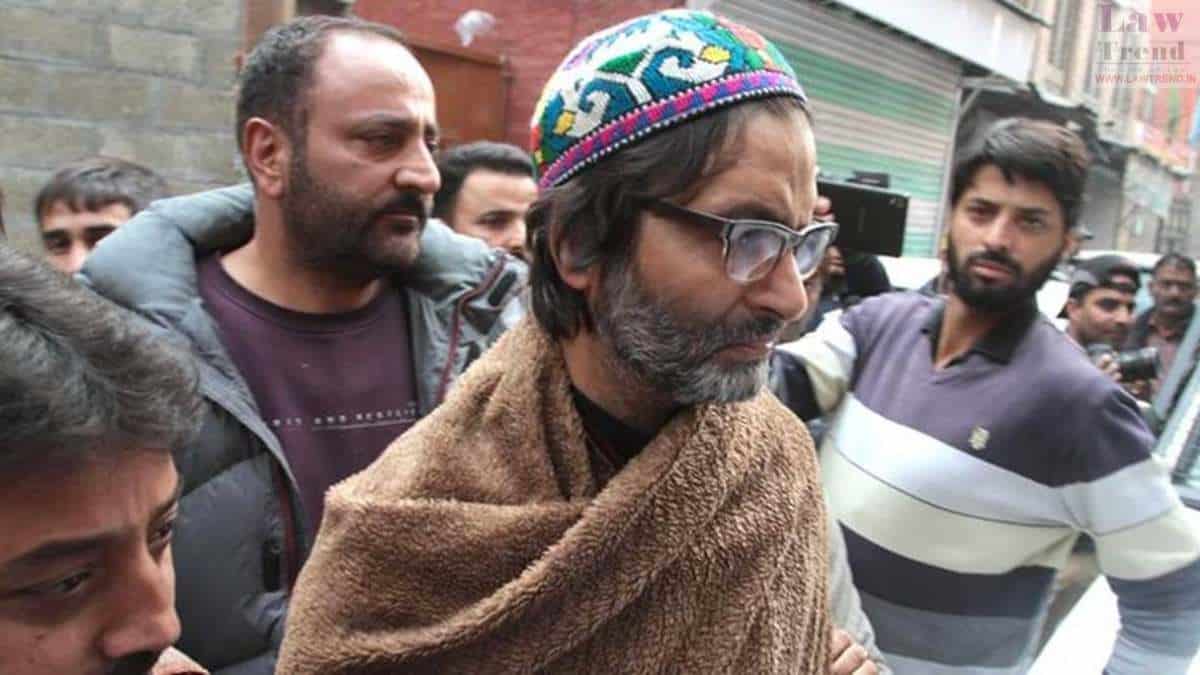
The Delhi High Court on Wednesday sought an explanation from prison authorities after Kashmiri separatist leader Yasin Malik failed to appear by video link for a scheduled hearing concerning the National Investigation Agency’s appeal for capital punishment against him.
A division bench comprising Justice Navin Chawla and Justice Arun Bhardwaj observed that the Jammu and Kashmir Liberation Front chief was required to attend the proceedings virtually from Tihar Jail, where he is currently serving a life sentence in a terror funding matter. Following his non-production, the judges ordered the jail superintendent to submit a formal report detailing why the video connection was not established.
Court Mandates Virtual Presence for December Hearing
The high court adjourned the matter to December 9, instructing prison administrators to ensure that Malik is connected to the courtroom via video conference on the next date of proceedings.
The bench is currently considering a petition filed by the National Investigation Agency challenging Malik’s life sentence and seeking the death penalty. Malik had earlier expressed his intention to present his own defense in person against the agency’s plea for enhanced punishment.
Security Concerns and Virtual Production Orders
Malik’s virtual appearance was mandated following earlier legal interventions regarding courthouse security. While the high court originally issued a notice to the separatist leader on May 29, 2023, requiring his attendance, prison administrators subsequently approached the court to alter those terms.
In their application, jail officials characterized Malik as a very high-risk inmate and maintained that transporting him physically to court posed significant hazards to public order and safety. The high court concurred with the security assessment and granted permission for him to attend all hearings remotely from prison.
National Investigation Agency Seeks Capital Punishment
The ongoing appellate proceedings stem from the investigative agency’s contention that a life term is insufficient for the offenses committed. The agency has argued that an admission of guilt should not shield an individual from capital punishment, warning that sparing offenders who plead guilty would undermine the nation’s sentencing policy and provide a loophole for convicted terrorists to evade execution.
The appeal challenges a May 24, 2022 decision by a special trial court in New Delhi, which sentenced Malik to life imprisonment after he pleaded guilty to charges framed under the Indian Penal Code and the Unlawful Activities (Prevention) Act. While the trial judge observed that Malik’s actions struck at the heart of the idea of India by seeking the forcible secession of Jammu and Kashmir, the court declined the capital punishment request on the grounds that the offense did not fall within the legal threshold of the rarest of rare cases.
Conflicting Claims Over Past Role and Militancy Ties
In contesting the agency’s push for the death penalty, Malik submitted an 85-page affidavit tracing his background from his student years to his interactions with political figures and militant groups. In his defense, Malik asserted that he had participated for nearly thirty years in an officially approved back-channel initiative, coordinating with several Indian prime ministers, intelligence directors, and corporate leaders to advance peace efforts in Jammu and Kashmir.
The investigative agency rejected these claims in a subsequent rejoinder, asserting that references to senior officials and political leaders neither exonerate Malik nor diminish his associations with militant figures such as Hafiz Saeed. The counter-terror agency stated that Malik maintained strong links with multiple militant groups and supporters of Lashkar-e-Taiba, adding that his citations of prominent politicians, diplomats, bureaucrats, and journalists were intended solely to cultivate public sympathy and enhance his own profile.




