

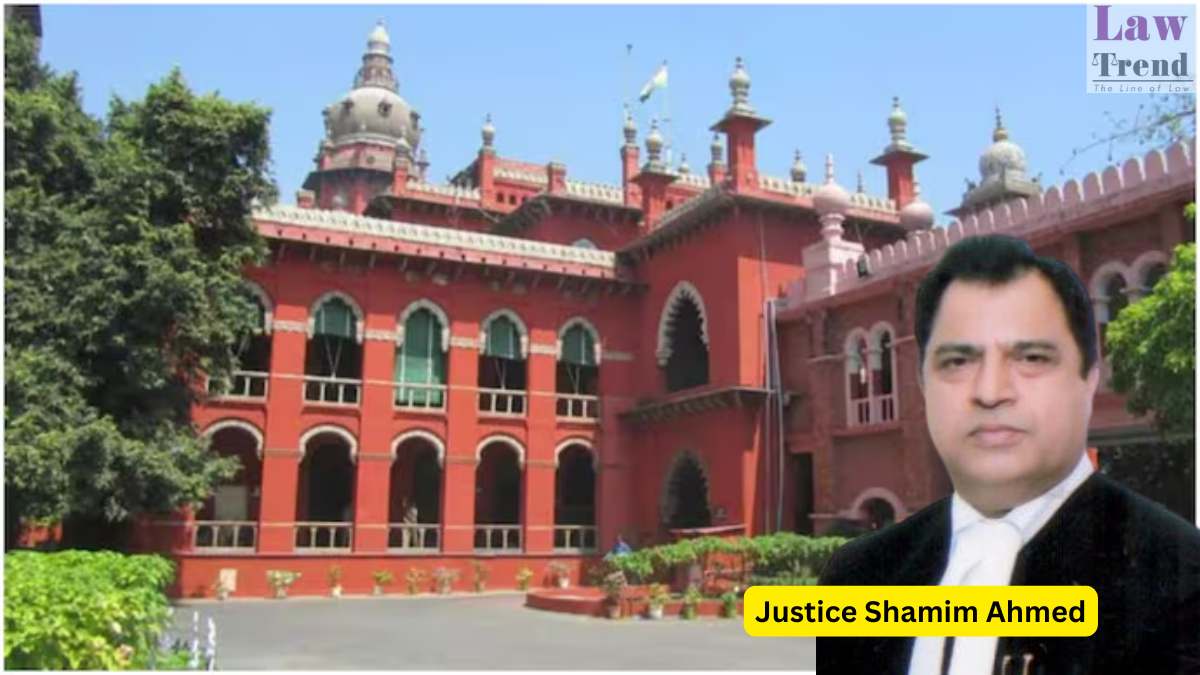
The Madras High Court has ruled that where an insured employee dies unexpectedly from sudden physical collapse or uneasiness while discharging duty on deputation, the statutory presumption under Section 51A of the Employees’ State Insurance Act, 1948 applies, deeming the death to have arisen out of employment in the absence of contrary evidence. Bench of Justice Shamim Ahmed dismissed a Civil Miscellaneous Appeal preferred by the Employees’ State Insurance Corporation (ESIC), upholding the order of the ESI Court, Coimbatore, which had granted dependants’ benefits with 7.5% interest per annum to the widow of a deceased worker.
Background of the Case
The deceased employee, M. Sakthivel, had been employed with K.U. Sudalamuthu and Co. Pvt. Ltd. from May 28, 2012, and was an insured person under the ESI Act. On October 29, 2020, his employer deputed him along with a co-worker to the factory premises of Luxmi Fibres in Himachal Pradesh for 30 days to undertake the erection and commissioning of bulb moulding machines.
On November 25, 2020, at around 4:30 p.m., while on duty at the Himachal Pradesh factory, Sakthivel developed acute uneasiness, collapsed, and died en route to the Civil Hospital, Cantonment at Ambala, Haryana. Following his demise, his widow, Chandramathi, submitted a claim before the ESIC for dependants’ benefits.
The Corporation rejected her claim on December 2, 2022. Aggrieved, the claimant filed ESIOP No. 19 of 2023 before the ESI Court, Coimbatore. On June 10, 2025, the ESI Court allowed her petition, holding that she was entitled to dependants’ benefits from the ESIC along with 7.5% interest per annum from the date of the claim petition until payment. The ESIC challenged this determination before the High Court.
Substantial Questions of Law and Non-Compliance
The High Court had admitted the appeal on August 4, 2026, framed on the following substantial questions of law:
- Whether the presumption under Section 51A of the Employees’ State Insurance Act, 1948, regarding an accident arising in the course of employment, can be applied where death was caused by a disease rather than an accident.
- Whether the deceased, having died due to natural causes and not due to an accident or occupational disease, can be said to have died from an employment injury under the Act.
The coordinate bench had granted an interim stay conditional upon the ESIC depositing 50% of the compensation within four weeks. However, the Corporation failed to make the deposit and sought an extension without showing justifiable cause. Justice Shamim Ahmed noted that the non-compliance demonstrated a lack of interest in prosecuting the appeal, but nonetheless proceeded to adjudicate the dispute on its merits.
Arguments of the Parties
Counsel for the ESIC argued that the deceased did not succumb to an “accident” or any disease causally connected to his vocation. The Corporation contended that Sakthivel died of “ruptured liver abscess with pyo peritoneium with sepsis”, which it characterized as a natural disease having no connection with employment. Consequently, the Corporation maintained that the death was not an “employment injury” under Section 2(8) of the Act, relieving it of liability under Section 52.
The claimant maintained that the deceased had served the company for years without any prior history of liver illness and died while discharging strenuous mechanical duties in the course of his deputation.
The Court’s Analysis
Examining the statutory framework, the High Court observed that the ESI Act is a social welfare legislation meant to give effect to Article 1 of the Universal Declaration of Human Rights, 1948, and must be liberally construed. Analyzing Sections 2(8), 51A, 52, and 52A, the Court outlined the chain of proof: an insured employee suffering an employment injury resulting in death entitles dependants to statutory benefits under Section 52.
The Court observed that the fact of employment and the occurrence of the collapse during duty hours on deputation were undisputed. Records before the trial court—including the employment injury report (Ex.R4), the accident-cum-spot investigation report (Ex.R5), and the co-worker’s statement (Ex.R9)—demonstrated that Sakthivel fell ill on duty at 4:30 p.m. and died on the way to the hospital. Moreover, the post-mortem report (Ex.P5) did not determine the exact cause of death, and the Corporation failed to examine the autopsy doctor.
Furthermore, witness testimony from medical witness RW.3, Dr. Anandan, revealed that the deceased had never taken medication for liver disease and acknowledged that physical efforts, work pressure, and handling machinery could precipitate an employment injury.
Addressing the definition of an “accident”, the Court cited the Supreme Court’s decision in Shakuntala Chandrakant Shreshta v. Prabakar Maruthi Garvali (2007), which endorsed the principles laid down in Mackinnon Mackenzie and Company Private Limited v. Ibrahim Mahammad Issak (1970):
“To come within the Act, the injury by accident must arise both out of and in the course of employment. The words arising out of employment are understood to mean that during the course of the employment, injury has resulted from some risk incidental to the duties of the service, which, unless engaged in the duty owing to the master, it is reasonable to believe the workman would not otherwise have suffered. In other words there must be a causal relationship between the accident and the employment. The expression arising out of employment is again not confined to the mere nature of the employment. The expression applies to employment as such to its nature, its conditions, its obligations and its incidents. If by reason of any of those factors the workman is brought within the zone of special danger the injury would be one which arises out of employment. To put it differently if the accident had occurred on account of a risk which is an incident of the employment, the claim for compensation must succeed, unless of course the workman has exposed himself to an added peril by his own imprudent act.”
The Court reiterated the established legal definition that:
“an accident means any unintended and unexpected occurrence, which produces hurt or loss. But, it is often used to denote any unintended and unexpected loss or hurt apart from its cause; and if the cause is not known, the loss or hurt itself would certainly be called an accident.”
Applying this standard, the Court held that because Sakthivel had worked for over seven years and died unexpectedly following sudden uneasiness on the job, the Corporation’s plea that it was not an accident was untenable.
The Court also referenced the Bombay High Court ruling in Bhagyashree Bharguram Mahadik v. ESIC (2013), which cited the Supreme Court’s dictum in Regional Director, ESIC v. South India Flour Mills (P) Ltd. (1986):
“The Act is a piece of social security legislation enacted to provide for certain benefits to employees in case of sickness, maternity and employment injury… In an enactment of this nature, the endeavour of the Court should be to interpret the provisions liberally in favour of the persons for whose benefit the enactment has been made”
The Bombay High Court judgment affirmed that when an employee dies during the course of employment on the employer’s premises and the Corporation tenders no evidence to rebut the presumption under Section 51A, the death must be held to have arisen out of employment by invoking the Notional Extension Theory.
Justice Shamim Ahmed highlighted that the ESIC failed to place any evidence on record to prove that the deceased suffered from prior chronic ailments or to rebut the statutory presumption that his death arose out of his employment under stress and strain.
Final Decision
Answering the substantial questions of law against the Corporation, the High Court held that the ESI Court had properly analyzed the evidence and rightly applied Section 51A alongside the Notional Extension Theory.
The High Court dismissed the Civil Miscellaneous Appeal, vacated the interim stay granted on August 4, 2026, and confirmed the order dated June 10, 2025, passed in ESIOP No. 19 of 2023. The claimant was granted liberty to recover the full awarded amount along with interest in accordance with law.
Case Details:
Case Title: The Deputy Director, Employees State Insurance Corporation v. Chandramathi and Others
Case No.: CMA No. 2673 of 2026 and CMP Nos. 20510 and 25491 of 2026
Bench: Justice Shamim Ahmed
Date: 28-09-2026




