

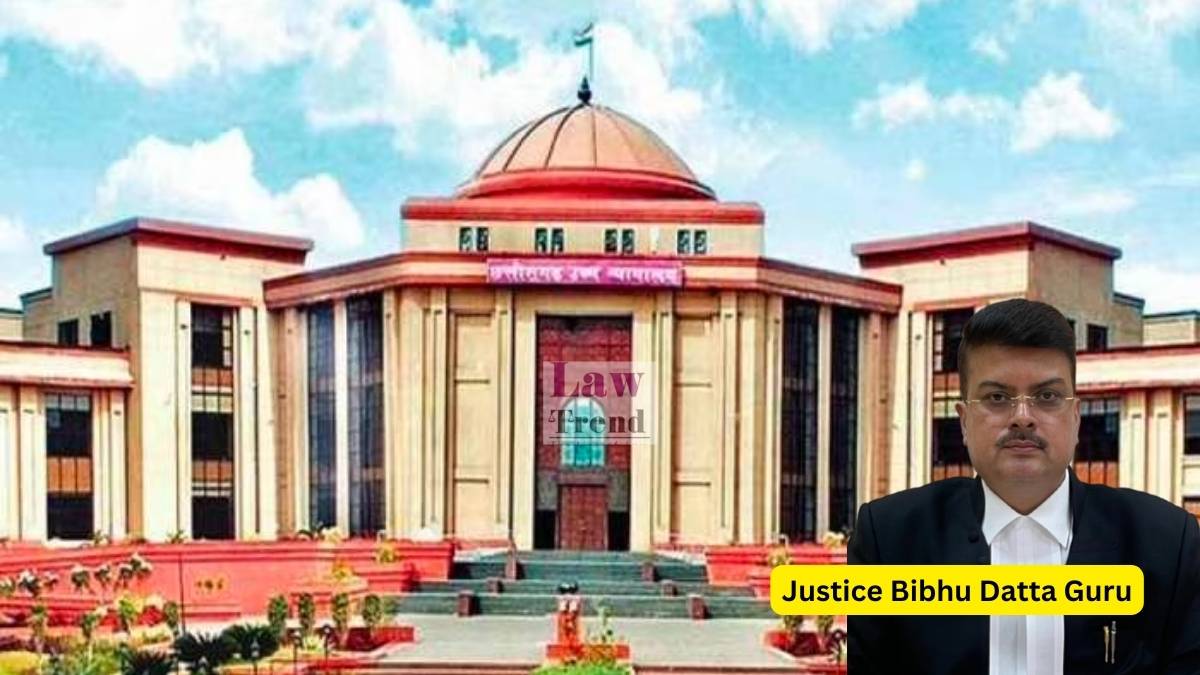
Underlining that constitutional courts cannot usurp legislative or executive functions to mandate the framing of policy or laws, the High Court of Chhattisgarh at Bilaspur, presided over by Justice Bibhu Datta Guru, has held that retired Janpad Panchayat employees have no enforceable statutory right to claim pension in the absence of governing rules. Dismissing a batch of writ petitions seeking the disbursement of monthly pensionary benefits, the Court held that judicial review cannot be used to compel the State to introduce a pension scheme for autonomous local body employees who are governed by a contributory provident fund system.
Background of the Dispute
The batch of writ petitions, led by Urmila Panigrahi and several other superannuated Janpad Panchayat employees, challenged an order dated July 21, 2025, passed by the Director, Directorate of Panchayat and Rural Development, whereby their representations claiming pension were rejected.
The petitioners were appointed under various Janpad Panchayats across districts including Bastar, Dantewada, Raigarh, Bijapur, Mungeli, Bilaspur, Dhamtari, Sakti, Kanker, Durg, Sukma, and Korba prior to the enactment of the Chhattisgarh Panchayat Raj Adhiniyam, 1993. Having served for long periods until their superannuation, the petitioners approached the High Court seeking the quashing of the rejection communication and a writ of mandamus directing the authorities to release monthly pension.
Arguments of the Parties
Appearing for the petitioners, counsel argued that the employees had rendered long, unblemished, and qualifying service before retiring in accordance with applicable rules. It was contended that Section 131 of the Chhattisgarh Panchayat Raj Adhiniyam, 1993 functions as an express saving clause protecting the pay, allowances, pension, and retiral benefits of permanent employees who were in service on the date the Act commenced.
The petitioners further alleged discrimination, submitting that similarly situated employees in Janpad Panchayat Gunderdehi (District Balod) were already drawing monthly pension. Citing the Supreme Court judgments in D.S. Nakara and Others v. Union of India and Janpad Panchayat & Zila Panchayat Karamchari Sangh and Others v. State of M.P. and Others, counsel submitted that pension is an earned property right protected under Article 300-A of the Constitution of India and cannot be withheld arbitrarily.
Opposing the petitions, the Additional Advocate General for the State of Chhattisgarh submitted that the petitioners were employees of autonomous Janpad Panchayats and not government servants appointed to civil services or posts in connection with the affairs of the State. Consequently, the Chhattisgarh Civil Services (Pension) Rules, 1976 do not apply to them. It was further pointed out that neither the 1993 Adhiniyam nor the Panchayat Services (Recruitment and General Conditions of Service) Rules, 1999 provide for any statutory pension scheme.
Referring to the State’s counter-affidavit, the government highlighted that under Rule 40 of the Madhya Pradesh Janpad Panchayat Employee (Qualification, Recruitment and Service Conditions) Rules, 1976 (read with Section 147 of the Madhya Pradesh Panchayat Adhiniyam, 1962), the petitioners were governed by a provident fund scheme. Having availed Contributory Provident Fund (CPF) benefits, they were expressly excluded from the 1976 Pension Rules by virtue of Rule 2(2)(d).
Addressing the parity argument, the State clarified that pension was being paid to three employees in Janpad Panchayat Gunderdehi and three in Janpad Panchayat Takhatpur solely from funds created by localized committee resolutions without any statutory authorization. The Panchayat Department had already issued show-cause notices dated August 27, 2026, and August 31, 2026, to examine the legality of those payments, and the principle of equality cannot be invoked to perpetuate an illegality.
The Court’s Analysis: Separation of Powers and Statutory Limits
Addressing the core legal question of whether courts can order the extension of retiral schemes, Justice Guru emphasized the constitutional boundary dividing the branches of government. Relying on Supreme Court precedents in State of Himachal Pradesh & Others v. Satpal Saini, Supreme Court Employees’ Welfare Assn. v. Union of India, and State of J & K v. A.R. Zakki, the Court observed that a writ of mandamus cannot be issued to direct the legislature to enact a law or the executive to frame subordinate legislation.
The Court cited the Supreme Court’s ruling in V.K. Naswa v. Union of India, quoting:
“18. Thus, it is crystal clear that the court has a very limited role and in exercise of that, it is not open to have judicial legislation. Neither the court can legislate, nor has it any competence to issue directions to the legislature to enact the law in a particular manner.”
Underscoring the principle encapsulated in the headnote of the judgment, the Court observed:
“The doctrine of separation of powers mandates that the Courts be circumspect while directing the executive to adopt a particular policy or the legislature to enact a law in a particular manner.”
The Court explained that the judiciary is one of three co-equal branches and does not formulate policies or sit in judgment over legislative wisdom. Where governing statutory provisions do not confer a particular benefit, courts cannot grant it simply because it is perceived as desirable.
Interpreting Section 131 of the 1993 Adhiniyam, the Court held that it is strictly a saving clause intended to protect pre-existing entitlements; it does not confer a fresh substantive right to pension where no such scheme existed in the service conditions. Turning to the petitioners’ reliance on Article 300-A and the Supreme Court decision in State of Jharkhand & Others v. Jitendra Kumar Srivastava & Another, the Court ruled that while pension is recognized as property, that principle operates only when an employee has an existing entitlement under governing law, rather than establishing a right independently of statutory rules.
Examining the autonomous character of Panchayats, the Court referenced coordinate bench decisions in Hemraj Nishad v. State of Chhattisgarh & Ors. and Om Prakash Parhi v. State of Chhattisgarh & Others, as well as the Madhya Pradesh High Court ruling in Baliram Khedekar v. Panchayat and Rural Development. Rejecting the argument that performing public functions brings local body employees into government service, the Court observed:
“It is noteworthy to mention here that Panchayat employees are not Government servants. Panchayat institutions are autonomous bodies and their employees are governed by the separate recruitment and service rules. Merely because a Panchayat employee performs public functions does not make him a Government servant. The petitioner continued to work in Panchayat service, drew salary from Panchayat funds and was governed by Panchayat rules. Therefore, the claim that they should be extended the benefit of pension is legally unsustainable.”
Distinguishing the decisions in D.S. Nakara and Janpad Panchayat Karamchari Sangh, the Court noted that unauthorized or disputed local fund disbursements in other Janpad Panchayats cannot create a legal right to parity:
“An erroneous or disputed benefit extended by one authority cannot be made the basis for issuing a mandamus contrary to the governing statutory framework.”
Decision
Holding that the petitioners failed to establish any statutory entitlement to pensionary benefits and that the impugned administrative rejection was legally sound, the High Court held all the writ petitions to be devoid of merit and dismissed the entire batch with no order as to costs.
Case Title: Urmila Panigrahi v. State of Chhattisgarh and Others (and connected matters)
Case No.: WPS No. 11820 of 2025 & other connected matters
Bench: Justice Bibhu Datta Guru
Date: October 05, 2026




