

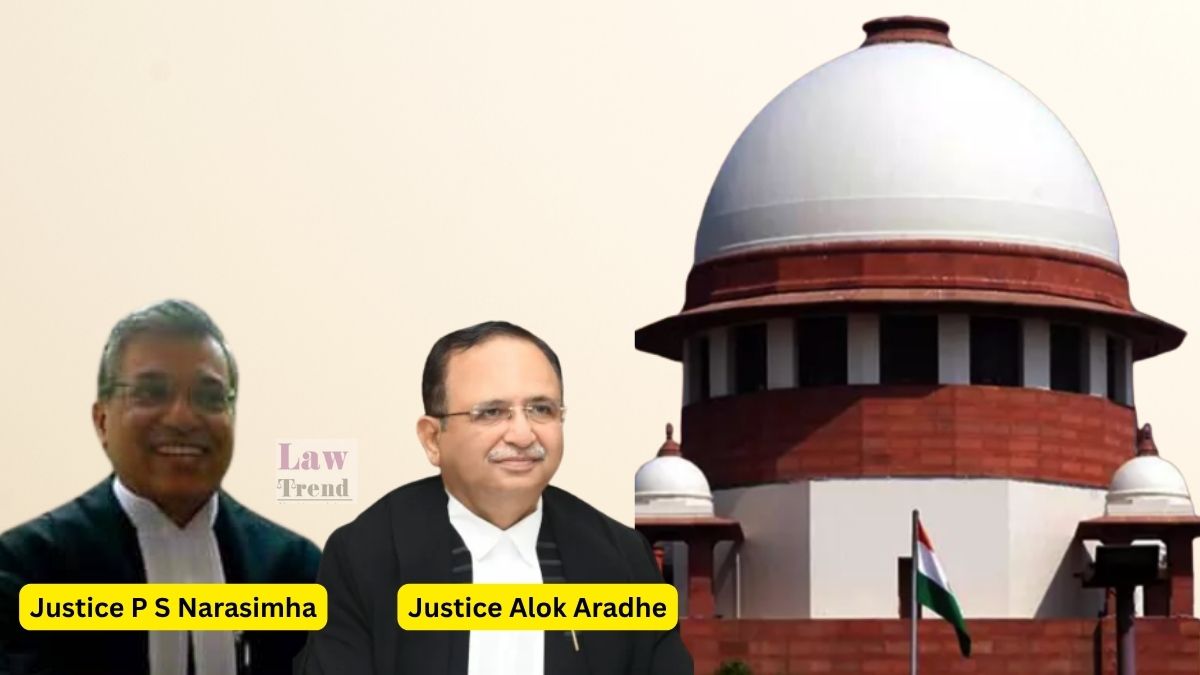
The Supreme Court of India has held that an express contractual clause barring claims for interest on delayed payments disentitles an arbitral tribunal from awarding pre-reference interest under Section 31(7)(a) of the Arbitration and Conciliation Act, 1996. A Bench comprising Justice Pamidighantam Sri Narasimha and Justice Alok Aradhe allowed an appeal filed by North Eastern Electric Power Corporation Limited (NEEPCO), setting aside a judgment of the High Court of Meghalaya that had restored pre-reference interest in favour of Astra Construction Private Limited. The Court ruled that where a contract independently prohibits interest on delays in payment, the arbitral tribunal exceeds its statutory jurisdiction by granting pre-reference interest.
Background of the Dispute
On June 12, 1995, NEEPCO invited tenders for civil works concerning the main plant and auxiliary building of a Gas Turbine Power Project situated at Ram Chandra Nagar, Tripura. Astra Construction’s tender was accepted, leading to the execution of a formal contract on May 23, 1996, valued at Rs. 17,09,26,913/-, with a completion timeline set for March 26, 1997.
Disputes arose during project execution, resulting in an arbitration reference. On June 5, 2015, the Arbitral Tribunal delivered an award attributing the execution delays to NEEPCO. The Tribunal allowed four claims totaling a principal sum of Rs. 3.30 crores, alongside 12% per annum pre-reference interest on each claim, and 9% per annum for pendente lite and future interest.
NEEPCO challenged the award before the Commercial Court under Section 34 of the 1996 Act. On February 15, 2024, the Commercial Court modified the award by setting aside pre-suit and pendente lite interest on Claim Nos. 2, 3, 4, and 5. Relying on Sayeed Ahmed & Company v. State of U.P. & Ors., the Commercial Court found that Clause 54 of the General Conditions of Contract (GCC) barred any grant of interest.
Astra Construction appealed this decision under Section 37 of the 1996 Act before the High Court of Meghalaya at Shillong. On June 19, 2025, the High Court set aside the Commercial Court’s modification and restored the award in its entirety. Relying on the three-judge Bench ruling in State of U.P. v. Harish Chandra and Co., the High Court held that Clause 54 only barred interest on money held up due to a dispute, and did not extend to claims under other heads or interest upon an award itself.
Submissions of the Parties
Appearing for NEEPCO, Solicitor General Tushar Mehta and Additional Solicitor General Raghavendra P. Shankar confined the appeal strictly to the restoration of pre-reference interest. They contended that the bar under Clause 54 was specifically pleaded in the Statement of Defence before the Arbitral Tribunal. They argued that the High Court erred in applying Harish Chandra, which was decided under the Arbitration Act, 1940, while overlooking the settled legal position under the 1996 Act laid down in Sayeed Ahmed and Jai Prakash Associates Limited v. Tehri Hydro Development Corporation Limited (THDC-I). NEEPCO also relied upon Ferro Concrete Construction (India) Pvt. Ltd. v. State of Rajasthan and ONGC v. G & T Beckfield Drilling Services Pvt. Ltd.
Senior Counsel Ritin Rai, representing Astra Construction, countered that NEEPCO had never raised the Clause 54 objection before the Arbitral Tribunal and had therefore waived its right to raise it, citing Union of India v. Susaka Pvt. Ltd. and Ors. He maintained that the High Court had correctly applied Harish Chandra to the wording of Clause 54.
Senior Counsel C.S. Vaidyanathan, appearing for intervenors, supported Astra Construction, contending that Clause 54 only barred interest on money lying with the corporation and did not bar pre-award interest on other heads such as damages. He argued that the phrase “or in any other respect whatsoever” took colour from the preceding words, citing Harish Chandra, Reliance Cellulose Products Ltd. v. ONGC Ltd., and THDC-I.
Legal Trajectory: The 1940 Act Versus The 1996 Act
The Supreme Court examined the legal framework governing an arbitrator’s power to award interest across both regimes.
Under the 1940 Act, which had no express provision on interest, a Constitution Bench in Secretary, Irrigation Department, Government of Orissa and Others v. G.C. Roy had recognized an implied power to award pendente lite interest unless the agreement expressly forbade it. Contractual prohibitions were strictly construed against the party invoking them, as reiterated in Union of India v. Ambika Construction, Ambika Construction v. Union of India, Reliance Cellulose Products Limited, and Ferro Concrete.
Conversely, the Supreme Court noted that Section 31(7)(a) of the 1996 Act altered this balance by explicitly subordinating the tribunal’s power to party autonomy with the opening words “unless otherwise agreed by the parties.” Referring to Pam Developments Private Limited v. State of West Bengal and Another, the Bench observed that an express contractual bar suffices to exclude the power to award interest under the 1996 Act.
Reaffirming the distinction between procedural and substantive claims, the Bench noted:
“It is thus settled, and we reaffirm the position, that pendente lite interest stands on the footing of procedural law, and is governed by Section 31(7)(a). Interest for the pre-reference period stands on a different footing altogether: it is referable to substantive law and cannot be sourced in Section 31(7)(a) alone.”
Court’s Analysis of Clause 54
The core question before the Court was the construction of Clause 54 of the GCC, which provides:
“54.0 No Claim for Delayed Payment due to Dispute Etc. No claims for interest or damages will be entertained by the Corporation with respect to any money or balance which may be lying with the Corporation owing to any dispute, difference or misunderstanding between the Engineer-in-Charge on the one hand and contractor on the other or with respect to any delay on the part of the Engineer-in-Charge making periodical or final payments or in any other respect whatsoever.”
The Supreme Court rejected the High Court’s reliance on Harish Chandra, pointing out that the clause in Harish Chandra restricted the bar to disputes arising during periodical or final payments, covering only money withheld due to a dispute.
In contrast, Clause 54 creates two distinct, independent grounds joined by the word “or”: first, money lying with the Corporation due to a dispute, difference, or misunderstanding; and second, any delay on the part of the Engineer-in-Charge in making periodical or final payments.
Differentiating the clauses, the Supreme Court observed:
“This is not a small drafting difference. By naming delay in payment as a separate ground, standing on its own and not tied to any dispute, Clause 54 does what the clause in Harish Chandra (supra) never did: it expressly shuts out a claim for interest arising from delayed payment, whether or not there was any dispute about it at all. The very situation that fell outside the bar in Harish Chandra (supra), delay in payment, without more, is brought squarely inside the bar in Clause 54. That is the true and complete answer to the High Court’s view that the two clauses say the same thing; they do not, and the difference is decisive.”
The Court underscored that similar two-pronged clauses were interpreted as complete bars to pre-reference and pendente lite interest in Sayeed Ahmed and Jaiprakash Associates Limited v. Tehri Hydro Development Corporation (India) Limited (THDC-II):
“The two clauses are worded differently, and that difference in wording makes all the difference in law. It is the line of decisions in Sayeed Ahmed (supra) and thereafter, not Harish Chandra (supra), that governs this case.”
Addressing the respondent’s plea of waiver, the Bench found that NEEPCO had specifically raised the Clause 54 bar in its Statement of Defence filed before the Arbitral Tribunal on August 23, 2012.
Decision
Holding that the Arbitral Tribunal lacked jurisdiction to grant pre-reference interest in the teeth of Clause 54 of the GCC and Section 31(7)(a) of the 1996 Act, the Supreme Court allowed NEEPCO’s appeal:
“For the foregoing reasons, we are of the considered view that Clause 54 of the GCC bars the grant of interest for the pre-reference period, and that the Arbitral Tribunal, in awarding such interest, exceeded the bounds of its jurisdiction under Section 31(7)(a) of the 1996 Act. The High Court erred in equating Clause 54 with the clause considered in Harish Chandra (supra), and in restoring the grant of pre-reference interest on that basis. The impugned judgment, to the extent it restores the grant of pre-reference interest, cannot be sustained and is accordingly set aside.”
The Court made no order as to costs.
Case Details
Case Title: North Eastern Electric Power Corporation Limited (NEEPCO) v. Astra Construction Private Limited
Case No.: Civil Appeal No. of 2026 (Arising out of SLP (Civil) No. 24803 of 2025)
Bench: Justice Pamidighantam Sri Narasimha and Justice Alok Aradhe
Date: September 22, 2026




