

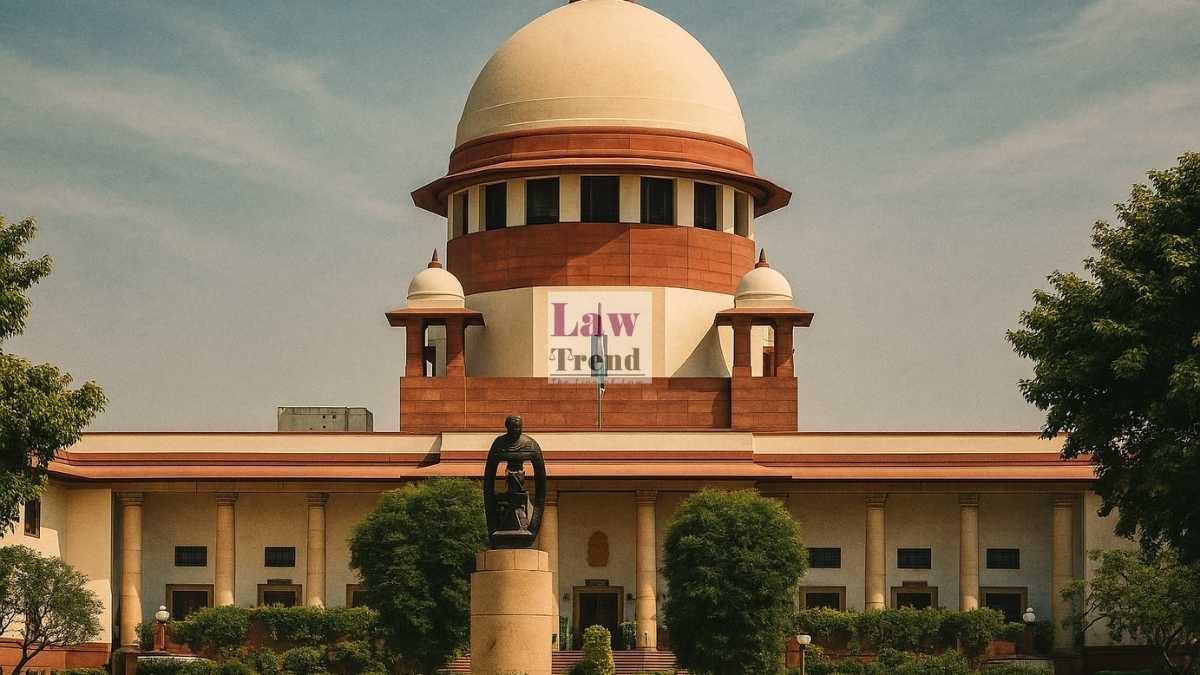
Holding that commercial revenue cannot override mandatory eligibility conditions, the Supreme Court bench comprising Justice K.V. Viswanathan and Justice Alok Aradhe dismissed appeals filed by Micky Traders and the Punjab State Agricultural Marketing Board, affirming the quashing of the tender awarded to the highest bidder for lacking specialized experience. Emphasizing that “a tender begins with competition, but it proceeds upon rules,” the Court ruled that an authority’s interpretation of its own tender must be rooted in the text, declaring that a higher bid of about Rs. 1.5 crore could not validate a non-responsive bid.
Background of the Dispute
The controversy stemmed from a Detailed Notice Inviting Tender (DNIT) issued on February 13, 2026, by the Market Committee, Ludhiana, inviting bids for the recovery and realization of user charges for utilizing Mandi infrastructure by retail and other vehicles carrying fruits, vegetables, and eatables for twelve months from April 1, 2026, to March 31, 2027. The annual reserve price was set at Rs. 12,21,58,500.
Under Clause 11(ix) of the DNIT read with Clause 9(c)(a) of the Punjab State Agricultural Marketing Board’s Instructions for Enlistment of Contractor Firms, bidders were required to furnish completion certificates evidencing “successful execution of annual collecting User Charges/Parking Fees work in Govt./Semi Govt./PSU organizations during last 2 years (upto 31.12.2025).”
Five bidders submitted tenders. The technical bid of Micky Traders (the H1 bidder) was accepted, and its financial bid of Rs. 16,51,51,000 was declared the highest, surpassing the Rs. 15,03,33,000 offer of L.R.Y. Labour Contractor (the H2 bidder). Despite an objection from the H2 bidder asserting that Micky Traders lacked the requisite experience, a Letter of Acceptance (LoA) was issued to Micky Traders on March 20, 2026.
L.R.Y. Labour Contractor approached the High Court of Punjab and Haryana at Chandigarh in CWP No. 8671 of 2026, pointing out that Micky Traders had merely produced certificates reflecting participation as a contractor in cattle fairs between December 16, 2023, and December 15, 2024, rather than two years of specialized experience in collecting user charges or parking fees. On May 27, 2026, a Division Bench of the High Court quashed the technical and financial acceptance of Micky Traders’ bid along with the LoA, directing the authorities to issue an LoA to the eligible tenderer. Both Micky Traders and the Board appealed to the Supreme Court.
Arguments of the Parties
Counsel for Micky Traders contended that the High Court exceeded the limited scope of judicial review by substituting its own interpretation for that of the tendering authority in the absence of mala fides, arbitrariness, or perversity. Relying on Afcons Infrastructure Ltd. v. Nagpur Metro Rail Corpn. Ltd. and Silppi Constructions Contractors v. Union of India, it was argued that the author of the tender is the best judge of its requirements. Counsel submitted that Clause 9(c)(a) should be construed purposively rather than in an ultra-technical, literal manner as held in K.P. Varghese v. Income Tax Officer. It was further argued that enlistment instructions were directory, that the experience of partnership firms should be attributed to their partner or proprietor, and that rejecting the bid would cause a loss of approximately Rs. 1.5 crore in public revenue.
Counsel for the Board and the Market Committee supported Micky Traders, arguing that the enlistment instructions were directory guidelines intended to secure competition and revenue. It was submitted that the High Court ought not to have interfered with the commercial wisdom of the tendering authority, placing reliance on decisions including Jagdish Mandal v. State of Orissa and Galaxy Transport Agencies v. New J.K. Roadways.
Senior Counsel for the H2 bidder countered that Micky Traders produced no certificate proving two years of user charge collection up to December 31, 2025. It was argued that organizing cattle fairs under the Punjab Cattle Fairs (Regulation) Rules, 1968, entails paying rent as a lessee rather than acting as a revenue-collecting agent for a public body. Moreover, the certificates were issued in the names of three different entities with no verified legal nexus to Micky Traders. Counsel highlighted that the Board itself had previously disqualified Micky Traders at Patiala and Rajpura under the exact same clause, submitting that an authority cannot apply a norm as mandatory against one bidder and directory for a favored bidder, citing West Bengal State Electricity Board v. Patel Engineering Co. Ltd. and Ramana Dayaram Shetty v. International Airport Authority of India.
The Court’s Analysis
Analyzing the scope of judicial review, the Supreme Court revisited landmark rulings including Tata Cellular v. Union of India, Sterling Computers Ltd. v. M&N Publications Ltd., Air India Ltd. v. Cochin International Airport Ltd., and Michigan Rubber (India) Ltd. v. State of Karnataka. The bench reiterated that while courts do not sit as an appellate body over technical evaluations, judicial intervention is mandated when an authority’s decision is arbitrary, perverse, or dehors the terms of the tender.
Citing Agmatel India (P) Ltd. v. Resoursys Telecom, the Court observed that deference to the tendering authority is available only where its interpretation is manifestly in consonance with the language of the tender document. Quoting Kimberley Club (P) Ltd. v. Krishi Utpadan Mandi Parishad, the bench underscored:
“In tender matters, the Court exercising judicial review does not sit in appeal over the decision of a tendering authority regarding disqualification of bid. Only in cases where such decision is dehors the terms of the NIT or is patently arbitrary would the Court exercise powers of judicial review and set aside such a decision.”
The Court also invoked Vidarbha Irrigation Development Corporation v. Anoj Kumar Agarwala, emphasizing that essential terms cannot be treated as redundant or waived arbitrarily. The bench laid down that:
“The reading given by an authority to its own tender is ordinarily final, provided that reading is one which the words it has chosen can bear and is not unfair, perverse or arbitrary.”
Applying these principles, the Supreme Court identified three fatal infirmities in the acceptance of Micky Traders’ bid:
- Incidental Collection Versus Specialized Obligation: The Court explained that running a high-volume Mandi contract worth over Rs. 16 crores demands specialized, revenue-facing operations such as gate management, ticketing systems, daily reconciliation, and accounting. In contrast, under the Punjab Cattle Fairs (Regulation) Rules, 1968, a cattle fair organizer is a lessee who pays rent to the authority and levies charges for his own account. The Court noted that treating such incidental charges as equivalent to collecting statutory user charges on behalf of a public body would render the condition meaningless, emptying the clause of the very specialization it was designed to test.
- Unverified Third-Party Certificates: The certificates furnished pertained to three distinct entities—”Shadab Rainder & Company, Rajpura”, “Rajpura, Mukatsar Cattle Fair, Rajpura”, and “Capital Cattle Fair, Rajpura”—and not Micky Traders. The Court observed that no partnership deed or registration under the Indian Partnership Act, 1932, was produced to substantiate the claim that the proprietor of Micky Traders was a partner in those firms, holding that eligibility cannot be established through unverified assertions.
- Inconsistent Conduct and Approbation: The Court noted that Micky Traders had accepted disqualification without challenge under the identical eligibility clause in tenders floated by the Market Committees of Patiala and Rajpura. Ruling that the bidder could not take an opposite stance in Ludhiana, the bench observed:
“A party cannot approbate and reprobate on the meaning of the very same contractual language according to the side of the fence on which it finds itself convenient to stand.”
Addressing the plea that Micky Traders offered Rs. 1.5 crore more than the next bidder, the Court firmly rejected the argument:
“Revenue considerations cannot cure ineligibility. Bids can be compared only among bidders who are eligible to be compared in the first place; to hold otherwise would be to allow every eligibility condition to yield to the highest figure quoted, and would render the tender document, and the enlistment instructions framed to secure competence and accountability in the collection of public revenue, wholly illusory. The public interest that the H1 Bidder invokes is served, not disserved, by holding the Committee to the conditions it has itself prescribed.”
The Court also rejected the contention that the enlistment instructions were directory, stating:
“A condition cannot be mandatory in the abstract and directory only in its application to a favoured bidder.”
Decision
Finding no infirmity in the High Court’s judgment, the Supreme Court held that the Market Committee’s acceptance of Micky Traders’ bid was patently arbitrary and outside the terms of the DNIT. The appeals filed by Micky Traders and the Board were accordingly dismissed with no order as to costs, clearing the way for the contract to be awarded to the eligible tenderer.
Case Details
Case Title: Micky Traders v. L.R.Y. Labour Contractor & Ors.
Case No.: Civil Appeal No. of 2026 (Arising out of SLP (C) No. 22161 of 2026) with Civil Appeal No. of 2026 (Arising out of SLP (C) No. 23127 of 2026)
Bench: Justice K.V. Viswanathan and Justice Alok Aradhe




