

NH Act Acquisitions | Date of Initial Award Determines Applicability of 1894 or 2013 Act for Solatium and Interest: Supreme Court
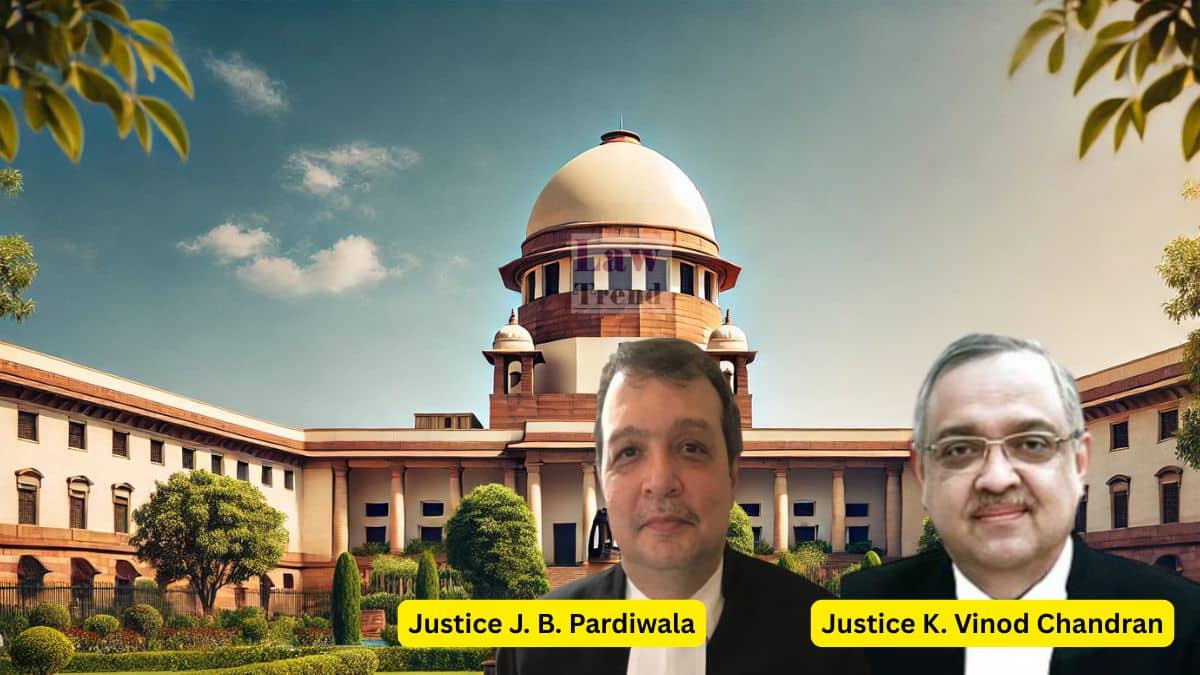
In a significant ruling addressing the interplay between highway land acquisitions and compensation statutes, a Supreme Court bench comprising Justice J. B. Pardiwala and Justice K. Vinod Chandran held that for land acquired under the National Highways Act, 1956, entitlement to solatium, interest, and interest on solatium depends strictly on whether the initial compensation award by the Competent Authority was rendered before or after January 1, 2015. Disposing of the landowner’s appeal, the Court clarified that where the initial determination under Section 3G(1) was made prior to January 1, 2015, the statutory benefits must be calculated under the Land Acquisition Act, 1894, rather than the more beneficial Right to Fair Compensation and Transparency in Land Acquisition, Rehabilitation and Resettlement Act, 2013.

Background of the Dispute

The appellant, Manav Bhanot, owned land that was acquired by the National Highway Authority of India (NHAI) under the National Highways Act, 1956 (NH Act). The preliminary acquisition notification under Section 3A of the NH Act was published in the Official Gazette on June 7, 2011, and in newspapers on July 1, 2011. Following the consideration of objections, the declaration under Section 3D(1) was published on January 20, 2012, followed by a notice for determination of compensation issued on September 1, 2012.

On July 11, 2014, the Competent Authority, NH-7 and Sub-Divisional Officer, Jabalpur, passed an order determining total compensation of Rs. 3,47,38,287/-, out of which the appellant received Rs. 49,17,000/- on October 13, 2014. Disputing the quantum, the appellant sought reference before the Arbitrator, who issued an arbitral award on May 17, 2017 (noted also as January 13, 2016 in Annexure P5). Subsequent challenges filed under Section 34 and Section 37 of the Arbitration and Conciliation Act, 1996, eventually led to the appeal before the Supreme Court.

Submissions of the Parties

Senior Counsel Harin P. Raval, appearing for the appellant-landowner, relied on Union of India & Another v. Tarsem Singh & Others (Tarsem Singh-II). Citing Paragraph 19 of that judgment, counsel contended that the Supreme Court had previously refused prospective operation of Union of India & Another v. Tarsem Singh & Others (Tarsem Singh-I) specifically to avoid an arbitrary distinction between a landowner whose land was acquired on December 31, 2014, and one whose land was acquired on January 1, 2015—the date an Ordinance extended the Act of 2013 to NH Act acquisitions. The appellant asserted entitlement to full benefits under the Act of 2013. In the alternative, the appellant urged that since the Arbitrator’s award was rendered after January 1, 2015, the 2013 Act should govern. Furthermore, relying on a Ministry of Road Transport and Highways notification (Clause 4.6(c)), the appellant argued that compensation should follow the First Schedule of the 2013 Act if the majority of landowners were not paid by December 31, 2014.

Senior Counsel Ankur Mittal, representing the NHAI, conceded that under the court’s established precedents, landowners under the NH Act are undisputedly entitled to solatium, interest on compensation, and interest on solatium. However, he argued that the computation rate depended on the governing statute at the time of the award. Because the Act of 2013 was made applicable to NH Act acquisitions only with effect from January 1, 2015, and the Competent Authority had passed the compensation award on July 11, 2014, the benefits must be computed exclusively under the Act of 1894. The NHAI relied on National Highways Authority of India v. Tarsem Singh & Others (Tarsem Singh-III) and pointed out that out of 3.080 hectares acquired, compensation for 1.700 hectares had already been disbursed in 2014 itself, satisfying the majority landholding criterion.

READ ALSO  Chhattisgarh High Court’s Proactive Interventions in 2024: Transforming Public Welfare Through Suo Motu Cognizance

The Court’s Analysis

The Supreme Court examined the evolution of the NH Act and the judicial precedents reconciling it with the 1894 and 2013 enactments. Tracing the 1997 amendments to the NH Act, the bench observed that Section 3J had previously excluded the application of the Act of 1894, but was struck down as unconstitutional under Article 14 in Tarsem Singh-I.

Analyzing the temporal application of the 2013 Act, the Court noted Section 105, which initially exempted enactments listed in the Fourth Schedule (including the NH Act) from the 2013 Act for one year, subject to extension. By Ordinance 9 of 2014 (extended by Ordinance 5 of 2015 and subsequent notification), the provisions of the 2013 Act relating to compensation, rehabilitation, and resettlement were applied to the Fourth Schedule enactments with effect from January 1, 2015.

READ ALSO  Transfer on Lack of Jurisdiction Cannot be Sought Before Leading Evidence: SC

Addressing the appellant’s reliance on past rulings, the Court observed:

“Tarsem Singh-II does not lay down as a proposition that solatium and interest before 01.01.2015 would also have to be computed based on the provisions under the Act of 2013, not even from its effect, i.e.: 01.01.2014; since for the acquisitions under the NH Act, the Act of 2013 came into effect only from 01.01.2015. That benefits of solatium and interest are due to even landowners whose lands are acquired on or before 01.01.2015, is unimpeachable, however, the entitlement would be determined as to whether the ‘award’ was passed before or after 01.01.2015; if before, the entitlement will be under the Act of 1894 and if after, under the Act of 2013.”

The Court then addressed what constitutes an “award” under the NH Act scheme in comparison to the Act of 1894 and Section 24(1)(a) of the Act of 2013, drawing support from the Constitution Bench ruling in Indore Development Authority v. Manoharlal and Others. The bench concluded:

“The determination made by the Competent Authority of the compensation under sub-section (1) of Section 3G and the determination of the dispute raised under sub-section (5), by the Arbitrator, under the NH Act are respectively in the nature of the award passed under Section 11 and the determination by a Civil Court, on a reference made to it under Section 18 of the Act of 1894.”

Synthesizing this framework, the bench ruled:

“If a determination of compensation has not been made before 01.01.2015, then necessarily the Act of 2013 was to apply. But if a determination of compensation is made by the Competent Authority under the NH Act before 01.01.2015, even if it is after 01.01.2014 solatium interest and interest of solatium would be payable under the Act of 1894.”

Rejecting the appellant’s plea regarding the Ministry notification, the Court clarified that Clause 4.6(c) applied where compensation had not been paid in respect of the majority of “land holdings,” not “landowners.” As the NHAI established that compensation for 1.700 hectares out of 3.080 hectares was paid in 2014, the notification provided no relief to the appellant.

Decision of the Court

The Supreme Court allowed the appeal partly, confirming that while the appellant is entitled to solatium, interest, and interest on solatium on the compensation determined by the Arbitral Award, the same must be computed under the provisions of the Land Acquisition Act, 1894, because the initial award was passed on July 11, 2014. The matter was remanded to the Competent Authority for computation and disbursal by the government.

READ ALSO  Important Cases Listed in the Supreme Court on Monday

Case Title: Manav Bhanot v. National Highway Authority of India
Case No.: Civil Appeal No. of 2026 (Arising out of SLP (C) No. 27541 of 2024)
Bench: Justice J. B. Pardiwala and Justice K. Vinod Chandran
Date: September 08, 2026

Law Trend
Law Trendhttps://lawtrend.in/
Legal News Website Providing Latest Judgments of Supreme Court and High Court

Related Articles

Latest Articles
