

‘Falsus in Uno, Falsus in Omnibus’ Does Not Apply in India: Supreme Court Reverses Acquittal of Two in Murder Case
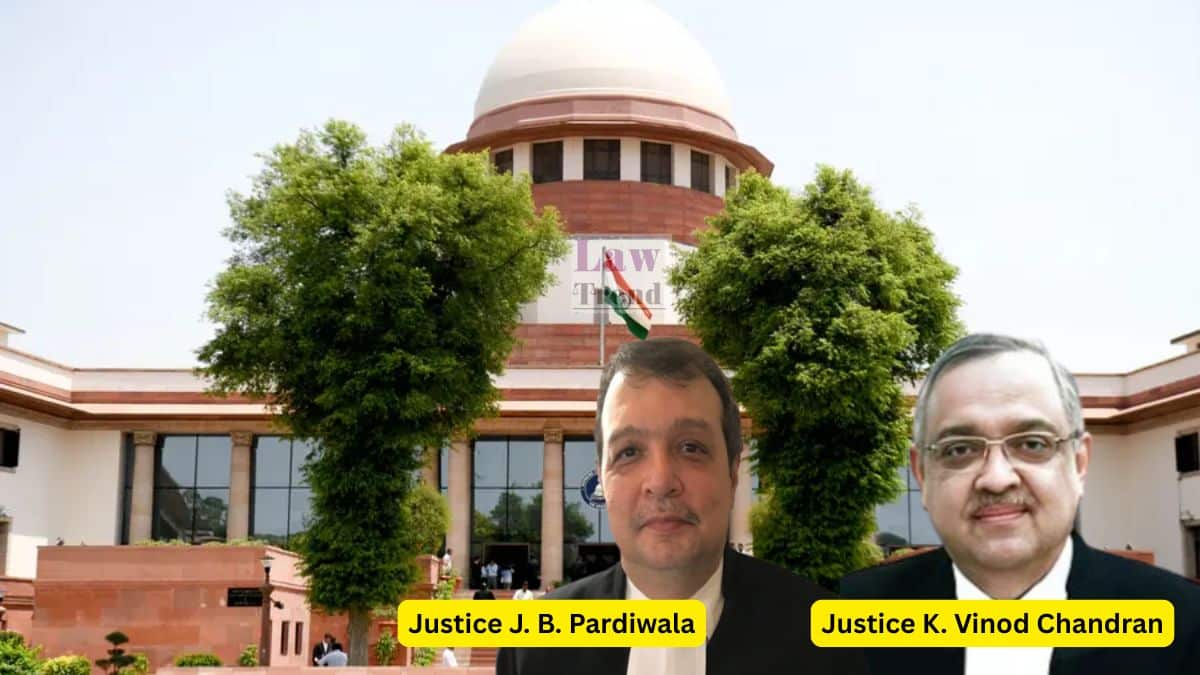
Addressing the scope of vicarious criminal liability under Sections 34 and 149 of the Indian Penal Code, 1860, and the evidentiary assessment of eyewitness testimonies, the Supreme Court of India bench comprising Justice J. B. Pardiwala and Justice K. Vinod Chandran set aside the High Court’s acquittal of two accused who caught hold of a victim and exhorted the shooter during an ambush, while sustaining the acquittal of another co-accused due to a lack of substantive evidence. The Court restored the conviction and sentence awarded by the Trial Court against accused Nagendra Singh (A6) and Dalpratap Singh (A12), while dismissing the appeal seeking the conviction of Rajeev Lochan Singh (A13) and ten other acquitted persons.

Background of the Case

The prosecution case arose from an incident where seventeen persons were accused of ambushing three brothers of a family and killing one of them, Virender Singh. According to the prosecution, the deceased along with PW1 (Santosh Singh), PW8, PW10, PW11, PW12, PW18, and another brother were sitting near their family barn when Ajeet Singh alias Babbe Singh (A1), accompanied by A8 and A9, arrived, hurling abuses and threats. When the victim and his companions walked home, they were ambushed near their house at around 8:00 PM on March 9, 2004, by seventeen persons.

During the assault, PW1 was struck with a lathi and sustained injuries to his left eye and head. A 15-year-old nephew witnessed the scuffle and raised an alarm, bringing PW2 (wife of PW1), PW6 (wife of PW8), and the victim’s mother to the scene. Despite pleas for mercy from the mother, A1 shot Virender Singh dead at close range. The mother of the victim died almost simultaneously following the shooting, out of shock or suicide.

Of the seventeen accused, three were absconding, and their trial was split up. The Trial Court tried fourteen accused, ultimately convicting four—A1, A6, A12, and A13—under Sections 302 and 148 of the Indian Penal Code, while acquitting the remaining ten. A13 had been summoned during the trial under Section 319 of the Code of Criminal Procedure, 1973 (CrPC).

On appeal, the High Court confirmed the conviction and sentence only against A1, who fired the fatal shot. The High Court acquitted A6, reasoning that shooting at close range would have injured anyone holding the victim, and acquitted A12 on the ground that an oral exhortation could not be reliably identified at night. The High Court also acquitted A13, holding that his mere presence with a double-barrel gun without firing an overt shot could not attract common intention under Section 34 or common object under Section 149 of the Indian Penal Code. Appeals were subsequently filed by the injured complainant, PW1, before the Supreme Court challenging the acquittals.

READ ALSO  Allahabad High Court Seeks Explanation From Family Court Judge For Granting Maintenance To Major Son Till Marriage

Arguments of the Parties

Appearing for the appellant (injured complainant), Senior Counsel contended that the eyewitnesses spoke in tandem and provided consistent, cogent accounts regarding the presence and specific roles of A6, A12, and A13 within the unlawful assembly. It was argued that the medical evidence was fully consistent with the ocular testimonies. The appellant submitted that both the Trial Court and the High Court had misapplied Section 149 of the Indian Penal Code by acquitting several accused purely on the flawed premise that no specific overt acts were attributed to them, despite their unequivocal presence in the unlawful assembly.

In defense, the accused argued that PW1’s presence was doubtful because his employment attendance marked him “on duty” on March 8, 9, and 10. The defense further contended that the prosecution witnesses were close relatives and interested witnesses, whereas independent local witnesses had turned hostile. It was highlighted that there was no seizure or recovery of weapons, no ballistic or forensic examination, and that several witness statements under Section 161 CrPC omitted critical details later introduced in Court. Regarding A13, the defense submitted that his name was omitted by several witnesses during the initial trial proceedings before he was summoned under Section 319 CrPC, and that he had pleaded an alibi of taking his daughter to an examination at Piparjhar. For A12, the defense argued that an exhortation could not be identified in the dark and confusion of a melee.

The Court’s Analysis

Delivering the judgment, Justice K. Vinod Chandran examined the medical and ocular evidence in detail. The Court noted that the testimony of PW3 (the Doctor) unequivocally established death by a firearm injury, recovering thirty-four pellets, a plastic cap, and packaging material lodged inside a 20 cm deep wound that traveled “right-downward-posterior” on the left sternum. PW1’s presence was independently corroborated by his sustained lathi injuries recorded in Exhibit P5. The Court dismissed the defense’s objection regarding PW1’s work attendance sheet, observing that marking daily-wage workers present in their absence, while a practice to be deprecated, did not negate PW1’s established presence and contemporaneous injuries.

Addressing the discrepancy alleged between the Dehati Merg Intimation (Exhibit P1) and the First Information Statement (Exhibit P2), the Court pointed out that PW1 had provided a detailed statement naming seventeen accused at the Naudihwa Police Outpost at 11:00 PM on the night of the incident itself, ruling out any fatal inconsistency.

READ ALSO  "उन्हें अपने घर ले जाएं": सुप्रीम कोर्ट ने आवारा कुत्तों के हमलों पर राज्यों को दी मुआवजे की चेतावनी, फीडर्स की जिम्मेदारी भी होगी तय

Evaluating witness reliability, the Court exercised caution regarding related witnesses PW2, PW6, and PW8 due to significant omissions between their Section 161 statements and court depositions, but found the testimonies of PW1, PW10, and PW11 to be credible and natural.

On the specific roles of the accused:

  1. Rajeev Lochan Singh (A13): The Supreme Court expressly disapproved of the High Court’s view that an armed person’s presence cannot attract Section 34 or Section 149 without firing a shot, observing that armed presence in an unlawful assembly can rope an accused into vicarious liability. However, on reviewing the record, the Supreme Court noted that PW10 and PW11 categorically denied A13’s presence, the First Information Statement made no mention of A13 carrying a gun or issuing threats, and witnesses had only introduced his name after he was summoned under Section 319 CrPC. Hence, due to the absence of substantive evidence, his acquittal was maintained.
  2. Nagendra Singh (A6): The Court rejected the High Court’s reasoning that holding the victim would necessarily cause injury to the holder as a mere surmise unsupported by expert evidence. Because the postmortem established that the bullet and pellets entered the body without exiting, “There is hence no possibility of a person holding on to the victim sustaining any injury.” The Court affirmed that whether A6 held down or dragged the victim was inconsequential, as his overt act clearly established common intention.
  3. Dalpratap Singh (A12): The Court found that A12’s exhortation to fire was consistently recorded from the inception in the First Information Statement and reiterated in court. Rejecting the claim of darkness, the Court noted that houses in the locality were electrified and the accused were well known to the witnesses, making voice and visual identification reliable.
READ ALSO  Hearing on Umar Khalid's bail plea in UAPA case adjourned to Jan 31 by SC

Addressing the false implication or omnibus inclusion of other accused due to a 6-7 year long-standing enmity, the Court observed:

“The principle of ‘falsus in uno, falsus in omnibus’ is not applicable to India and as has been famously held, here, the Courts have a duty to separate the grain from the chaff in analyzing evidence.”

The Court held that an attempt to rope in other individuals against whom only omnibus allegations were made without assigned roles did not warrant disbelieving the credible testimonies implicating A1, A6, and A12.

Decision of the Court

The Supreme Court allowed the appeal against the acquittal of Nagendra Singh (A6) and Dalpratap Singh (A12), setting aside the High Court’s order and restoring the conviction and sentence passed against them by the Trial Court.

The Court sustained the acquittal of Rajeev Lochan Singh (A13) and dismissed the appeal challenging the acquittal of the other accused persons. The appeal filed against A1 was rejected as unnecessary since his conviction and sentence had already been upheld.

The Court granted A6 and A12 two weeks’ time to surrender before the Sessions Court to serve their sentences, failing which the Sessions Court was directed to take appropriate steps to apprehend them.

Case Title: Santosh Singh v. The State of Madhya Pradesh and Ors. With Criminal Appeal No. 1306 of 2022

Case No.: Criminal Appeal Nos. 1303-1305 of 2022 with Criminal Appeal No. 1306 of 2022

Bench: Justice J. B. Pardiwala and Justice K. Vinod Chandran

Date: September 08, 2026

Law Trend
Law Trendhttps://lawtrend.in/
Legal News Website Providing Latest Judgments of Supreme Court and High Court

Related Articles

Latest Articles
