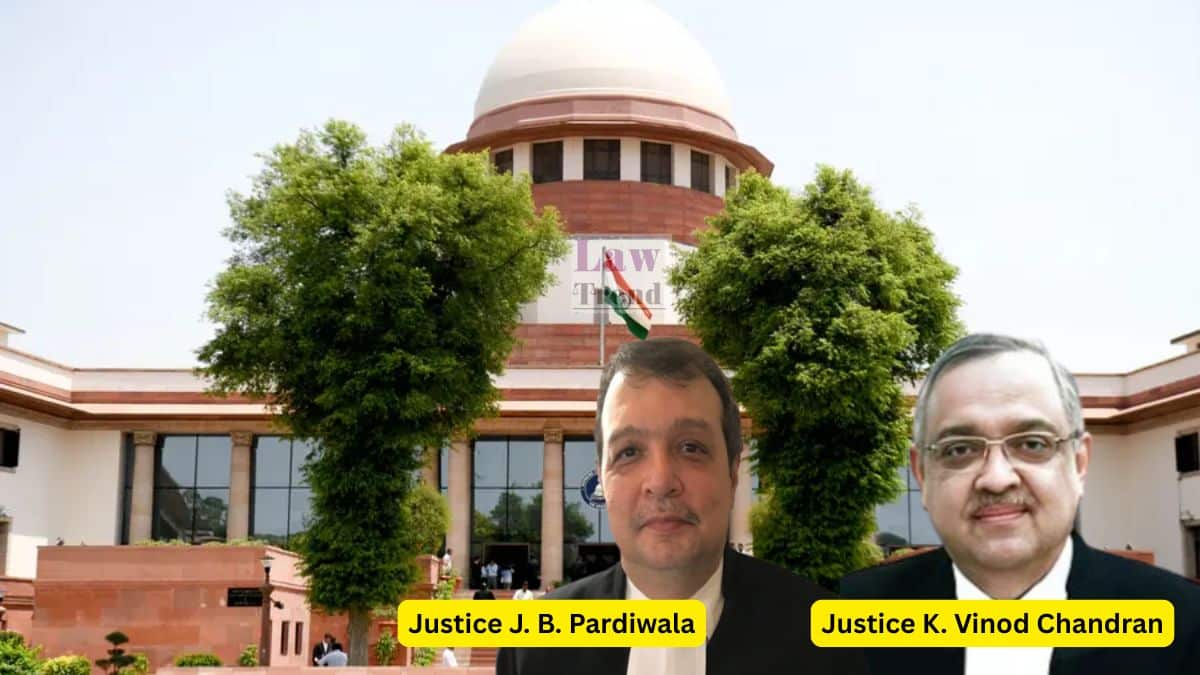
The Supreme Court bench comprising Justice J. B. Pardiwala and Justice K. Vinod Chandran has ruled that a conviction under Section 13(1)(d) of the Prevention of Corruption Act, 1988 read with Section 120B of the Indian Penal Code cannot be sustained in the absence of any finding that the accused obtained a pecuniary advantage. Setting aside the conviction of a store-in-charge in a 1993 case involving alleged bogus medicine supplies to the Assam Veterinary Department, the apex court acquitted the appellant after noting that the High Court had specifically recorded that no valuable thing or pecuniary advantage was obtained by the accused.
Background of the Case
The criminal proceedings originated from a complaint lodged by the Veterinary Department of the State of Assam regarding an alleged loss of Rs. 5,97,200/-. The loss was said to have been occasioned through the submission of false RCC Bills for medicines that were never actually supplied, while payments were released to a fictitious firm.
Following an investigation by the Central Bureau of Investigation (CBI), seven persons were charge-sheeted. The trial court convicted and sentenced four individuals and acquitted three. On appeal before the High Court, the accountant who passed the bills was acquitted. However, the High Court convicted the appellant, who served as the in-charge of the store, alongside the storekeeper under Section 13(1)(d) read with Section 13(2) of the Prevention of Corruption Act and Section 120B of the Indian Penal Code.
The specific allegation against the appellant was that entries had been made in the store register by the storekeeper and subsequently certified by the appellant as the store-in-charge, acknowledging the receipt of medicines that were never delivered. While the High Court found that the medicines were never received, it explicitly noted that there was no evidence on record showing that the appellant or the storekeeper had obtained any valuable thing or pecuniary advantage from the commission of the offence. Consequently, the High Court acquitted them of offences under Sections 420, 471, 465, and 477A of the IPC, but sustained their conviction under the Prevention of Corruption Act.
Arguments Before the Supreme Court
Appearing for the appellant, Senior Counsel Sri Siddharth Dave contended that in the absence of any pecuniary advantage obtained by the accused, the conviction under Section 13(1)(d) could not stand. It was further submitted that the alleged incident dated back to 1993, and if no pecuniary advantage was obtained, the department could have initiated disciplinary proceedings and quantified the loss, which had not been done.
Additional Solicitor General Ms. Aishwarya Bhati appeared on behalf of the respondent, Central Bureau of Investigation, defending the prosecution’s case.
Court’s Analysis and Key Observations
Examining the statutory ingredients of Section 13(1)(d) of the Prevention of Corruption Act, 1988, the Supreme Court held:
“Without a pecuniary advantage, there could be no conviction under Section 13(1)(d), which the High Court has categorically found, does not exist in the present case.”
The bench observed that while the evidence could potentially have been construed to attract provisions under the IPC—specifically Sections 420 and 477A—the High Court had acquitted the accused under those sections. The CBI failed to challenge that acquittal, meaning the benefit of that finding necessarily had to inure to the accused.
The court also expressed serious concern regarding the manner in which corruption trials are conducted, particularly the introduction of excessive and non-germane evidence:
“We cannot but notice that in corruption cases voluminous evidence is led, which is often intimidating to the Court, especially since many aspects attempted to be led in evidence are way off the mark, in providing a substantiation of the allegation, or to bring home the guilt of the accused-public servant.”
The bench pointed out that the prosecution had examined 62 witnesses, yet the High Court referred to only nine—eight dispensary in-charges who testified that supplies were not received, and the actual owner of the supplier firm, who testified that he neither supplied medicines nor received money. The court highlighted that no investigation was carried out to trace the money trail once the funds were disbursed from the department.
Remarking on systemic delays, the court added:
“Prosecution in corruption cases have a history of long pendency; especially because of the voluminous evidence led, which often is unnecessary and as we noticed, mostly irrelevant.”
Decision
Finding no legal basis to uphold the conviction under Section 13(1)(d) of the Prevention of Corruption Act, the Supreme Court allowed the appeal and set aside the conviction. The court directed that the appellant be acquitted and released forthwith if in custody (and not required in any other case), or that his bail bonds be cancelled if already on bail.
Case Details:
Case Title: Khanindra Kr. Dutta v. Central Bureau of Investigation
Case No.: Criminal Appeal No. 1882 of 2024
Bench: Justice J. B. Pardiwala and Justice K. Vinod Chandran
Date: September 08, 2026