

Section 98(2) Of Gujarat Prohibition Act Not An Absolute Embargo On Releasing Seized Vehicles: Supreme Court
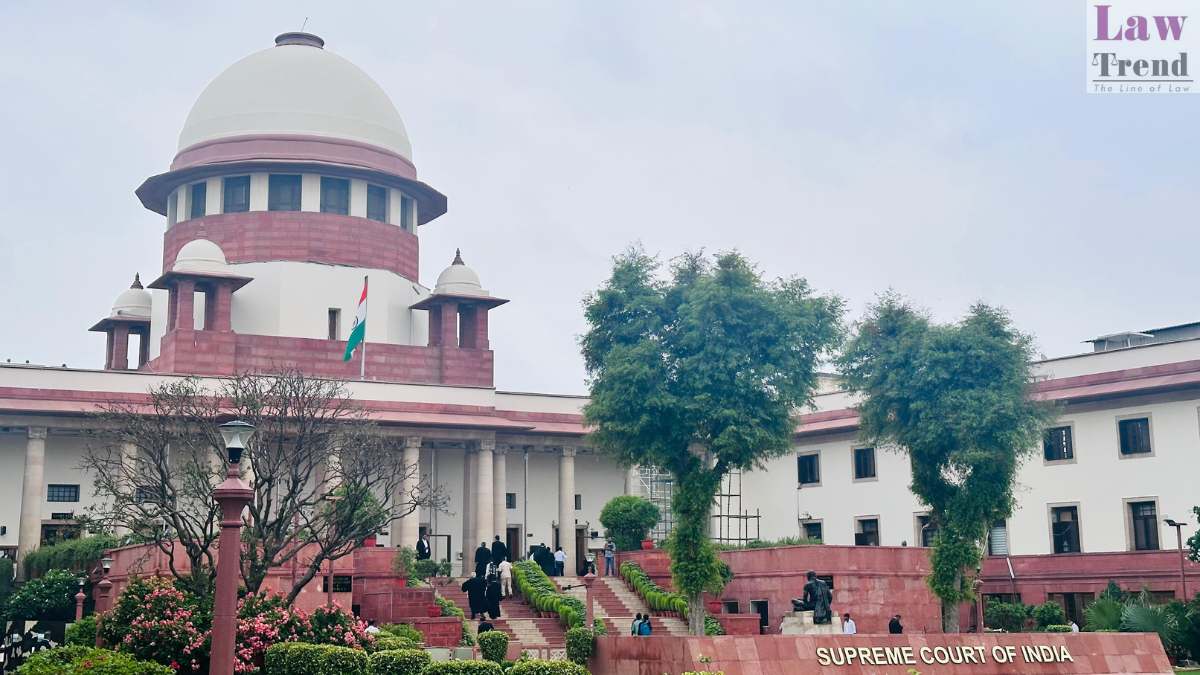
The Supreme Court of India has held that Section 98(2) of the Gujarat Prohibition Act, 1949, does not create an absolute statutory embargo against the interim release of seized vehicles, ruling that trial courts must exercise their discretionary powers under the Code of Criminal Procedure, 1973 (CrPC) to prevent vehicles from deteriorating in police compounds pending trial. Setting aside the concurrent orders of the Gujarat High Court and the lower courts, a Bench comprising Justice Prashant Kumar Mishra and Justice Shree Chandrashekhar directed the interim release of an Ashok Leyland truck seized with a massive consignment of prohibited liquor, subject to conditions including a personal bond and security of Rs 15 lakh.

Background of the Case

The case originates from an interception during the intervening night of January 4–5, 2025. An Ashok Leyland truck bearing registration RJ-14-GQ-22692, owned by M/S ABC Express, was intercepted while travelling from Modasa towards Vadodara via Lunawada. The truck was being driven alone by one Qasid Mohammad Khan, who claimed the vehicle was ferrying miscellaneous transport goods belonging to the appellant company.

Upon opening the rear doors, police discovered plastic bags, plastic boxes, and khaki cardboard boxes containing Indian-Made Foreign Liquor (IMFL). As the driver could not produce a valid pass or permit, the vehicle and driver were taken into custody and brought to the Local Crime Branch office. An inventory prepared before panch witnesses revealed 8,064 bottles containing approximately 22,532.253 litres of IMFL valued at Rs 17,02,656, alongside legitimate edible transport goods worth Rs 98,66,552.

Following the seizure, CR No. 11187006250007/2025 was registered at Police Station Lunawada, District Mahisagar, for offences punishable under Sections 65(a), 65(e), 98(2), 81, 116(b), and 83 of the Prohibition Act. The police subsequently filed a charge-sheet on March 1, 2025, against four accused persons, including the driver.

The appellant company moved Muddamal Application No. 7 of 2025 before the Chief Judicial Magistrate, Lunawada, seeking interim custody of the truck under Section 497 of the Bharatiya Nagarik Suraksha Sanhita, 2023 (BNSS). The Magistrate rejected the plea on May 22, 2025, and this order was affirmed by the Sessions Judge, Mahisagar at Lunawada, on August 7, 2025. A further challenge before the High Court of Gujarat under Articles 226 and 227 of the Constitution and Section 528 of the BNSS was dismissed on September 9, 2025, prompting the appeal before the apex court.

READ ALSO  Whether Government is Bound to Accept the Highest Bid in an Auction? Answers Supreme Court

Arguments of the Parties

The appellant contended that the truck was a commercial business vehicle seized from the driver, and that the owner had no involvement in the alleged offence. It was submitted that the trial could take four to five years to conclude, and having remained parked at the police station for more than a year, the vehicle was actively deteriorating. The appellant affirmed its willingness to furnish adequate security to secure interim custody.

On the other hand, counsel appearing for the State of Gujarat argued that under the provisions of Section 98(2) of the Prohibition Act (as amended), the seized vehicle could not be released on bond or surety because the quantity of seized liquor exceeded prescribed limits. The State maintained that the trial court, the Sessions Court, and the High Court had correctly rejected the interim custody application.

Court’s Analysis and Precedents

Addressing the rival submissions, the Supreme Court observed that the lower courts committed a serious error by taking an overly narrow view of their powers under Sections 451, 457, 458, and 459 of the CrPC. The Court stressed that keeping seized property at police stations indefinitely serves no useful purpose and inflicts major financial injury on owners.

Relying on the precedent in Khengarbhai Lakhabhai Dambhala v. The State of Gujarat (2024), the Bench examined the interplay between Section 98 and Section 132 of the Prohibition Act vis-à-vis Section 451 of the CrPC. The Court cited its findings in Khengarbhai:

“Sub-section (1) of Section 98 deals with the articles liable to confiscation, whenever any offence punishable under the Act has been committed. However, sub-section (2) of Section 98 is in two parts. The first part upto the conjunctive word ‘but’, states about the confiscation of the articles like receptacle, package or covering and about the confiscation of the animals, carts, vessels or any other conveyances used in carrying any such article, and the second part starting with the conjunctive word ‘but’ is perceived to be an embargo against release of the conveyance used for carrying the article liable to be confiscated if the quantity of the seized liquor carried in such conveyance is more than the prescribed quantity, till the final judgment of the court… applying the doctrine of harmonious construction, we will have to harmonise the provisions contained therein with the other provisions of the Act and with the provisions contained in the Cr.P.C.”

The Court also cited Khengarbhai to emphasize:

READ ALSO  Plaintiff Can’t Seek Return Of Court Fees and Plaint After Suit Is Dismissed: Kerala HC

“Section 451 of the Cr.P.C. would come into play when the article property seized during the course of inquiry or investigation is produced before the jurisdictional Court as per Clause (a) of Section 132 and the Court is called upon to pass appropriate orders for the proper custody of such article/property pending the conclusion of the inquiry or the trial.”

Reiterating the three-Judge Bench decision in Basavva Kom Dyamangouda Patil (Smt.) v. State of Mysore and Another (1977), the Court quoted:

“The object and scheme of the various provisions of the Code appear to be that where the property which has been the subject-matter of an offence is seized by the police it ought not to be retained in the custody of the Court or of the police for any time longer than what is absolutely necessary. As the seizure of the property by the police amounts to a clear entrustment of the property to a Government servant, the idea is that the property should be restored to the original owner after the necessity to retain it ceases. It is manifest that there may be two stages when the property may be returned to the owner. In the first place it may be returned during any inquiry or trial. This may particularly be necessary where the property concerned is subject to speedy or natural decay.”

The Bench further relied upon Sunderbhai Ambalal Desai v. State of Gujarat (2002) and General Insurance Council and Others v. State of Andhra Pradesh and Others (2010), citing from the latter:

“It is a matter of common knowledge that as and when vehicles are seized and kept in various police stations, not only they occupy substantial space of the police stations but upon being kept in open, are also prone to fast natural decay on account of weather conditions. Even a good maintained vehicle loses its road worthiness if it is kept stationary in the police station for more than fifteen days. Apart from the above, it is also a matter of common knowledge that several valuable and costly parts of the said vehicles are either stolen or are cannibalised so that the vehicles become unworthy of being driven on road….”

The Court clarified that the precedents cited by the High Court did not apply: State of Madhya Pradesh v. Uday Singh (2020) pertained to the Indian Forest Act, 1927, where Section 52-C specifically ousted court jurisdiction upon intimation of confiscation, while Multani Hanifbhai Kalubhai v. State of Gujarat and Another (2013) arose under the Gujarat Animal Preservation Act, 1954 and did not pertain to confiscation. In contrast, the Prohibition Act contemplates its own confiscation procedure including notice, hearing, and the option to pay a fine in lieu thereof, which cannot preclude interim custody.

READ ALSO  Making Baseless Accusations of Adultery, Fornication, and Coerced Prostitution by a Woman against Her Husband is Mental Cruelty: Patna HC

The Decision

The Supreme Court concluded that continued seizure caused ongoing loss of livelihood to the appellant, occupied space, and left the vehicle to decay without serving any evidentiary purpose, particularly when the charge-sheet had already been filed. The Court held that remaining evidentiary value could be preserved through panchnama, photography, and videography.

Allowing the appeal, the Court set aside the impugned orders and directed the release of the vehicle to the appellant subject to:

  1. Furnishing a personal bond and appropriate security of Rs 15,00,000 to the satisfaction of the Trial Court.
  2. Giving an undertaking to produce the truck before the Investigating Officer or the Trial Court whenever directed.
  3. Not alienating or creating any third-party interest in the vehicle during the pendency of the trial.
  4. Preparation of a detailed panchnama, photographs, and videography of the vehicle’s condition by the Investigating Officer in the presence of the appellant’s representative and two independent witnesses before handover.
  5. In the event the vehicle is ordered to be confiscated upon conclusion of the trial under Section 98(2), liberty to the Trial Court to proceed against the security furnished or auction the vehicle as permitted by law.
  6. Abiding by any further conditions imposed by the Trial Court.

The Court clarified that its observations are strictly confined to the issue of interim custody and shall not be construed as an expression of opinion on the merits of the pending criminal trial.

Case Title: M/S ABC Express v. State of Gujarat

Case No.: Criminal Appeal No. 4172 of 2026 (Arising out of S.L.P. (Crl.) No. 10301 of 2026)

Bench: Justice Prashant Kumar Mishra and Justice Shree Chandrashekhar

Date: September 02, 2026

Law Trend
Law Trendhttps://lawtrend.in/
Legal News Website Providing Latest Judgments of Supreme Court and High Court

Related Articles

Latest Articles
