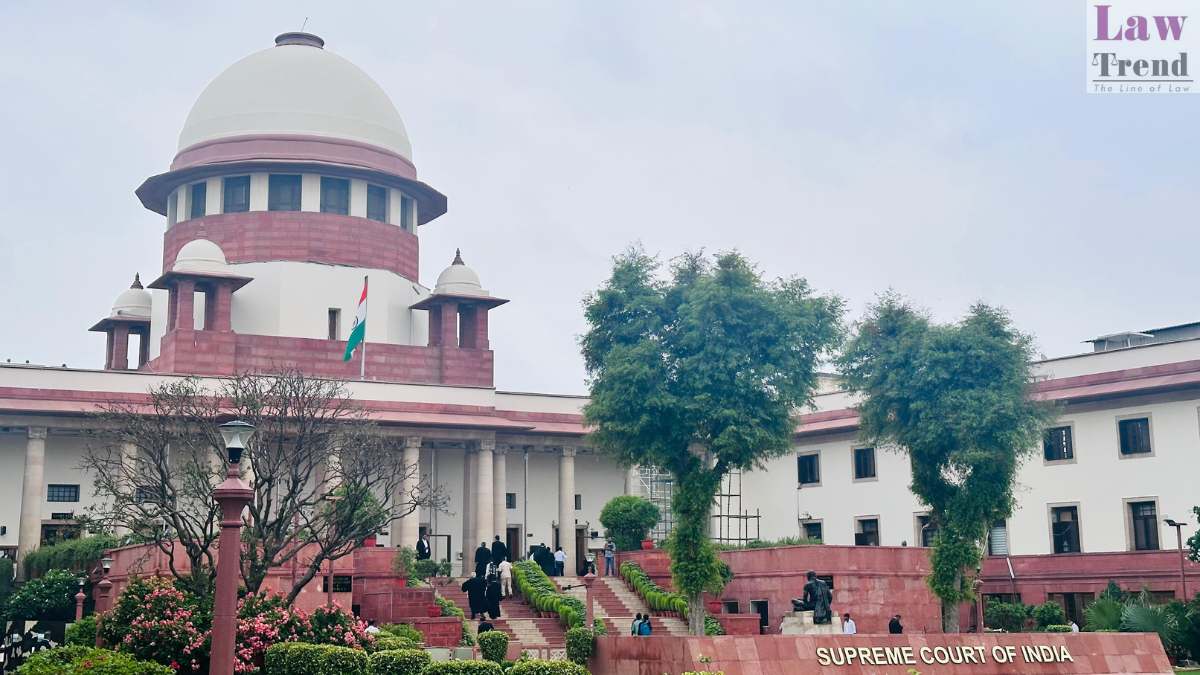
The Supreme Court of India, comprising a bench of Justice Prashant Kumar Mishra and Justice Shree Chandrashekhar, has ruled that employees regularized after long ad-hoc or daily-wage service are entitled to count their pre-regularization service as qualifying service for pensionary benefits, thereby bringing them under the pre-2004 Old Pension Scheme. Dismissing an appeal filed by the Punjab School Education Board against its regularized employees, the apex court affirmed the decisions of the Single Judge and Division Bench of the Punjab and Haryana High Court, holding that administrative or artificial breaks in service must be ignored and treated as continuous.
Background of the Dispute
The Punjab School Education Board (PSEB), an autonomous statutory body constituted under the Punjab School Education Board Act, 1969, initially engaged the respondent-employees as Clerks and Peons between 1993 and 1996 on a contract, ad-hoc, daily-wage, or work-charge basis for 89-day stints.
Following a protracted history of litigation over regular appointments and terminations, the Government of Punjab issued a notification on January 23, 2001, revising its policy for regularizing work-charged, daily-wage, and other categories of workers who had completed three years of service. Although the High Court initially held in 2001 that government instructions did not automatically bind the autonomous Board unless adopted, the Board subsequently constituted a committee to examine the issue.
On July 9, 2004, the committee recommended adopting the government policy dated January 23, 2001, as a one-time humanitarian measure on a mutatis mutandis basis for employees in service as of that date with three years of service. The Board accepted this recommendation on July 13, 2004, issued a public notice on July 18, 2004, and issued appointment letters starting in August 2004.
Following their regularization, the employees claimed pension under the Old Pension Scheme. On November 28, 2011, the Board sought the State Government’s approval to extend the old scheme. However, on December 9, 2011, the State Government declined the request on the ground that the Defined Contributory Pension Scheme had taken effect on January 1, 2004. The Board subsequently accepted the mandatory applicability of the new contributory scheme, prompting the employees to approach the High Court. Both the Single Judge and the Division Bench ruled in favor of the employees, holding that they had indeed been regularized and were entitled to count their pre-regularization service toward retiral benefits.
Arguments of the Parties
Before the Supreme Court, the appellant-Board contended that the prior rounds of litigation operated as res judicata against the employees. The Board also argued that the engagements in August 2004 constituted fresh appointments rather than regularization, pointing out that the employees were issued “appointment” letters, had to qualify a typewriting test, undergo a one-year probation period, and submit medical fitness certificates. The Board further maintained that as an autonomous body, it was governed by the Defined Contributory Pension Scheme post-January 1, 2004.
On the other hand, the respondent-employees argued that the mere nomenclature of “appointment” letters did not displace the continuous service relationship subsisting since the 1990s. They contended that their services were regularized strictly pursuant to the policy dated January 23, 2001. Relying on past precedents, they asserted that pre-regularization service rendered on a contract, ad-hoc, or daily-wage basis must be counted toward qualifying service for retiral benefits. Because their initial entry into service preceded January 1, 2004, they argued they fell under the old pension framework.
The Court’s Analysis
The Supreme Court rejected the Board’s preliminary plea of res judicata, noting that previous litigations pertained to the claim for regularization itself, whereas the present dispute concerned the pensionary consequences arising out of the regularization subsequently effected.
Addressing the nature of the engagement, the bench affirmed that “the substance of the respondent-employees’ engagement must prevail over its form.” The Court observed that the public notice issued on July 18, 2004, was not open to the general public but merely invited objections to appointing existing workers on a regular basis against permanent vacant posts. The Court also highlighted the Board’s own communication dated October 20, 2011, to the State Government, wherein the Board acknowledged that the employees were regularized after rendering long service and had been recruited well prior to January 1, 2004.
Examining Regulations 3, 5(i), and 8(2) of the Punjab School Education Board (Employees’ Pension, Provident Fund and Gratuity) Regulations, 1991, the Court reiterated the settled legal position on retiral entitlements. Citing the Constitution Bench ruling in D.S. Nakara & Others v. Union of India, the Court underscored that “pension is neither a bounty nor ex-gratia payment but a payment for the past service rendered.” Justice Prashant Kumar Mishra observed:
“The Constitution Bench of this Court in D.S. Nakara (supra) had also rightly observed that payment of pension is a social welfare measure rendering socio-economic justice. As the abovementioned provisions, too, codify, pension is a deferred wage that must be assessed and paid on the basis of the service rendered by the employee. When an employee has rendered long and continuous service, and stands ultimately regularized, denial of pensionary benefits based on technicalities or artificialities is generally unjustified.”
The bench approved the High Court’s reliance on Harbans Lal v. The State of Punjab & Others (which had relied on the Full Bench decision in Kesar Chand v. State of Punjab), where it was established that daily-wage service rendered prior to regularization must be counted as qualifying service for pension. Dealing with interruptions in engagement, the Court observed:
“The breaks in service were either ‘notional’ or artificial/administrative breaks, or precipitated by Court orders. They must be ignored and the service should be treated as continuous.”
The Court held that the Board’s autonomous status offered no defense, as it had voluntarily adopted the government regularization policy mutatis mutandis. Requirements such as probation or typing tests merely reflected adapted procedural conditions rather than fresh appointments.
Decision of the Court
Holding that the decisions of the Single Judge and the Division Bench were legally sound, the Supreme Court held that the employees were regularized and entitled to be treated as having entered service prior to January 1, 2004.
The Court affirmed that the employees fall under Tier II of the Defined Contributory Pension Scheme, retaining the discretion to choose either the old General Provident Fund (GPF) pension scheme or the new scheme. Consequently, the Supreme Court dismissed the appeal filed by the Punjab School Education Board with no order as to costs.
Case Details
Case Title: Punjab School Education Board and Another v. Satnam Singh and Others
Case No.: Civil Appeal No. 6865 of 2022
Bench: Justice Prashant Kumar Mishra, Justice Shree Chandrashekhar
Date: September 08, 2026