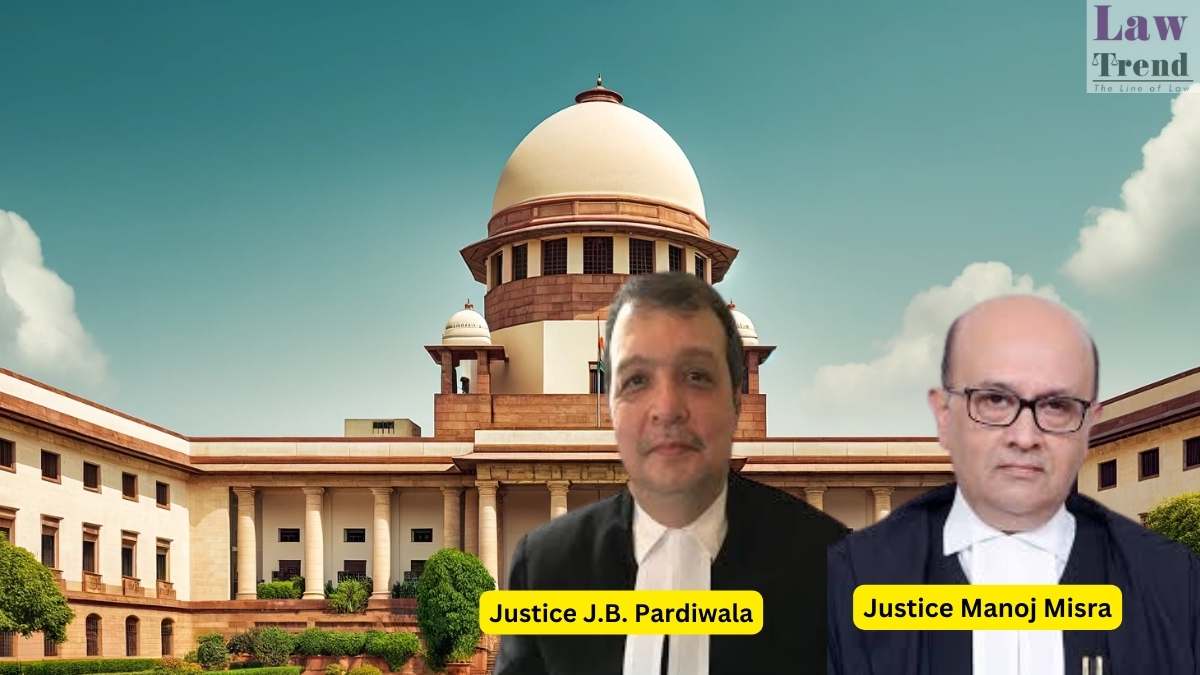
In a significant ruling on environmental regulatory procedures, a Supreme Court bench comprising Justice J.B. Pardiwala and Justice Manoj Misra has held that prior land allotment or procurement is not a mandatory condition precedent for submitting a Form 1 application to seek Terms of Reference (ToR) under the Environmental Impact Assessment Notification, 2006 (EIA, 2006). Setting aside a National Green Tribunal (NGT) order that had quashed the environmental clearances granted to a bio-medical waste facility in Sambhal district, Uttar Pradesh, the top court ruled that mere identification of prospective sites suffices at the initial stage, with proof of land acquisition status becoming essential only at the final appraisal stage.
The dispute arose after the Principal Bench of the NGT on July 5, 2024, quashed the fresh Environmental Clearance (EC) and Consent to Establish (CTE) granted on December 20, 2023, to M/s Punahchakran Private Limited for setting up a Common Bio-medical Waste Treatment Facility (CBWTF) at the UPSIDC Industrial Area, Babrala, District Sambhal. The appellant had originally applied to the Uttar Pradesh State Industrial Development Authority (UPSIDA) for plots E-25 and E-26 (aggregating 0.89 acres) and applied for a ToR before the Uttar Pradesh State Environment Impact Assessment Authority (UP SEIAA) in Form 1 on August 11, 2021.
Although UPSIDA initially rejected the allotment for a CBWTF and re-allotted the plots to the appellant for “fabrication of industrial equipment”, the appellant subsequently secured an EC and CTE in 2022. However, the NGT in Aniruda Panwar v. Ministry of Environment, Forests and Climate Change set aside these initial clearances on July 31, 2023, holding that land procurement was a condition precedent and that the plots did not satisfy the one-acre requirement under Clause 7 of the Revised Guidelines for Common Bio-Medical Waste Treatment and Disposal Facilities, 2016 (RG, 2016). The NGT, however, granted liberty to re-apply after procuring additional land or seeking relaxation in accordance with law.
Following this, UPSIDA approved the change in land use to a CBWTF on September 19, 2022. The Central Pollution Control Board (CPCB), in consultation with the Uttar Pradesh Pollution Control Board (UPPCB), granted relaxation of the one-acre plot requirement to 0.89 acres on November 17, 2023, attaching stringent conditions including zero liquid discharge, real-time online continuous emission monitoring (OCEMS), and odour controls. Relying on the original ToR issued on August 17, 2021, UP SEIAA granted a second EC, and UPPCB granted a second CTE on December 20, 2023. Aggrieved by these permissions, respondent competitor Indotech Waste Solution challenged them before the NGT, which once again set them aside on July 5, 2024, holding the approvals vitiated by malice in law and ruling that Babrala was a Nagar Panchayat with a population under 25 lakhs, making it ineligible for land relaxation under Clause 7(b) of the RG, 2016.
Before the Supreme Court, Senior Counsel Shyam Divan, appearing for the appellant, argued that the industrial area is situated in a rural area under Village Noorpur, Noorpur Gram Panchayat, and not within Babrala Nagar Panchayat limits. He contended that the first ToR remained valid for four years under Ministry of Environment, Forest and Climate Change (MoEF&CC) Office Memorandums, was never quashed by the NGT, and that the authorities had duly applied their mind. Opposing the appeal, Senior Counsel Pinaki Misra, appearing for Indotech Waste Solution, submitted that under Clause 8(vi) of EIA, 2006 and the ruling in Hanuman Laxman Aroskar v. Union of India, concealment or false statements regarding land in Form 1 vitiate the entire clearance exercise from its inception. He maintained that land procurement was an indispensable prerequisite and that the relaxation granted by CPCB suffered from complete non-application of mind.
Addressing the nature of the RG, 2016, the bench rejected arguments drawing on Gulf Goans Hotels Company Limited v. Union of India to suggest that guidelines lack the force of law without gazette notification. The court observed that the RG, 2016 was issued under the statutory framework of the Environment (Protection) Act, 1986 and the Bio-Medical Waste Management Rules, 2016 (BMWM Rules). Citing B.K. Srinivasan v. State of Karnataka, the court held that where parent statutes and rules are silent on the mode of publication, publication via official websites is sufficient: “Neither the EP Act nor the BMWM Rules prescribe a strict mode of publication for the RG, 2016. Undeniably, we would fall under the third-type of scenario as per the decision in B.K. Srinivasan (supra). Therefore, publication in the Official Gazette, although the general rule, cannot be said to be a sine qua non. We are of the view that publication of such technical guidelines i.e. the RG, 2016, on the official website of the CPCB was reasonably sufficient.”
Examining the permissibility of the land relaxation, the bench relied on official reports submitted by the District Magistrate, Sambhal, which confirmed that the facility was located in Village Noorpur, 2.6 km outside the municipal limits of Babrala Nagar Panchayat. Consequently, the precondition of being located in a “rural area” under Clause 7(b) was fully satisfied.
Analyzing the procedural thresholds of land acquisition, the court synthesized Clause 6 of the EIA, 2006, the MoEF&CC Office Memorandum dated October 7, 2014, and Clause 2 of the RG, 2016. The bench clarified that the regulatory scheme contemplates differing standards at different milestones: “Clause 6 of the EIA, 2006 states that an application in Form 1 can be made after the identification of prospective site(s). Therefore, land allotment cannot be said to be a pre-condition for the making of an application under Form 1.”
The court further explained that while identification suffices at the Form 1 stage, a credible document demonstrating intent to transfer or allotment status is strictly necessary when the State Expert Appraisal Committee (SEAC) and SEIAA undertake Stage 4 appraisal. Addressing the relation between CTE and EC under the Water Act, Air Act, and MoEF&CC’s order dated September 20, 2021, the bench held that while an EC is a mandatory prerequisite for obtaining a Consent to Operate (CTO), land allotment is not a strict condition precedent for applying for or obtaining a CTE.
Regarding the reliance on the first ToR, the Supreme Court distinguished the case from Hanuman Laxman Aroskar, holding that the appellant’s omission was connected to the appraisal stage rather than the initial scoping data. The court held that quashing an EC does not mechanically extinguish a valid ToR: “Hence, when the EC is set-aside in such cases, the applicant must not be required to mechanically restart the process, particularly when going to the starting line virtually adds nothing to the procedure and is purely redundant. We must be alive to the costs and delay that would accompany such a pointless restart.”
Citing Bengaluru Development Authority v. Sudhakar Hegde, the court observed that ToRs possess an operative validity of four years under prevailing MoEF&CC circulars to account for environmental dynamism. As the baseline data was neither challenged nor outdated, the grant of the second EC on the basis of the first ToR was legally valid.
Concluding that the NGT committed an egregious error, the Supreme Court allowed the appeal and set aside the Tribunal’s judgment dated July 5, 2024, thereby restoring the environmental clearance and consent granted to the appellant.
Case Details:
Case Title: M/s Punahchakran Private Limited v. Indotech Waste Solution & Ors.
Case No.: Civil Appeal No. 7367 of 2024
Bench: Justice J.B. Pardiwala, Justice Manoj Misra
Date: September 7, 2026