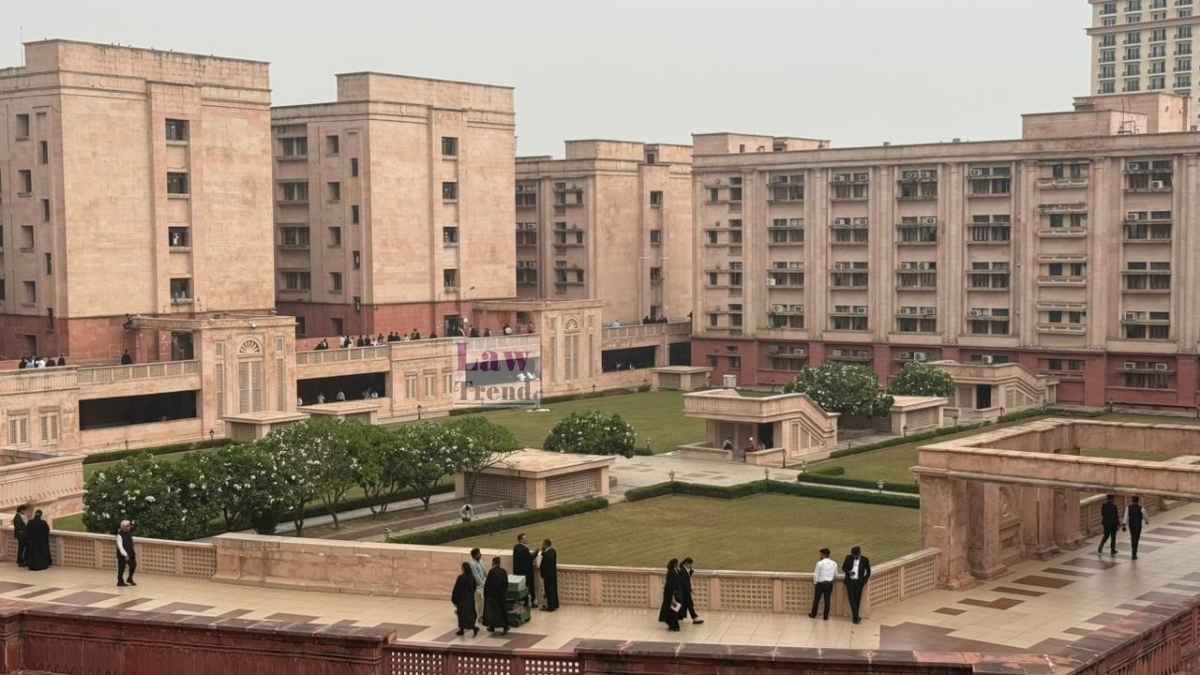
The Allahabad High Court, presided over by Justice Subhash Vidyarthi at its Lucknow Bench, has held that an order framing charges passed by a Special Court under the National Investigation Agency (NIA) Act is not an interlocutory order. Consequently, the High Court dismissed a petition filed under Article 227 of the Constitution of India challenging such an order, ruling that the aggrieved party must pursue the statutory remedy of filing an appeal before a Division Bench under Section 21 of the NIA Act.
Background of the Case
The petitioner, Satendra Siwal, had filed a petition under Article 227 of the Constitution of India challenging an order dated October 10, 2024, passed by the Special Judge, NIA, Lucknow, in Sessions Trial No. 2126 of 2024 (arising out of Case Crime No. 2 of 2024).
The underlying case was registered at Police Station ATS, District Lucknow, under Section 121-A of the Indian Penal Code (IPC) and Sections 3, 5, and 9 of the Official Secrets Act, 1923. The petitioner specifically challenged the trial court’s order to the extent that it framed charges against him under Section 121-A IPC.
Arguments of the Parties
At the outset, Shiv Nath Tilhari, learned A.G.A.-I appearing for the State of U.P. and the U.P. Anti-Terrorist Squad, raised a preliminary objection regarding the maintainability of the petition. He contended that the petitioner had an available statutory remedy of filing an appeal under Section 21 of the NIA Act before a Division Bench of the High Court, rendering the petition under Article 227 non-maintainable. To support his argument, he relied on Supreme Court decisions in Madhu Limaye v. State of Maharashtra, Sanjay Kumar Rai v. State of U.P., and Asian Resurfacing of Road Agency Private Limited v. Central Bureau of Investigation.
Replying to the objection, Prashant Tiwari, counsel for the petitioner, argued that a four-judge bench of the Supreme Court in V.C. Shukla v. State had established that an order framing charges is an interlocutory order. He submitted that Section 21 of the NIA Act explicitly bars appeals against interlocutory orders. He further noted that this principle was followed by Division Benches of the Delhi High Court in Shahid Yusuf v. NIA, the Jammu & Kashmir and Ladakh High Court in Ayaz Ahmad v. Union Territory of J&K, and the Gauhati High Court in Londhoni Devi v. State through National Investigating Agency. Therefore, he argued, an Article 227 petition before a Single Judge was maintainable.
Court’s Analysis and Reasoning
The core legal issue addressed by the High Court was whether an order passed by a Special Court under the NIA Act framing charges under Section 121-A IPC constitutes an interlocutory order within the meaning of Section 21 of the NIA Act.
Analyzing the precedents, the Court noted that V.C. Shukla was decided in the context of the repealed Special Courts Act, 1979, where Special Courts were presided over by sitting High Court Judges, and appeals lay directly to the Supreme Court. The majority judgment in V.C. Shukla had explicitly observed:
“We feel that one reason why no appeal was provided against an interlocutory order like framing of the charges, as construed by us so far as the Act is concerned, may have been that it would be against the dignity and decorum of the very high status which the Special Judge under the Act enjoys in trying the case against an accused in that the Judge is a Sitting Judge of a High Court and therefore must be presumed to frame the charges only after considering the various principles and guidelines laid down by other High Courts and this Court in some of the cases referred to above.”
Applying the principles laid down by a Constitution Bench in P.S. Sathappan v. Andhra Bank Ltd., the Court observed that a judgment is an authority for what it decides in light of its specific statutory context. The framework of the Special Courts Act, 1979 differed substantially from Section 21 of the NIA Act, where Special Courts are presided over by Sessions Judges and appeals lie to a Division Bench of the High Court.
Addressing the precedent conflict, the Court highlighted that a three-judge bench of the Supreme Court in Asian Resurfacing of Road Agency (P) Ltd. v. CBI had examined and explained the earlier decision in V.C. Shukla, ruling:
“Thus, we declare the law to be that order framing charge is not purely an interlocutory order nor a final order….”
To resolve which decision governs, the Court applied the rule laid down in Iveco Magirus Brandschutztechnik GMBH v. Nirmal Kishore Bhartiya:
“The other course available is to look at whether the previous decision has been noticed, considered and explained in the subsequent decision; if not, the earlier decision continues to remain binding whereas if the answer is in the affirmative, the subsequent decision becomes the binding decision.”
Because the three-judge bench in Asian Resurfacing explicitly considered and explained V.C. Shukla, the subsequent view holds the field. This position was further reaffirmed by another three-judge bench in Sanjay Kumar Rai v. State of U.P., which noted:
“The correct position of law as laid down in Madhu Limaye, thus, is that orders framing charges or refusing discharge are neither interlocutory nor final in nature and are, therefore, not affected by the bar of Section 397(2) CrPC.”
The Court held that the Division Bench rulings of the Gauhati, Jammu & Kashmir and Ladakh, and Delhi High Courts relied upon by the petitioner had applied V.C. Shukla without considering how it was subsequently explained in Asian Resurfacing.
Decision of the Court
The High Court concluded that an order framing charges is not an interlocutory order. Since Section 21 of the NIA Act only prohibits appeals against interlocutory orders, a statutory appeal is maintainable against a charge-framing order before a Division Bench of the High Court.
The Court held that entertaining an Article 227 petition before a Single Judge Bench while a statutory appeal lies before a Division Bench would lead to a breach of judicial discipline. Accordingly, the petition under Article 227 was dismissed, leaving it open for the petitioner to challenge the charge-framing order by filing an appeal under Section 21 of the NIA Act before a Division Bench.
Case Title: Satendra Siwal Versus State of U.P. Thru. Prin. Secy. Home Lko. and 2 others
Case No.: Matters Under Article 227 No. 4289 of 2026
Bench: Justice Subhash Vidyarthi
Date: August 13, 2026