

Lok Adalat Cannot Determine Entitlement to Land Acquisition Compensation Merely on Basis of Physical Possession: Supreme Court
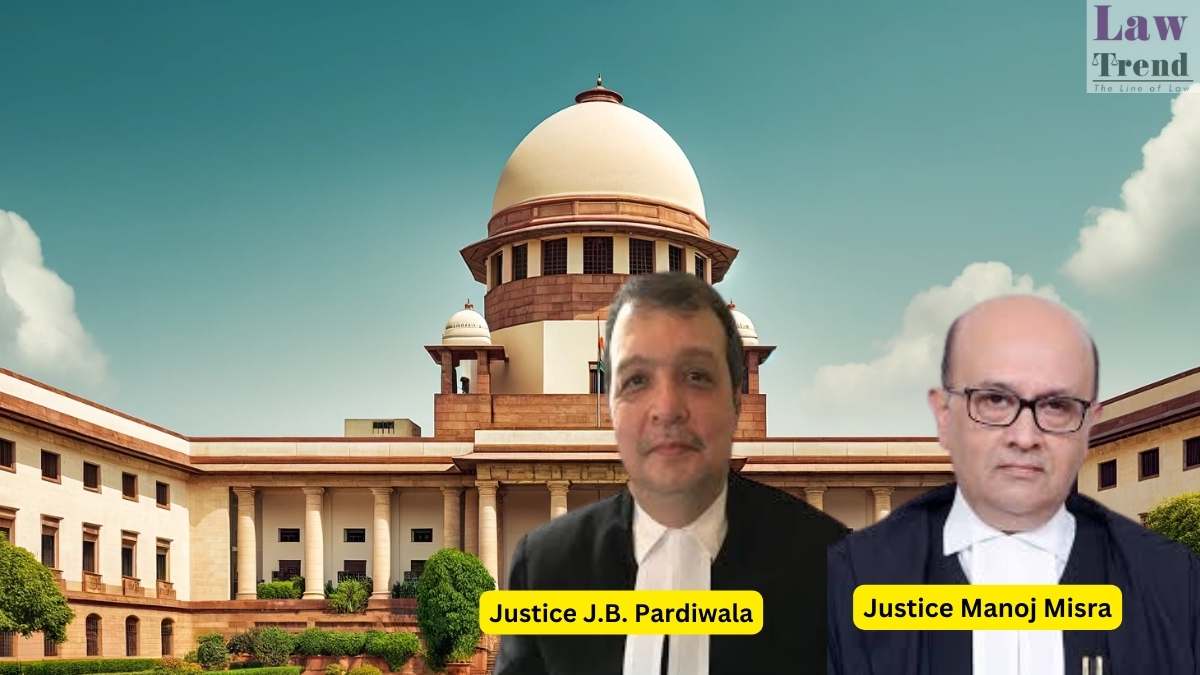

The Supreme Court of India, in a bench comprising Justice J.B. Pardiwala and Justice Manoj Misra, has held that an “enjoyment survey” reflecting mere physical possession cannot establish legal title or determine entitlement to land acquisition compensation. Setting aside a judgment of the High Court of Telangana, the apex court ruled that a Lok Adalat lacks the jurisdiction to adjudicate disputed title questions or pass compensation apportionment awards without the consent and signatures of all interested claimants, and that proceedings involving rival title claims cannot be treated as a class action suit under Order I Rule 8 of the Code of Civil Procedure, 1908 (CPC).

Background of the Case

The case stems from the acquisition of Acre 489.04 guntas of land in Kommepalli, Sathuapalli Mandal, by the Special Deputy Collector (Land Acquisition) for mining operations by Singareni Collieries Company Ltd. (SCCL). Notifications under Section 4(1) of the Land Acquisition Act, 1894 were issued on December 19, 2010. On December 30, 2013, the Land Acquisition Officer determined compensation at Rs. 3,48,935/- per acre under Section 11 of the 1894 Act. Due to title disputes and apportionment issues among claimants, the matter was referred to the Principal District Judge, Khammam, under Sections 30 and 31 of the 1894 Act, numbered as LAOP No. 619 of 2014.

Landowners challenged the acquisition before the High Court in a writ petition (W.P. No. 13942 of 2013). During pendency, SCCL proposed a settlement, and the matter was referred to the High Court Legal Services Committee (HCLSC). Claimants agreed to receive Rs. 10,95,000/- per acre as enhanced compensation. In a coordination meeting on May 30, 2015, parties agreed to conduct an “enjoyment survey” based on title deeds and resolve disputes through Lok Adalat.

On March 29, 2016, the Lok Adalat Bench at Khammam passed 16 awards covering Ac. 363 guntas in LAOP No. 619 of 2014. Subsequently, the High Court disposed of the initial writ petitions as settled in Lok Adalat.

However, appellants filed a second writ petition (W.P. No. 21315 of 2017) seeking to set aside the 16 Lok Adalat awards, contending that they were excluded from the settlement, did not sign the awards, and that the Land Acquisition Officer failed to ascertain true entitlement. On November 28, 2017, the Principal District Judge, Khammam, sent a letter to the High Court clarifying that all disputed title holders were neither made parties nor were signatories to the awards, and that the Lok Adalat passed awards as if the dispute was between the Land Acquisition Officer and individual claimants, misunderstanding the directions for the enjoyment survey.

READ ALSO  [COVID19 Suo Motu] Supreme Court Cannot be Mute Spectator During National Crisis: SC

Despite this letter, the High Court dismissed the writ petition on August 17, 2022, holding that the appellants produced no title documents, the awards were passed pursuant to consent and enjoyment survey, and the proceedings before Lok Adalat were akin to a class action suit under Order I Rule 8 of the CPC. Aggrieved, the appellants appealed to the Supreme Court.

Arguments of the Parties

Counsel for the appellants argued that title disputes under Section 30 of the 1894 Act must be adjudicated by a civil court and cannot be determined by Lok Adalat on the basis of an enjoyment survey. Reliance was placed on National Legal Services Authority (Lok Adalat) Regulations, 2009 (NALSA Regulations), specifically Regulation 13(6) which precludes Lok Adalat from adjudicating disputed title questions, and Regulation 17(2) which mandates that an award is valid only when both parties affix their signatures. Citing State of Punjab v. Jalour Singh, it was argued that Lok Adalat lacks jurisdiction to determine title.

Counsel for SCCL and private respondents contended that the awards should be treated as a settlement reached in a class action suit under Order I Rule 8 of the CPC and that Section 19(5) of the Legal Services Authorities Act, 1987 empowers Lok Adalat to arrive at settlements. They submitted that private respondents proved ownership through title deeds and enjoyment survey details.

Court’s Analysis

Examining the statutory scheme under Sections 29, 30, and 31 of the 1894 Act, the Supreme Court emphasized that there are only two permissible modes to resolve compensation apportionment: mutual agreement under Section 29, or judicial reference under Section 30.

READ ALSO  Schools shall not debar students for Non-Payment of Fees; 15% Deduction be Given: Supreme Court

The Court held that an agreement under Section 29 requires concurrence of all interested parties:

“…a partial or truncated consensus, wherein some claimants are involved, cannot take effect as an ‘agreement’ within the meaning of Section 29. We say so because those who are excluded from the agreement still remain in dispute.”

Citing the landmark judgment in G.H. Grant (Dr) v. State of Bihar, the bench reaffirmed:

“The Collector is not authorised to decide finally the conflicting rights of the persons interested in the amount of compensation : he is primarily concerned with the acquisition of the land.”

Addressing the reliance on the “enjoyment survey,” the Court held that physical possession does not equate to legal title:

“An enjoyment survey captures nothing more than the fact of physical occupation on the land at the time it is conducted. It does not purport to examine the legal title, right, or interest by virtue of which such occupation is held. In such circumstances, the findings of such survey cannot be treated as conclusive of entitlement to compensation.”

The Court cited decisions of the Telangana High Court in Gudala Pentamma v. State of Telangana, which observed that “…an enjoyment survey conducted during land acquisition proceedings is intended to capture the state of physical occupation on the ground, and it cannot by itself determine the legal title or entitlement to compensation,” and Kottamula Mallaiah v. The State of Telangana, which noted that “The concept of conducting an enjoyment survey for the purpose of acquiring the lands under the provisions of the Act, 2013, does not find place in the said Act.”

Regarding the application of Order I Rule 8 of the CPC (class action), the Supreme Court rejected the High Court’s reasoning, holding:

READ ALSO  Service of Legal Notices via WhatsApp is Impermissible: Karnataka High Court Quashes Police Notice

“It would be wholly inappropriate to a proceeding where the subject matter of the dispute is the bone of contention between the claimants themselves and they are not the ‘two parties’ arriving at a settlement. We say so because in such a case, there exists no common interest capable of representation.”

The Court noted:

“The claimants in the present case did not share a common adversary in the respondent no. 4, rather there was a conflict amongst them over entitlement of compensation.”

Referencing Vasant Nanaji Patre v. Vidarbha Irrigation Development Corporation, the bench reiterated:

“…the award passed by the Lok Adalat will be binding only on the parties, who entered into a settlement accepted by both sides.”

The Court held that the awards failed the test of law as they lacked compromise terms between competing claimants and lacked signatures of disputing parties in violation of Regulation 17(2) of NALSA Regulations.

Decision

The Supreme Court allowed the appeal, set aside the High Court’s impugned judgment dated August 17, 2022, and remitted the matter to the Principal District Judge, Khammam, for a de novo hearing of the reference under Section 30 of the 1894 Act. The reference court was directed to decide the apportionment dispute uninfluenced by any observations, after putting all concerned parties on notice, within six months. The Registry was further directed to forward copies of the judgment to all High Courts.

Case Details:

Case Title: Singapogu Babu Rao & Ors. v. Special Deputy Collector (Land Acquisition) & Ors.
Case No.: Civil Appeal No. 7838 of 2024
Bench: Justice J.B. Pardiwala, Justice Manoj Misra
Date: August 19, 2026

Law Trend
Law Trendhttps://lawtrend.in/
Legal News Website Providing Latest Judgments of Supreme Court and High Court

Related Articles

Latest Articles

