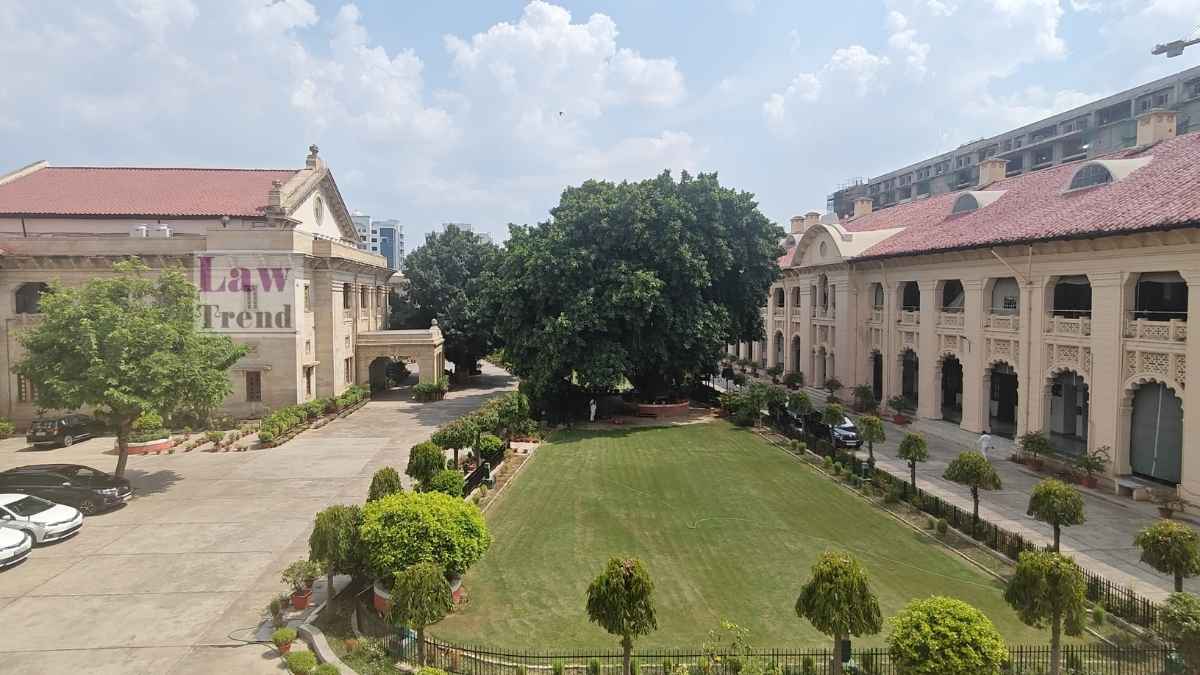
The High Court of Judicature at Allahabad, presided over by Justice Santosh Rai, has set aside a trial court order summoning two relatives of a primary accused under Section 358 of the Bharatiya Nagarik Suraksha Sanhita (BNSS) / Section 319 of the Code of Criminal Procedure (CrPC) in a case involving the Scheduled Castes and Scheduled Tribes (Prevention of Atrocities) Act. The High Court held that the mere utterance of the caste name “Chamar,” without the specific intention or knowledge to insult or humiliate a person on account of their caste, does not prima facie constitute an offence under the SC/ST Act.
Background of the Case
An First Information Report (FIR) was registered at Police Station Izzatnagar, District Bareilly, under Sections 376(2)(n), 504, and 506 of the Indian Penal Code (IPC) alongside Sections 3(2)(5A), 3(2)(r), and 3(2)(s) of the SC/ST Act against the main accused, Himmat Singh, along with his father Vegraj Singh and elder brother Daulat. During the investigation, statements of the victim and other witnesses were recorded under Sections 161 and 164 of the CrPC.
Following the investigation, the Investigating Officer submitted a charge-sheet exclusively against the principal accused, Himmat Singh, and exonerated Vegraj Singh and Daulat. Subsequently, during trial proceedings in Session Trial No. 1452 of 2024 before the Special Judge (SC/ST Act), Bareilly, the trial court issued a summoning order on March 21, 2025, under Section 358 BNSS (Section 319 CrPC) against Vegraj Singh and Daulat, relying on the deposition of the victim (PW-1). The appellants subsequently filed a criminal appeal before the High Court challenging the summoning order.
Arguments of the Parties
Counsel for the appellants submitted that Vegraj and Daulat were exonerated by the Investigating Officer after no material was found against them. It was argued that in her statements recorded under Sections 161 and 164 CrPC, the victim had not assigned any specific or distinct role to the appellants regarding casteist remarks, abuse, or intimidation. Counsel contended that they were summoned solely based on PW-1’s trial testimony, where the victim stated that they had abused her and used the word “Chamar.” It was urged that the mere use of the word, in the absence of specific allegations demonstrating the requisite intention or knowledge to insult on caste grounds, does not prima facie constitute an offence under the SC/ST Act, and the primary allegations relating to rape and promise of marriage were directed solely against Himmat Singh.
Opposing the appeal, the learned Additional Government Advocate (AGA) for the State submitted that the appellants were named in the FIR and the victim had consistently disclosed their involvement. The State argued that the victim specifically alleged before the trial court that the appellants abused her using the caste-related word “Chamar” and threatened her. The AGA contended that the trial court found sufficient grounds under Section 358 BNSS to summon them, and the victim’s evidence could not be discarded merely due to the Investigating Officer’s earlier exoneration, as the required intention and ingredients are matters to be adjudicated during trial.
Court’s Analysis and Precedents Cited
Analyzing the facts and material on record, the High Court observed that Vegraj is the father and Daulat is the real brother of the main accused. The Court noted that in her Section 161 CrPC statement, the victim alleged casteist remarks without attributing any specific or distinct word to either appellant. During trial, they were summoned based on PW-1’s statement that they abused her and used the word “Chamar.”
The High Court observed: “Mere use of the word “Chamar”, however, would not, by itself, establish that the appellants used the said word with the intention or knowledge of insulting or humiliating the victim on the ground of her belonging to an SC/ST community.” The Court added that “Thus, the material on record does not disclose any specific, distinct or sufficient role attributable to the present appellants.“
To elucidate the legal requirements, the High Court discussed several Supreme Court precedents:
- Swaran Singh v. State (2008): The Supreme Court drew a distinction between a “public place” and “any place within public view,” holding that words like “Chamar” may amount to an offence if used as casteist abuse with intent to humiliate. However, the Apex Court emphasized that “there must be intentional insult or intimidation; and intent to humiliate the victim because he or she belongs to a Scheduled Caste or Scheduled Tribe. Mere abuse or quarrel, without the requisite intention contemplated by the Act, is insufficient.“
- Gorige Pentaiah v. State of A.P. (2009): The Supreme Court held that “when the basic ingredients of the offence are missing in the complaint, then permitting such complaint to continue and to compel the appellant to face the rigmarole of the criminal trial would be totally unjustified leading to abuse of process of law.“
- Hitesh Verma v. State of Uttarakhand (2020): The Supreme Court held that a dispute arising inside a private house over land possession without independent public witnesses does not satisfy the statutory threshold of Section 3(1)(r) of the SC/ST Act.
- Shajan Skaria v. State of Kerala (2024) and Khuman Singh v. State of M.P. (2020): The Supreme Court reiterated that “The offence under Section 3(1)(r) of the Act would indicate the ingredient of intentional insult and intimidation with an intent to humiliate a member of a Scheduled Caste or a Scheduled Tribe. All insults or intimidations to a person will not be an offence under the Act unless such insult or intimidation is on account of victim belonging to Scheduled Caste or Scheduled Tribe.“
- Hardeep Singh v. State of Punjab (2014): A Constitution Bench held that power under Section 319 CrPC is extraordinary and discretionary, observing that “Power under Section 319 CrPC is a discretionary and an extraordinary power. It is to be exercised sparingly and only in those cases where the circumstances of the case so warrant.” The Apex Court ruled that summoning a new accused requires much stronger evidence than a mere probability of complicity.
Decision of the Court
Applying these legal principles, the High Court concluded that the allegations in the FIR and investigation material do not prima facie disclose the essential ingredients of offences under Sections 3(1)(r) and 3(1)(s) of the SC/ST Act against the appellants. The Court observed that the principal allegations were directed at the main accused, Himmat Singh.
The High Court noted: “In the absence of any reliable, sterling material or evidence pointing unmistakably towards the complicity of the appellant, the trial court erred in law by summoning the appellant under Section 319 Cr.P.C. in a casual and cavalier manner.“
Consequently, the High Court allowed the appeal and set aside the summoning order dated March 21, 2025, passed by the Special Judge (SC/ST Act), Bareilly. The Registrar (Compliance) was directed to communicate the order to the trial court through the District and Sessions Judge, Bareilly, via email or FAX within 48 hours.
Case Title: Vegraj Singh And Another v. State of U.P. and Another
Case No.: Criminal Appeal No. 4882 of 2025
Bench: Justice Santosh Rai
Date: August 13, 2026