

Deliberate Suppression Of Pending Criminal Cases Valid Ground For Discharge From RPF Service: Supreme Court
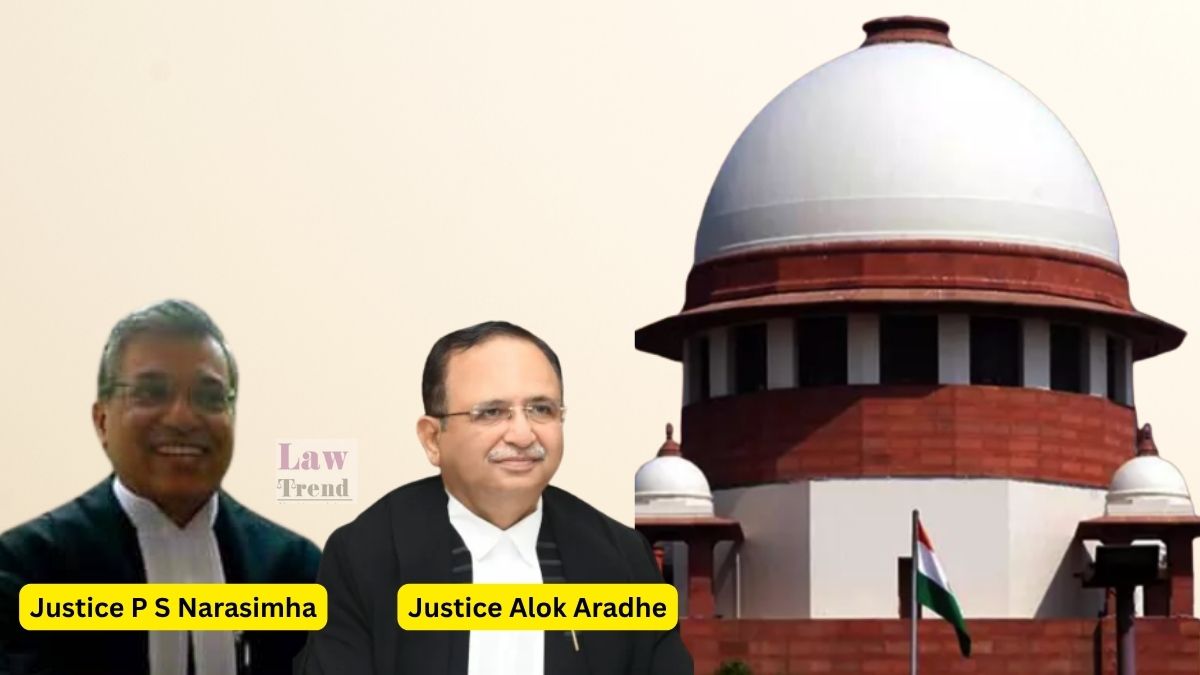

The Supreme Court has held that the deliberate suppression and non-disclosure of pending criminal cases by a candidate during recruitment verification is a valid ground for discharge from service, affirming that a person suppressing material information cannot claim an unfettered right to continuity in service. A Bench comprising Justice P. S. Narasimha and Justice Alok Aradhe dismissed a batch of civil appeals filed by candidates selected as constables in the Railway Protection Force (RPF) and Railway Protection Special Force (RPSF), upholding the common judgment of the Division Bench of the Allahabad High Court which approved their discharge from service.

Background of the Case

The Chief Security Commissioner, RPF, issued an Employment Notice on February 23, 2011, to fill constable vacancies in the RPF and RPSF. The appellants qualified in the written examination held on June 16, 2013, cleared the physical efficiency test, and were included in the select list published on September 17, 2014. During document verification and medical examination between May and June 2014, the candidates filled out attestation forms.

In the attestation forms, under Column 12 asking whether they had ever been arrested or prosecuted, the appellants marked “NO”, despite having pending criminal cases against them. Subsequently, allotment letters were issued and they were sent for training. While the appellants were undergoing training, the authorities discovered the subsisting criminal cases and initiated discharge orders between June and October 2015 under Rules 52 and 67 of the RPF Rules, 1987, Clause 9(f) of the Employment Notice, and Paragraph 3 of the Attestation Form.

The appellants challenged these discharge orders before the Allahabad High Court. Single Judge Benches initially quashed the discharge orders and directed the authorities to reconsider the cases in light of the Supreme Court’s judgment in Avtar Singh v. Union of India & Ors. Upon reconsideration, the authorities passed detailed orders in 2017 again discharging the appellants on grounds of suppression. Fresh writ petitions filed by the appellants were dismissed by a Single Judge, and subsequent writ appeals were dismissed by a Division Bench of the High Court on September 22, 2021.

Arguments of the Parties

Senior Advocates Mr. Gopal Sankaranarayanan and Mr. Anand Sanjay M. Nuli, appearing for the appellants, argued that removing an employee solely for suppression without an independent and objective evaluation is arbitrary. They relied on Avtar Singh v. Union of India & Ors., Pawan Kumar v. Union of India, and SPO/Constable IRB Satpal Singh v. State of Punjab & Ors. to contend that a discharge cannot be ordered merely because of a pending criminal case. It was further submitted that all appellants had been acquitted of all charges (with 14 out of 17 acquitted prior to discharge) and that 26 similarly situated candidates with prior criminal antecedents had been reinstated, making the non-reinstatement of the appellants discriminatory.

READ ALSO  High Court Cannot Re-Interpret Contract Under Section 37 After Arbitral Award Is Upheld Under Section 34: Supreme Court

Additional Solicitor General Mr. Vikramjit Banerjee, representing the Union of India, submitted that the cases were re-examined pursuant to High Court directions and detailed reasoned discharge orders were issued in 2017 declaring the appellants unsuitable. He argued that making false statements regarding criminal antecedents directly affects an employee’s character. Distinguishing Pawan Kumar, the ASG noted that in that case, acquittal occurred before the attestation form was filled, whereas here, criminal cases were pending at the time of form submission. Regarding parity, he stated that reinstated candidates were either acquitted prior to filling attestation forms or reinstated following specific judicial directions and case-by-case evaluations of trivial allegations.

Court’s Analysis

The Supreme Court examined the RPF Rules, 1987—specifically Rule 52 (Verification) and Rule 67 (Disciplinary Control)—along with Clause 9(f) of the Employment Notice and Column 12 of the Attestation Form. The Court observed that these provisions clearly establish that full disclosure of criminal cases is required prior to formal appointment, and non-disclosure entails discharge or termination.

READ ALSO  जमानत याचिकाओं के शीघ्र निपटान और तदर्थ न्यायाधीशों की नियुक्ति के लिए पटना हाकोर्ट को निर्देश देने के लिए सुप्रीम कोर्ट में याचिका पर कल सुनवाई

The Court noted that despite explicit warnings, the appellants chose to answer “NO” regarding pending prosecutions. Aligning with the Division Bench’s finding, the Court observed that the appellants “were guilty of suppressio veri or suggestio falsi, i.e., had knowledge of suppression of specific information sought in the attestation/verification form, which they had deliberately omitted to mention.”

Applying the principles laid down in Avtar Singh v. Union of India & Ors., the Court highlighted paragraph 38.7 of that precedent:

“In a case of deliberate suppression of fact with respect to multiple pending cases such false information by itself will assume significance and an employer may pass appropriate order cancelling candidature or terminating services as appointment of a person against whom multiple criminal cases were pending may not be proper.”

The Supreme Court distinguished Pawan Kumar v. Union of India on the basis that the acquittal in that case took place before the candidate filled out the attestation form. Similarly, the Court distinguished SPO/Constable IRB Satpal Singh v. State of Punjab & Ors., noting that the employee in that case had already served for twelve years and the matter originated from a civil suit.

READ ALSO  Injury Report Not Mandatory For Conviction Under Section 323 IPC: Supreme Court

Regarding the plea of discrimination and parity, the Court accepted the ASG’s clarification that candidates who were reinstated either stood on a different footing by virtue of being acquitted prior to filling verification forms or had trivial allegations evaluated on a case-to-case basis.

Decision

The Supreme Court concluded that there was no error in the findings of the Single Judge or the Division Bench of the High Court and that the impugned orders fully complied with natural justice and the principles in Avtar Singh. Finding no reason to interfere with the High Court’s judgment, the Supreme Court dismissed the civil appeals with no order as to costs.

Case Title: Bappa Barai v. Union of India & Ors.
Case No.: Civil Appeal No. of 2026 (Arising out of SLP (C) No. 12389 of 2022)
Bench: Justice P. S. Narasimha and Justice Alok Aradhe
Date: August 18, 2026

Law Trend
Law Trendhttps://lawtrend.in/
Legal News Website Providing Latest Judgments of Supreme Court and High Court

Related Articles

Latest Articles

