

Reference To Caste Scrutiny Committee Not Required When Issuing Authority Disowns Caste Certificate: Chhattisgarh High Court
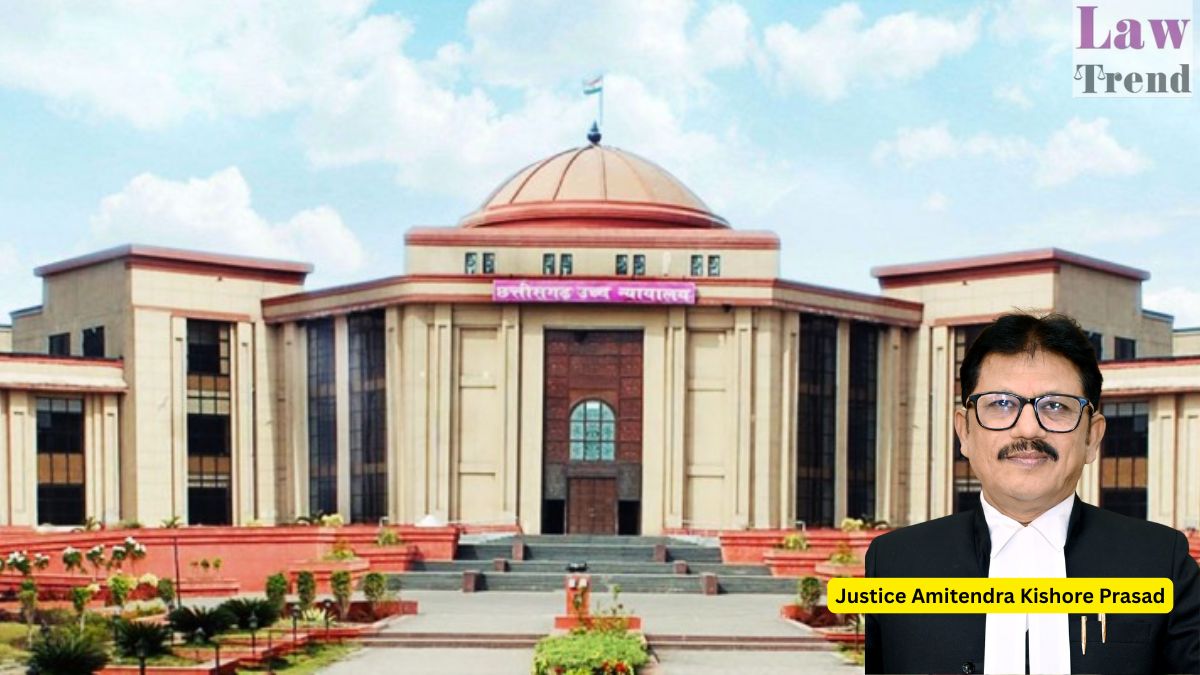

The High Court of Chhattisgarh at Bilaspur, in a bench presided over by Justice Amitendra Kishore Prasad, has held that when an issuing authority itself certifies that a social status certificate was never issued from its office, reference to a Caste Scrutiny Committee under the Chhattisgarh Scheduled Castes, Scheduled Tribes and Other Backward Classes (Regulation of Social Status Certification) Act, 2013 is not required. The Court ruled that the Divisional Commissioner is fully competent under Section 19(1)(a-1) of the Chhattisgarh Municipal Corporation Act, 1956, to determine statutory disqualification and remove an elected Councillor who contested from a reserved seat using a non-existent or disowned certificate. The High Court further held that a consequential election process, once commenced, cannot be interfered with by Courts under writ jurisdiction. Consequently, the High Court dismissed the writ petition filed by removed Councillor Mohammad Salman and allowed the writ petition filed by Chandan Yadav, affirming his election as the valid Councillor of Ward No. 35, Sharda Para, Bhilai Municipal Corporation.

Background of the Case

The dispute arose out of the election for the post of Councillor of Ward No. 35 (Sharda Para), Bhilai Municipal Corporation, District Durg. Under a Gazette notification dated March 22, 2021, Ward No. 35 was reserved for candidates belonging to the Other Backward Class (OBC) category.

In December 2021, Mohammad Salman (also known as Engineer Salman) submitted his nomination claiming to belong to the Kunjda caste, an OBC category in Chhattisgarh, relying upon a social status certificate bearing Revenue Case No. 363/B-121/2015-16 dated June 15, 2016. Following the election, Mohammad Salman was declared elected and his victory was notified in the official Gazette on December 24, 2021. Chandan Yadav secured the second highest number of votes.

Subsequently, Bhojram and Chandan Yadav filed objections alleging that Mohammad Salman did not belong to the Kunjda caste and had used an invalid caste certificate. Proceedings were initiated under Section 19(1)(a-1) of the Act of 1956. Pursuant to directions issued by the High Court in an earlier writ petition (W.P.(C) No. 1015 of 2024), the Divisional Commissioner, Durg, conducted an inquiry.

During the inquiry, a report dated March 7, 2024, submitted by the Sub-Divisional Officer (Revenue), Durg, revealed that the revenue case number mentioned on Salman’s caste certificate was not recorded in his name in the official Daaira Register, but was recorded in the name of one Nomita Deshmukh, daughter of Yuvraj Deshmukh. The issuing authority certified that no such caste certificate had ever been issued to Mohammad Salman from its office. An FIR (No. 103 of 2024) was also registered regarding the alleged use of forged documents.

On May 6, 2024, the Divisional Commissioner, Durg, passed an order removing Mohammad Salman from the office of Councillor under Section 19(1)(a-1) of the Act of 1956. Salman’s statutory appeal under Section 19(3) was dismissed by the Secretary, Urban Administration and Development Department, Government of Chhattisgarh, on September 4, 2024. Mohammad Salman challenged both orders in Writ Petition (C) No. 5555 of 2024.

Following the vacancy, the Chhattisgarh State Election Commission issued a by-election notification on January 20, 2025. Chandan Yadav filed his nomination, and after the withdrawal of another candidate, he was declared elected on January 31, 2025, with an official Gazette notification published on February 24, 2025.

READ ALSO  गरिमापूर्ण मृत्यु के अधिकार में सम्मानजनक अंतिम संस्कार शामिल: छत्तीसगढ़ हाईकोर्ट ने श्मशानों की 'दयनीय' स्थिति पर स्वतः संज्ञान लिया

However, on January 28, 2025, a Co-ordinate Bench of the High Court had granted an interim stay on the removal orders in Mohammad Salman’s writ petition without being informed of the ongoing by-election process. Based on this interim stay, the Mayor of Bhilai Municipal Corporation nominated Salman to the Mayor-in-Council on March 18, 2025, while the authorities failed to administer the oath of office to Chandan Yadav. Chandan Yadav then filed Writ Petition (C) No. 1808 of 2025 seeking a direction for his oath ceremony and challenging Salman’s continued functioning.

Arguments of the Parties

Submissions on behalf of Mohammad Salman

Counsel for Mohammad Salman submitted that he belongs to the Kunjda caste as reflected in his educational and contemporaneous family records. It was contended that:

  • Nomination papers were accepted in 2021 after scrutiny, and the challenge brought after three years was politically motivated.
  • Under the Act of 2013 and the principles laid down in Kumari Madhuri Patil v. Additional Commissioner, Tribal Development, only a Caste Scrutiny Committee has the jurisdiction to examine or cancel a caste certificate.
  • The Divisional Commissioner lacked jurisdiction under Section 19(1)(a-1) of the Act of 1956 to decide caste status without a prior finding from a Caste Scrutiny Committee.
  • An election can only be challenged through an election petition under Section 441 of the Act of 1956, relying on Babita Balmiki v. Amrika Bai & Others.
  • The interim stay order dated January 28, 2025, restored his status as Councillor, making the subsequent by-election invalid.

Submissions on behalf of the State Authorities

The Additional Advocate General submitted that:

  • The Divisional Commissioner and the appellate authority passed well-reasoned quasi-judicial orders after granting full opportunity of hearing.
  • Section 19(1)(a-1) specifically empowers the Divisional Commissioner to remove a Councillor who does not belong to the reserved category.
  • The SDO (Revenue) verified that the caste certificate was never issued to Mohammad Salman, and he failed to discharge his burden of proof under Section 14 of the Act of 2013.

Submissions on behalf of Chandan Yadav

Counsel representing Chandan Yadav argued that:

  • The case does not involve verification of a genuine caste certificate, but a document that was never issued by the competent authority.
  • Kumari Madhuri Patil applies to genuine certificates facing correctness challenges, whereas non-existent or fabricated certificates stand on a different footing, relying on Abhishek Agariya v. State of Madhya Pradesh, Bhubaneswar Development Authority v. Madhumita Das, Bharat Singh Batham v. Life Insurance Corporation of India, and Hemant Batham v. State of Madhya Pradesh.
  • Having been elected through a statutory by-election process under Article 243-ZA of the Constitution, Chandan Yadav has a right to take oath and hold office.
  • Reliance was placed on Supreme Court decisions including Election Commission of India v. Ashok Kumar, Mohinder Singh Gill v. Chief Election Commissioner, Lakshmi Charan Sen v. A.K.M. Hassan Uzzaman, State of Assam v. Barak Upatyaka Damsanghathan, and Jyoti Basu v. Debi Ghosal.

Submissions on behalf of the State Election Commission

Senior Counsel appearing for the State Election Commission submitted that:

  • The by-election process was initiated under constitutional authority following the vacancy created by removal.
  • Article 243-ZG(b) creates an express bar against judicial interference in municipal elections once the process has commenced, relying on Election Commission of India v. Ashok Kumar and Anugrah Narain Singh v. State of U.P.

Court’s Analysis and Observations

The High Court examined the statutory scheme of the Chhattisgarh Municipal Corporation Act, 1956, and the legal framework governing social status verification.

Scope of Section 19(1)(a-1) of the Act of 1956

The Court held that Section 19(1)(a-1) empowers the Divisional Commissioner to independently inquire into statutory disqualification when an elected candidate is found not to belong to the reserved category:

The expression “does not belong to the reserved category” occurring in Section 19(1)(a-1) of the Act of 1956 is of wide amplitude. It is not confined merely to cases where the caste of a candidate is subsequently invalidated by a Scrutiny Committee. The expression is wide enough to include a situation where the very document on the basis of which the candidate claimed eligibility is demonstrated to be forged, fabricated or never issued by the competent authority.

The Court noted that proceedings under Section 19(1)(a-1) operate independently of an election petition under Section 441.

Distinction Between Verification and Non-Existent Certificates

Addressing the argument regarding mandatory reference to the Caste Scrutiny Committee under Kumari Madhuri Patil, the Court distinguished between a false certificate issued by an authority and a document that was never issued:

READ ALSO  Mere Membership in a Gang Without Active Involvement Doesn't Justify Punishment Under Gangster Act: Allahabad High Court

The elaborate procedure contemplated in Kumari Madhuri Patil (supra) and subsequently incorporated in the Act of 2013 is intended to examine the correctness of an existing caste certificate validly issued by a competent authority. Such procedure presupposes the existence of a genuine certificate requiring verification. The present case stands on an entirely different footing. Here, the competent revenue authority itself has categorically certified that the caste certificate relied upon by Mohammad Salman was never issued from its office.

It is well settled that there exists a clear distinction between a false social status certificate and a non-genuine or fabricated social status certificate. A false certificate is one which has in fact been issued by the competent authority, but its issuance has been procured by the applicant by suppressing material facts or by furnishing incorrect or misleading information regarding his caste or social status. In such cases, the document is a genuine official certificate, though its procurement is alleged to be fraudulent, thereby requiring verification by the competent Caste Scrutiny Committee. On the other hand, where the competent authority itself certifies that the alleged caste certificate was never issued from its office or that the particulars contained therein do not correspond with the official records maintained by it, the dispute is not merely one of verification of social status but relates to the very authenticity and existence of the document relied upon by the claimant.

Electoral Process and By-Election Validity

Regarding the by-election conducted by the State Election Commission, the Court observed that once the election process commenced following the vacancy under Section 23(3) of the Act of 1956, it could not be interdicted:

It is a settled principle of law that once the election process has commenced, the constitutional bar contained under Article 329 of the Constitution of India comes into operation and the Courts ordinarily cannot interfere with the electoral process.

The Court held that the interim stay dated January 28, 2025, granted without full knowledge of the by-election process, did not bar the conduct of the by-election or the election of Chandan Yadav.

Final Decision

The High Court held as follows:

  1. Writ Petition (C) No. 5555 of 2024 filed by Mohammad Salman was dismissed. The orders dated May 6, 2024 (passed by the Divisional Commissioner, Durg) and September 4, 2024 (passed by the State Appellate Authority) removing him from the post of Councillor were upheld.
  2. Writ Petition (C) No. 1808 of 2025 filed by Chandan Yadav was allowed. The Court held that the election of Chandan Yadav as Councillor of Ward No. 35 (Sharda Para), Bhilai Municipal Corporation, is valid and in accordance with law.
  3. No order as to costs was passed.
READ ALSO  Liberty is a Precious Right, High Courts Must Be Cautious in Cancelling Bail: Supreme Court

Case Title: Mohammad Salman v. State of Chhattisgarh and Others (with Chandan Yadav v. State of Chhattisgarh and Others)

Case No.: W.P.(C) No. 5555 of 2024 and W.P.(C) No. 1808 of 2025
Bench: Justice Amitendra Kishore Prasad
Date: August 3, 2026

Law Trend
Law Trendhttps://lawtrend.in/
Legal News Website Providing Latest Judgments of Supreme Court and High Court

Related Articles

Latest Articles

