

IBC Cannot Give New Lease of Life to Time-Barred Debts; Mere Subsistence of Contract Does Not Keep Limitation Alive: Supreme Court
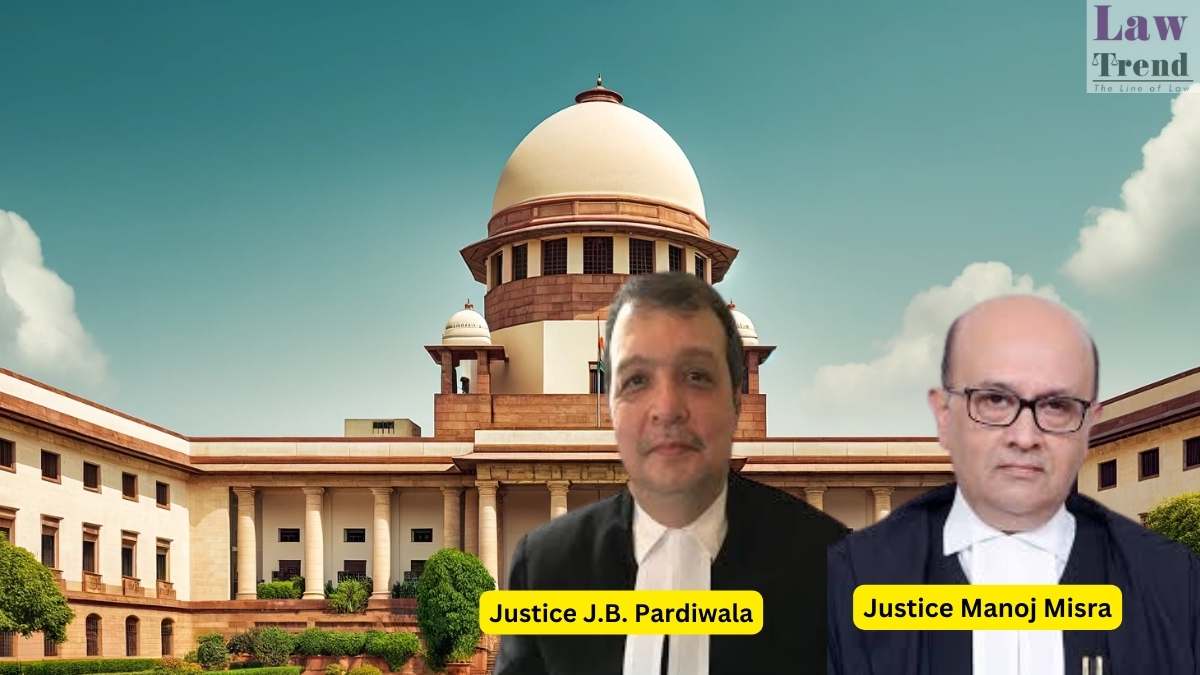

The Supreme Court of India, comprising a bench of Justice J. B. Pardiwala and Justice Manoj Misra, has held that proceedings under the Insolvency and Bankruptcy Code, 2016 (IBC) cannot be used to give a new lease of life to time-barred debts, ruling that the mere subsistence of an agreement does not extend or grant a continuing cause of action for default under Section 9 of the Code. Setting aside the orders of the National Company Law Appellate Tribunal (NCLAT) and the National Company Law Tribunal (NCLT), the court allowed an appeal filed by corporate debtor Srinivasa Reddy Velagala against operational creditor Sravanthi Infratech Pvt. Ltd., holding that the insolvency application was barred by limitation.

Background of the Case

The dispute stems from an International Competitive Bid invited on December 13, 2010, by Srinivasa Reddy Velagala for setting up a 225 MW gas-based combined cycle Power Station in Bikkavolu, East Godavari District, Andhra Pradesh. Sravanthi Infratech Pvt. Ltd. emerged as the lowest bidder and was awarded a Letter of Award (LOA) dated December 24, 2010, for Rs 827 crore. The parties executed an Engineering Procurement and Construction (EPC) agreement on February 9, 2011, with a scheduled completion timeframe of 14 months.

Under the agreed terms of payment, milestone payments were structured across supply and commissioning stages. The first milestone required an initial advance payment of 10% of the contract price (Rs 82.7 crore) upon submission of corporate guarantees. Although Sravanthi Infratech provided the required guarantees and achieved initial milestones, the corporate debtor disbursed only Rs 50.15 crore out of the cumulative Rs 165.4 crore due across the initial milestones.

Sravanthi Infratech submitted its Billing Break-up (BBU) on July 13, 2011, and resubmitted it on January 3, 2012, which was acknowledged by the corporate debtor. Owing to persistent non-payment, Sravanthi Infratech issued a notice of suspension of works on July 30, 2011, stopped EPC activities, terminated vendor contracts, and completely demobilised from the site by November 2011.

Thereafter, Sravanthi Infratech sent legal notices on July 25, 2014, September 16, 2014, and July 15, 2015, demanding dues under the EPC contract. Receiving no response, Sravanthi Infratech issued a statutory demand notice under Section 8 of the IBC on July 2, 2018, demanding Rs 1,292.13 crore, stating that the debt fell due on February 25, 2011. An application under Section 9 of the IBC was subsequently filed on October 12, 2018.

READ ALSO  Police Officer's Duty to Protect Citizens Supersedes Personal Threat: J&K&L High Court Upholds Dismissal

The NCLT admitted the Section 9 application on December 13, 2019, holding that the contract subsisted as neither party had terminated it, making the debt recoverable and not time-barred. The NCLAT affirmed the NCLT’s order on February 1, 2021, prompting the corporate debtor to approach the Supreme Court.

Arguments of the Parties

Senior Counsel Shyam Divan, appearing for the appellant corporate debtor, argued that the operational debt claimed was hopelessly time-barred. He submitted that default occurred in 2011 and was acknowledged in 2012, whereas insolvency proceedings were initiated only in 2018. Citing Babulal Vardharji Gurjar v. Veer Gurjar Aluminium Industries (P) Ltd. and Sabarmati Gas Ltd. v. Shah Alloys Ltd., he contended that the IBC cannot be used to revive time-barred claims. He further relied on Asset Reconstruction Co. (India) Ltd. v. Bishal Jaiswal to contend that there was no written acknowledgment extending limitation, and on Mobilox Innovations Pvt. Ltd. v. Kirusa Software (P) Limited to argue that pre-existing disputes barred the Section 9 application.

Counsel Nitin Bhardwaj, appearing on behalf of the respondent operational creditor, argued that the EPC contract was never terminated under Clause 14 of the agreement. He submitted that suspension of work did not amount to contract termination, and as long as the contract subsisted without formal termination or frustration, a continuous cause of action existed, bringing the claims within the limitation period. He further submitted that no pre-existing dispute had been raised prior to the Section 9 filing and that the Resolution Professional had segregated valid operational debts from claims in the nature of damages.

Court’s Analysis

The judgment authored by Justice J. B. Pardiwala evaluated four key legal issues:

1. Subsistence and Frustration of the EPC Contract

The court noted that neither party invoked Clause 14 to terminate the contract. It rejected the argument that the contract was frustrated due to efflux of time, clarifying that effluxion of time is a natural mode of contract completion, whereas frustration requires an unforeseen supervening event. Referring to Boothalinga Agencies v. V.T.C. Poriaswami Nadar, the court stated: “We think the principle of this case applies to the Indian law and the provisions of Section 56 of the Indian Contract Act cannot apply to a case of “self-induced frustration”. In other words, the doctrine of frustration of contract cannot apply where the event which is alleged to have frustrated the contract arises from the act or election of a party.” The court concluded that while the EPC contract continued to subsist, suspension due to non-payment did not amount to contract frustration.

2. Operational Debt vs. Damages

Examining Section 5(21) of the IBC, the court held that amounts payable under the EPC milestone schedule for works undertaken constitute operational debt. However, claims under heads such as suspension, idling, and demobilisation charges are in the nature of damages. The court clarified that damages, whether liquidated or unliquidated, cannot be treated as operational debt until assessed and crystallised through adjudication by a court of competent jurisdiction.

READ ALSO  उपभोक्ता कानून की मौद्रिक क्षेत्राधिकार व्यवस्था को सुप्रीम कोर्ट की मंजूरी

3. Pre-Existing Dispute

Analyzing Mobilox Innovations (P) Ltd. v. Kirusa Software (P) Ltd., the court recalled: “So long as a dispute truly exists in fact and is not spurious, hypothetical or illusory, the adjudicating authority has to reject the application.” The bench noted that while silence is generally not an indicator of the absence of a dispute, the corporate debtor’s total and consistent silence across multiple legal notices over a period of seven years was strong evidence that no prior dispute existed at the material time.

4. Limitation Period

On the critical issue of limitation, the court rejected the operational creditor’s argument that the subsistence of the contract yielded a continuous cause of action. The court held that under Section 238A of the IBC read with Article 137 of the Limitation Act, 1963, limitation triggers on the date of default under Section 3(12) of the IBC.

READ ALSO  Supreme Court Dismisses Plea by Sameer Kulkarni in Malegaon Blast Case

Referring to Next Education India (P) Ltd. v. K12 Techno Services, the court observed that limitation is tied to each milestone or invoice’s due date. Pointing to B. Prashanth Hegde v. SBI, the court emphasised that the date of default specified in statutory forms determines maintainability.

The court reiterated the principles established in Babulal Vardharji Gurjar v. Veer Gurjar Aluminium Industries (P) Ltd., highlighting that the “intention of the Code is not to give a new lease of life to debts which are time-barred”. Merely sending legal notices in 2014 and 2015 without a written acknowledgment of liability from the corporate debtor under Section 18 of the Limitation Act could not reset the limitation period. The bench observed that while principles of limitation for EPC contracts in civil suits or arbitration may allow a fresh right to sue during final bill reconciliation (Union of India v. West Coast Paper Mills Ltd.), such principles do not apply to insolvency applications under Section 9 of the IBC where default crystallises on non-payment.

Decision of the Court

The Supreme Court concluded that “default had occurred over three years prior to the date of filing of the application and, therefore, the application is clearly time barred.”

Consequently, the court allowed the appeal, setting aside both the impugned judgment of the NCLAT and the admission order of the NCLT. However, considering the facts of the case, the court granted liberty to Sravanthi Infratech Pvt. Ltd. to approach the appropriate dispute resolution forum provided under the EPC contract to contest its claims.

Case Title: Srinivasa Reddy Velagala v. Sravanthi Infratech Pvt. Ltd.
Case No.: Civil Appeal No. 876 of 2021
Bench: Justice J. B. Pardiwala and Justice Manoj Misra
Date: August 12, 2026

Law Trend
Law Trendhttps://lawtrend.in/
Legal News Website Providing Latest Judgments of Supreme Court and High Court

Related Articles

Latest Articles

