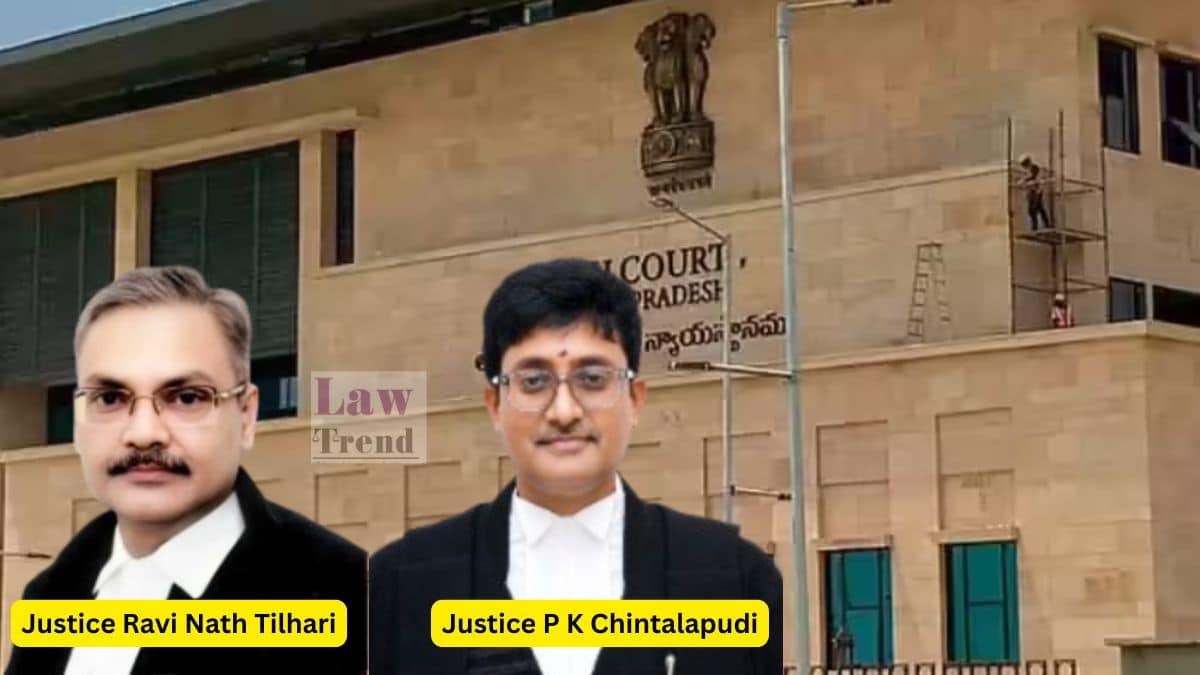
The High Court of Andhra Pradesh has held that a reference to the competent authority under Section 64 of the Right to Fair Compensation and Transparency in Land Acquisition, Rehabilitation and Resettlement Act, 2013 (RFCTLARR Act, 2013) cannot be made in the absence of an ‘award’ passed under the Act. A Division Bench comprising Justice Ravi Nath Tilhari and Justice Purushottam Kumar Chintalapudi set aside the orders of a Single Judge directing the Revenue Divisional Officer to refer a land dispute under Section 64, ruling that the applicability of statutory provisions is a pure question of law and that there can be no estoppel against a statute.
Background of the Case
The matter arose from a writ petition (W.P. No. 30008 of 2023) filed by V. Shanmugam and three others claiming ownership over Ac.0.81 ½ cents in Sy.No.82/9A and Ac.0.81 ½ cents in Sy.No.82/9B (total Ac.1.63 cents) in Thimmasamudram Revenue Village, Chittoor Mandal. The writ petitioners contended that they had purchased the land through registered sale deeds dating back to 1977 and were entitled to compensation. They challenged the proposed allotment of the land to respondent No. 5 for a Middle Income Group (MIG) layout on the premise that it was DKT (assigned) land.
The appellant, T. Subramanyam, filed an impleadment application claiming that a DKT patta was granted to him and that his name was recorded in the revenue records and 1B Namuna. He disputed the petitioners’ sale deed and claimed entitlement to compensation.
In response, the Tahsildar (respondent No. 4) stated in a counter-affidavit that the land was originally classified as Government Dry and assigned in 1955. The revenue official submitted that under the DKT Rules, assigned land could not be sold or purchased, making the sale transactions invalid, and that the Government was at liberty to resume assigned lands for public purposes.
On December 17, 2025, a Single Judge disposed of the writ petition by directing the parties to agitate their rights before the ‘Authority’ under Section 64 of the RFCTLARR Act, 2013, and ordered the Joint Collector to refer the matter while withholding disbursement of funds. On January 21, 2026, the order was modified upon a joint representation by counsel, directing the Revenue Divisional Officer (RDO) instead of the Joint Collector to make the reference. The appellant subsequently filed Writ Appeal No. 280 of 2026 challenging these orders.
Arguments of the Parties
Counsel for the appellant argued that a reference under Section 64 of the RFCTLARR Act, 2013 requires an existing ‘award’ under the Act. Since no land acquisition proceedings were initiated and no award was passed, Section 64 had no application.
Pursuant to directions from the High Court to clarify whether land acquisition proceedings had been initiated, the Revenue Divisional Officer filed an affidavit dated July 07, 2026. The affidavit stated that land acquisition proceedings were not initiated; rather, the lands were resumed from assignees on payment of market value in terms of G.O.Ms.No.259, Revenue (ASSN.I) Department, dated June 21, 2016, with compensation calculated strictly using the framework and parameters of the 2013 Act.
Counsel for the writ petitioners argued that since the modification order dated January 21, 2026 was passed on joint representation, the appellant was estopped from raising the plea regarding the inapplicability of Section 64.
Court’s Analysis
Examining the scheme of Section 64 of the RFCTLARR Act, 2013, the Division Bench noted that the provision enables an interested person who has not accepted an award to apply for a reference to the Authority on issues such as land measurement, compensation amount, apportionment, or rehabilitation rights.
The Court observed:
“So, for applicability of Section 64 there must be an ‘award’ and any party interested must not have accepted the award. If there is no award, there would be no question of any party interested who had not accepted the award, for making the application for reference under Section 64.”
Addressing the contention of estoppel raised by the writ petitioners, the Court held that determining whether Section 64 applies to undisputed facts is a pure question of law:
“The question of applicability of the legal provisions, viz., Section 64, on the facts not in dispute is a pure question of law. It cannot be said that the correct provision should not be applied, and if some incorrect provision was stated by the learned counsels to be applicable and the order was passed thereon, so, the order, cannot be revisited.”
Reiterating established judicial precedent, the Bench cited the judgments of the Supreme Court in State of U.P. v. U.P. Rajya Khanij Vikas Nigam Sangharsh Samiti (2008) 12 SCC 675 and A.P. Pollution Control Board II v. M.V. Nayudu (2001) 2 SCC 62, emphasizing that “there can be no estoppels against the statute.”
Decision of the Court
The Division Bench allowed the Writ Appeal and set aside the impugned judgments dated December 16, 2025 (December 17, 2025) and January 21, 2026. The High Court restored the writ petition to its original number for a fresh decision on whether an ‘award’ was passed under the 2013 Act or whether the case involved resumption of land, and whether recourse to Section 64 of the Act was applicable.
The Court further directed that the affidavit filed by the official respondents regarding the land resumption proceedings shall form part of the record in the writ petition. No order as to costs was made.
Case Details:
Case Title: T. Subramanyam v. V. Shanmugam, & 8 others
Case No.: Writ Appeal No. 280/2026
Bench: Justice Ravi Nath Tilhari and Justice Purushottam Kumar Chintalapudi
Date: 13.07.2026