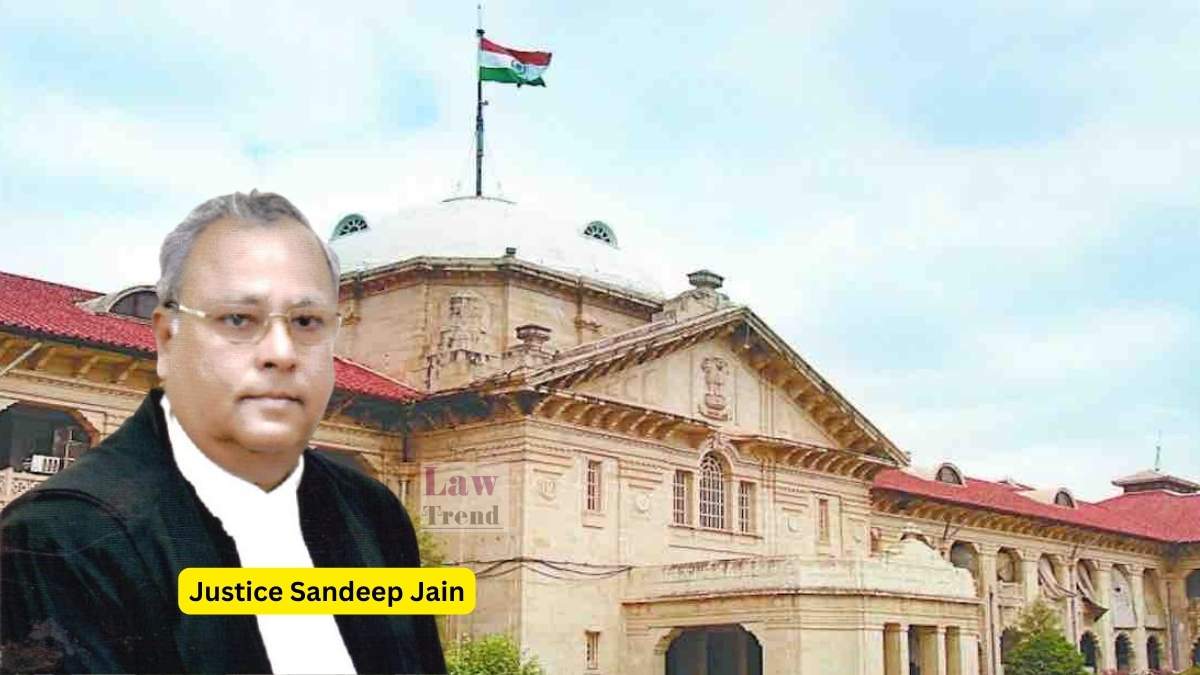
Addressing whether parental disapproval and pending criminal investigations can justify the detention of adult women who converted to another faith, the High Court of Judicature at Allahabad, in a judgment delivered by Justice Sandeep Jain, allowed a habeas corpus writ petition, declaring two converted adult sisters free to reside according to their choice. Holding their father and the State of Uttar Pradesh jointly and severally liable for unlawful confinement and violation of fundamental rights, the Court directed them to pay ₹25,00,000 in constitutional compensation to the women.
Background of the Case
The habeas corpus petition was instituted by Kunwar Sultan Ali and two others seeking the production and freedom of two sisters. Pursuant to the Court’s order dated July 30, 2026, both women were produced before the Court by police officials from Cyber Crime Police Station, Agra.
During personal interaction with the Court, the elder sister stated that she is about 35 years of age, highly educated with M.Sc. and M.Phil degrees in Zoology, holds a B.Ed. degree, and has served as a Lecturer. She stated that in the year 2020, she voluntarily embraced Islam of her own free will to attain mental peace, spiritual fulfilment, and inner solace, without coercion, undue influence, or extraneous consideration. She stated that her father, Anil Kumar Bhatia (Respondent No. 4), opposed her decision and forcibly confined her in the parental home, employing physical restraint, intimidation, and mental harassment to compel her to revert to Hinduism. She further stated that her passport, identity documents, bank passbooks, educational certificates, and conversion documents remained in her father’s custody.
The younger sister, aged about 20 years and educated up to Intermediate level, similarly stated that she voluntarily embraced Islam in 2021 based on personal faith and conscience. She stated that her father opposed her choice and unlawfully restrained her in the parental home, depriving her of liberty solely for professing a faith different from her family. Both women affirmed that their decision was an exercise of individual autonomy protected under Articles 21 and 25 of the Constitution of India and sought immediate release.
Arguments of the Parties
Appearing for the State of Uttar Pradesh, Additional Advocate General Manish Goyal, assisted by AGA Pankaj Saxena, challenged the maintainability of the petition. The State submitted that the father had lodged Case Crime No. 228 of 2025 at Police Station Sadar Bazar, Agra, alleging forcible and deceitful conversion. Originally registered under Section 87 of the Bharatiya Nyaya Sanhita (BNS), 2023, the investigation subsequently incorporated Sections 61(2), 111(3), 111(4), and 152 of the BNS, alongside Sections 3, 5(1), and 5(2) of the Uttar Pradesh Prohibition of Unlawful Conversion of Religion Act, 2021.
The State contended that the conversion formed part of an organized conspiracy with foreign influences threatening the sovereignty, integrity, and unity of the nation. The State argued that fundamental rights under Articles 21 and 25 are not absolute, that procedural requirements under the 2021 Act were not met, and that releasing the women could prejudice the ongoing criminal investigation.
In response, counsel for the petitioners, Mr. Ali Bin Saif and colleagues, submitted that the Court’s jurisdiction under Article 226 in habeas corpus proceedings is confined to examining the legality of detention. They argued that both women are major adults legally competent to decide their faith, residence, and association. The petitioners asserted that claims of national security threats were speculative and that the pendency of a criminal investigation against third parties cannot justify the continued illegal confinement of adult women who are victims rather than accused persons. The petitioners cited the Supreme Court judgments in Rajendra Bihari Lal & another Vs. State of U.P. & others (2025 INSC 1249) and Shafin Jahan Vs. Asokan K.M. & others ((2018) 16 SCC 368).
Court’s Analysis and Precedents
Examining the legal framework governing habeas corpus, the Court referred to the Supreme Court ruling in Home Secretary (Prison) and Others vs. H. Nilofer Nisha ((2020) 14 SCC 161), emphasizing that the writ is a processual remedy to secure individual liberty against unlawful detention by either the State or private parties.
Addressing individual choice upon attaining majority, the Court relied on the three-judge Bench decision of the Supreme Court in Sonni Gerry vs. Gerry Douglas ((2018) 2 SCC 197), which was also followed by the Madhya Pradesh High Court in Urmila Jharia vs. The State of Madhya Pradesh (2026 SCC OnLine MP 23120). The Court highlighted the established principle:
“It needs no special emphasis to state that attaining the age of majority in an individual’s life has its own significance. She/He is entitled to make her/his choice. The courts cannot, as long as the choice remains, assume the role of parens patriae. The daughter is entitled to enjoy her freedom as the law permits and the court should not assume the role of a super guardian being moved by any kind of sentiment of the mother or the egotism of the father. We say so without any reservation.”
The Court further cited the Division Bench judgment of the Kerala High Court in Rajamohan MS vs. State of Kerala and Others (2009 SCC OnLine Ker 6330), reaffirming that parental authority cannot justify restraint over an adult major:
“There can be no question of an adult major woman being kept in the “custody” of anyone else against her wishes, desire and volition. Even if it be the parents, such custody cannot in the absence of better reasons be justified… An adult major woman is not a chattel. The theory that until marriage a woman must be under the custody and confinement of her father and thereafter in the custody and confinement of her husband cannot possibly be accepted in this era.”
The Court also discussed Joju George and Others vs. State of Kerala and Others (2026:KER:27190), which referenced Apex Court decisions in Kanu Sanyal v. District Magistrate, Darjeeling, Somprabha Rana v. State of M.P., Rahamtullah v. Secretary of State, Navtej Singh Johar v. Union of India, K.S. Puttaswamy v. Union of India, and Common Cause v. Union of India to reinforce that individual decisional autonomy is intrinsic to dignity under Article 21.
Justice Sandeep Jain observed that non-compliance with the Uttar Pradesh Prohibition of Unlawful Conversion of Religion Act, 2021, does not validate private detention, as the legality of religious conversion and the legality of personal confinement are two distinct issues. The Court rejected the State’s submission regarding threats to national sovereignty, stating that broad assertions without admissible material cannot override fundamental rights.
Reiterating the boundaries of parental authority, the Court held:
“Constitutional rights cannot be eclipsed by parental authority, social morality or majoritarian sentiment. The liberty of an adult individual is inviolable, and any attempt to suppress that liberty by force or coercion invites the constitutional scrutiny of this Court and attracts appropriate public law consequences, including the award of monetary compensation for the infringement of fundamental rights.”
On the grant of public law compensation, the Court relied on landmark decisions in Rudul Sah v. State of Bihar & Another ((1983) 4 SCC 141) and Nilabati Behera vs. State of Orissa and Others ((1993) 2 SCC 746), which established monetary amends as an exemplary public law remedy for gross breaches of Article 21 rights. The Court held both the father and the State accountable—the father for unlawful confinement, and the State machinery for inaction and tacit support under the cover of criminal proceedings.
Court Decision and Reliefs Granted
The High Court allowed the writ petition and issued the following directions:
- Declared both sisters free to reside at any place and with any person of their choice, without interference from their father, the State, or its functionaries.
- Directed Respondent No. 4 (the father) and the State of Uttar Pradesh to jointly pay compensation of ₹25,00,000/- (Rupees Twenty-Five Lakh only), divided equally between the two women, within eight weeks. The State was granted liberty to recover 50% of the award from Respondent No. 4 and the remaining 50% from delinquent public servants whose acts or omissions contributed to the illegal detention, after giving due opportunity of hearing.
- Restrained Respondent No. 4 from directly or indirectly interfering with the personal liberty, movement, residence, profession, or religious choices of both women.
- Directed police authorities to ensure no interference occurs in their peaceful life and liberty and to provide adequate protection if required.
- Ordered Respondent No. 4 to hand over all original documents, including passports, educational certificates, identity cards, bank passbooks, cheque books, and conversion-related documents, to the women within seven days.
The Court clarified that its observations are confined strictly to the question of illegal detention and shall not affect the independent investigation or trial in Case Crime No. 228 of 2025 or the validity of the religious conversion before the competent forum.
Case Title: Kunwar Sultan Ali And 2 Others v. State Of U.P. And 3 Others
Case No.: Habeas Corpus Writ Petition No. 1079 of 2026
Bench: Justice Sandeep Jain
Date: August 6, 2026