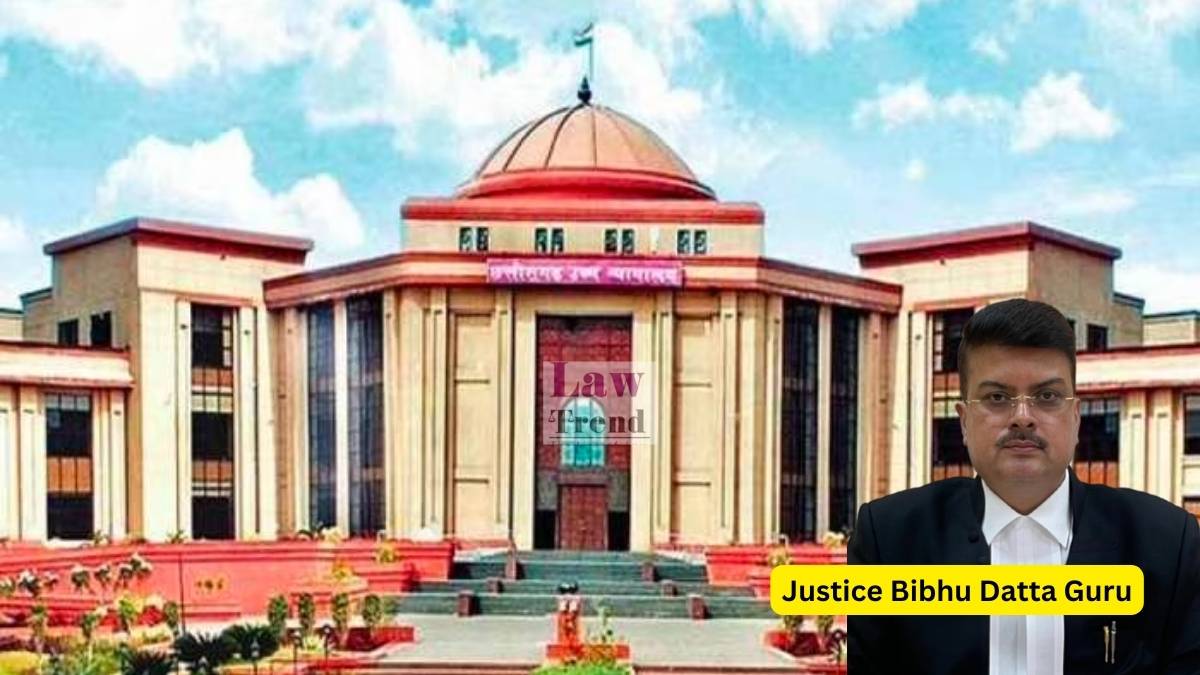
The High Court of Chhattisgarh, presided over by Justice Bibhu Datta Guru, has held that a promotion granted in violation of statutory rules does not create any enforceable or vested right in favor of an employee and can be rectified by the employer after following the principles of natural justice. Ruling on a writ petition challenging the cancellation of a promotion and subsequent reversion of two employees to their substantive posts, the court affirmed the departmental administrative review and dismissed the petition.
Background of the Case
The petitioners, Hirman Das Mahant and Vidyabhushan Shukla, were initially employed as Jeep Drivers under the Water Resources Department. On April 12, 2023, they were promoted to the post of Mechanic Grade-II following a selection process, and their names were subsequently reflected in the provisional seniority list for Mechanic Grade-II.
However, on June 25, 2026, the Chief Engineer, Minimata (Hasdeo) Bango Project, Bilaspur, passed an order cancelling their promotions and reverting them to their substantive post of Jeep Driver. Aggrieved by this order, the petitioners filed a writ petition under Article 226 of the Constitution of India before the High Court of Chhattisgarh.
Arguments of the Parties
Advocate Vimal Pathak, appearing for the petitioners, submitted that the petitioners were promoted after undergoing the prescribed selection process and had continuously worked on the promotional post for nearly three years. It was argued that the reversion order was arbitrary, unreasoned, and violative of the principles of natural justice. The petitioners contended that no fraud, concealment, or misrepresentation was attributable to them, and therefore they could not be made to suffer for any alleged mistake committed by the Department or the Departmental Promotion Committee (DPC). They further argued that once a promotion had been acted upon, it could not be withdrawn after such a long period.
Countering these submissions, Deputy Government Advocate Ms. Diksha Gouraha, representing the State respondents, argued that the promotions granted were ex facie contrary to the applicable statutory rules governing work-charged employees. Departmental scrutiny revealed that the DPC had ignored mandatory eligibility conditions and prescribed procedures while recommending the petitioners. The State pointed out that show cause notices were issued to both petitioners and their replies/representations were considered prior to passing the cancellation order, thereby adhering to the principles of natural justice.
The State relied on the judgment of the Supreme Court in Union of India and Another v. Narendra Singh [(2008) 2 SCC 750] to submit that an order granting promotion contrary to statutory rules does not create an enforceable right. Reference was also made to Fundamental Rule 31-A to argue that pay drawn on an erroneously granted promotional post does not confer any vested right to continue on such a post.
Court’s Analysis
Examining the record, Justice Bibhu Datta Guru observed that the matter was not a disciplinary enquiry or a case involving allegations of misconduct, but rather an administrative review of the promotional exercise undertaken by the Department. The Court noted that issuing a show cause notice prior to passing the cancellation order did not convert the administrative correction into a disciplinary proceeding, but merely fulfilled the requirement of natural justice.
Highlighting that an illegal promotion cannot be protected by the mere passage of time, the Court observed:
“It is well settled that there can be no estoppel against a statute. An employee does not acquire an indefeasible right merely because an illegal promotion has remained in operation for some time. If the promotion itself is contrary to the governing Rules, the employer is competent to withdraw the same after following the minimum requirements of natural justice.”
Referring to the Supreme Court’s decision in Narendra Singh, the Court reiterated that “promotion granted de hors the statutory Rules can always be corrected and no vested right accrues from an illegal promotion.”
The Court also highlighted Fundamental Rule 31-A, noting that it empowers the competent authority to regulate pay when an appointment or promotion is found to be erroneous, which “negatives the contention that continuance on an erroneous promotion creates a perpetual or indefeasible right in favour of the employee.”
On the scope of judicial review under Article 226 of the Constitution, the Court held that judicial review does not extend to re-appreciating the correctness of DPC proceedings once the competent authority finds that recommendations were contrary to governing rules and corrects the error after affording an opportunity of hearing.
Decision of the Court
The High Court held that the petitioners failed to demonstrate that the findings regarding the violation of promotion rules were perverse or unsupported by the record. Finding no arbitrariness, mala fides, or jurisdictional error warranting interference under Article 226, the Court dismissed the writ petition.
Case Details
Case Title: Hirman Das Mahant & Anr. v. State of Chhattisgarh & Ors.
Case No.: WPS No. 5352 of 2026
Bench: Justice Bibhu Datta Guru
Date: 27/07/2026