

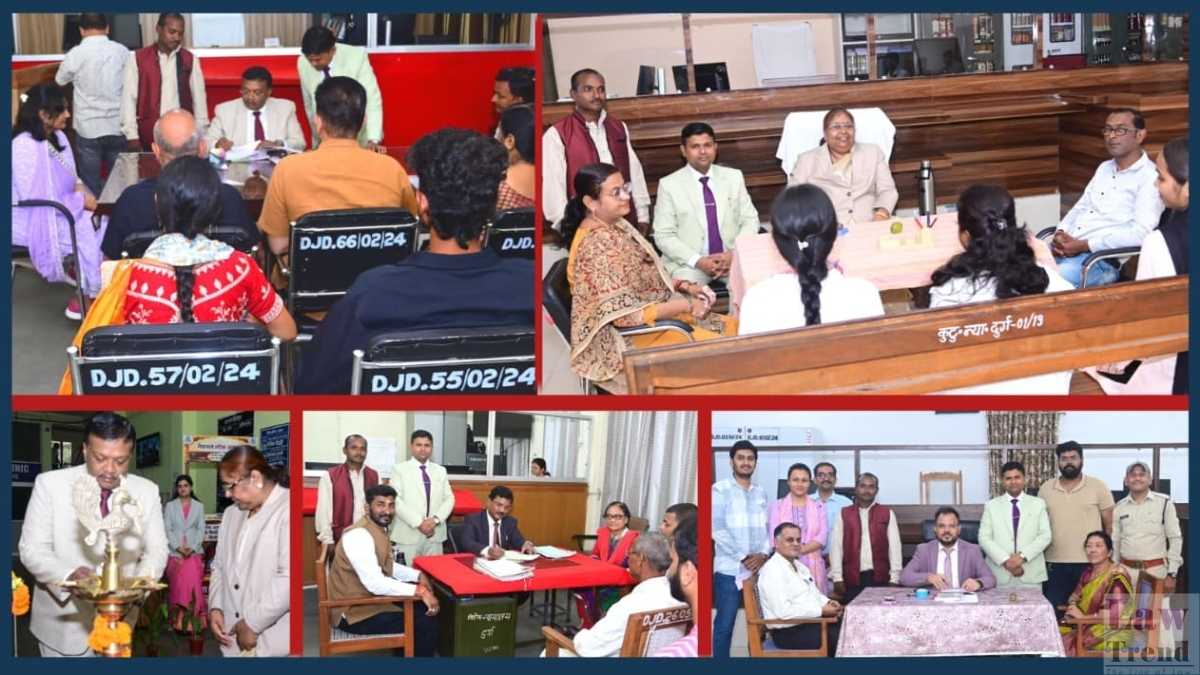
For some, it was a family dispute that had continued for years. For others, it was an old personal feud. For someone else, it was a case involving a stolen motorcycle. And for many, the dispute concerned outstanding dues relating to banks, electricity or telecommunications. Yet, on September 12, 2026, in Durg, these otherwise different stories found a common ending — through dialogue, compromise and mutual consent. That, in essence, is the real strength of a Lok Adalat.
Pursuant to the directions of the National Legal Services Authority (NALSA), New Delhi, and under the guidance of the Chhattisgarh State Legal Services Authority (CSLSA), Bilaspur, the Third National Lok Adalat of the year 2026 was organised across various courts and judicial institutions in Durg district, under the direction of the Principal District and Sessions Judge-cum-Chairman, District Legal Services Authority, Durg.
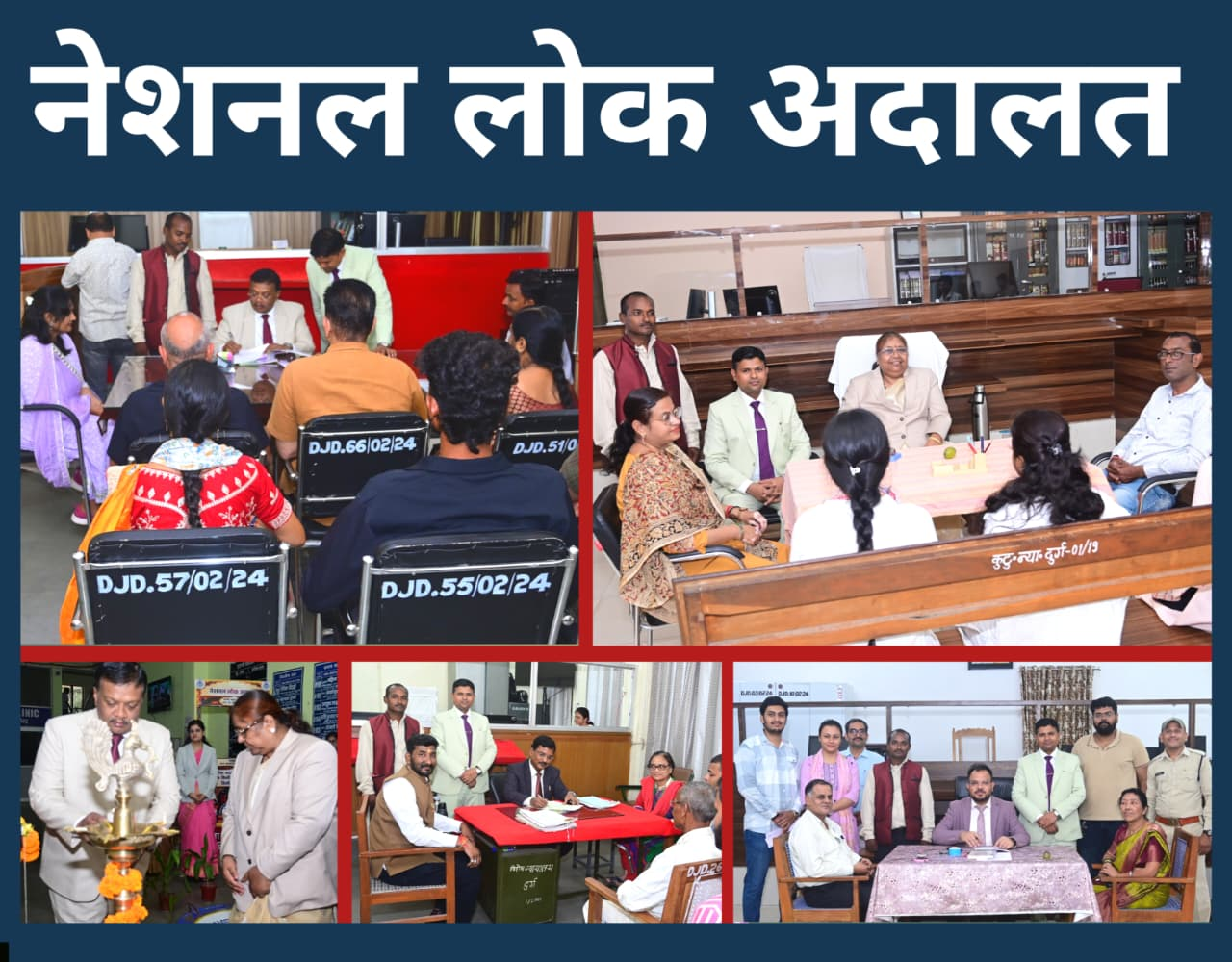
The National Lok Adalat resulted in the disposal of more than 4.10 lakh court and pre-litigation matters, with settlement amounts aggregating to approximately ₹685.90 crore. Not Merely a Number — 4 Lakh-Plus Resolutions, 4 Lakh-Plus Stories. A total of 37 Benches were constituted for the National Lok Adalat.
Proceedings were conducted at the Family Court, Durg; District Court, Durg; Civil Courts at Bhilai-3, Patan and Dhamdha; Juvenile Justice Board; Labour Court; Permanent Lok Adalat (Public Utility Services); Revenue Courts; Consumer Forum; and other judicial and legal-service institutions.
As many as 13,851 court cases and 3,96,869 pre-litigation matters were disposed of, taking the total number of matters resolved to 4,10,720. A substantial number of pre-litigation disputes relating to banking and financial institutions, electricity and telecommunications were also resolved through settlement.
But some cases cannot truly be measured in numbers.One Settlement That Reunited a Family. At the Family Court, Durg, a matrimonial dispute between a husband and wife had continued for a considerable period. When the matter came before the National Lok Adalat, the parties were encouraged to look beyond their immediate legal claims and consider the larger dimensions of their future, dignity, mutual trust and family life. The husband and wife ultimately decided to leave their past differences behind and move forward with mutual respect and renewed trust. In an emotionally significant moment, both exchanged garlands in the courtroom. A litigation came to an end. But more importantly, a family got an opportunity to begin again. Both parties left the court premises happily, having chosen reconciliation over continued conflict.
An Old Family Feud Gets a New Beginning:-In another matter, longstanding bitterness between members of the same family had eventually taken the form of a criminal case.The dispute had remained pending for years, creating tension and distance among family members.During the National Lok Adalat, the Court, keeping in view the emotional dimensions of the dispute and the sensitivity of the family relationships involved, facilitated an environment conducive to dialogue.
The result was a peaceful settlement by mutual consent, bringing an end to an old family feud.There were five connected parties in the matter. Since the personal presence of all the parties was not possible, technology was not allowed to become an impediment to settlement. Some of the parties participated through video conferencing, enabling the compromise proceedings to be completed.Technology reduced the physical distance; mediation reduced the distance between relationships.
A Motorcycle, a Mistake and an Apology:- Another matter involved a motorcycle theft. A person returning home at night accidentally dropped his earphone on the way. When he stopped and came back to retrieve it, he found that his motorcycle was missing. A report regarding the theft was lodged, and the matter eventually reached the Court.The motorcycle was subsequently recovered and handed over to the complainant.When the matter was placed before the National Lok Adalat, the complainant expressed his willingness to settle the dispute amicably.Following the Court’s counselling and intervention, the accused persons expressed remorse, assured the complainant that they would not repeat such conduct in the future, and tendered an apology.The complainant, in turn, agreed to the settlement.Once again, dialogue succeeded where prolonged litigation might otherwise have continued.The matter was accordingly brought to a harmonious conclusion on the basis of mutual compromise.
The Lok Adalat Model: ‘Justice + Care’
The significance of this National Lok Adalat was not confined merely to the number of cases disposed of.
For litigants and members of the public visiting the court premises, a one-day free health check-up camp was also organised with the support of the District Hospital, Durg.
Medical Officer Dr. Nivedita Gardia, along with officials and staff of the Health Department, provided health screening and necessary medical services.
Judicial officers, members of the Bar, litigants and a large number of members of the public availed themselves of the facility.
The initiative reflected a simple but meaningful principle: “Justice for the case, Care for the person.”
A Story of Skill and Rehabilitation from the Central Jail
An exhibition and sale of jail products manufactured by inmates lodged at the Central Jail, Durg, was also organised on the occasion of the National Lok Adalat.
The products received appreciation from the visitors and participants.
The initiative conveyed a broader message about the justice system — that justice is not confined merely to punishment.
Reform, rehabilitation and the reintegration of individuals into the mainstream of society are equally important dimensions of justice.
Why Is Lok Adalat Different?
Because here, the question is not confined to:
“Who is right?”
The question is also:
“Can a solution be found that enables both sides to move forward?”
That is the philosophy that lies at the heart of the Lok Adalat mechanism.
A dispute that has continued for years can sometimes be resolved within hours. A conflict that has persisted for hours can, at times, be settled within minutes.
And a litigation can, in the right circumstances, become an opportunity to rebuild a relationship.
The National Lok Adalat at Durg once again demonstrated that access to justice is not merely about adjudicating rights and liabilities; it is also about creating avenues for dialogue, reconciliation and closure. It represents a model of justice in which law walks hand in hand with human sensitivity.




