

Invalidity Of One Ground Does Not Vitiate Detention Order Under PIT NDPS Act If Supported By Other Severable Grounds: Andhra Pradesh High Court
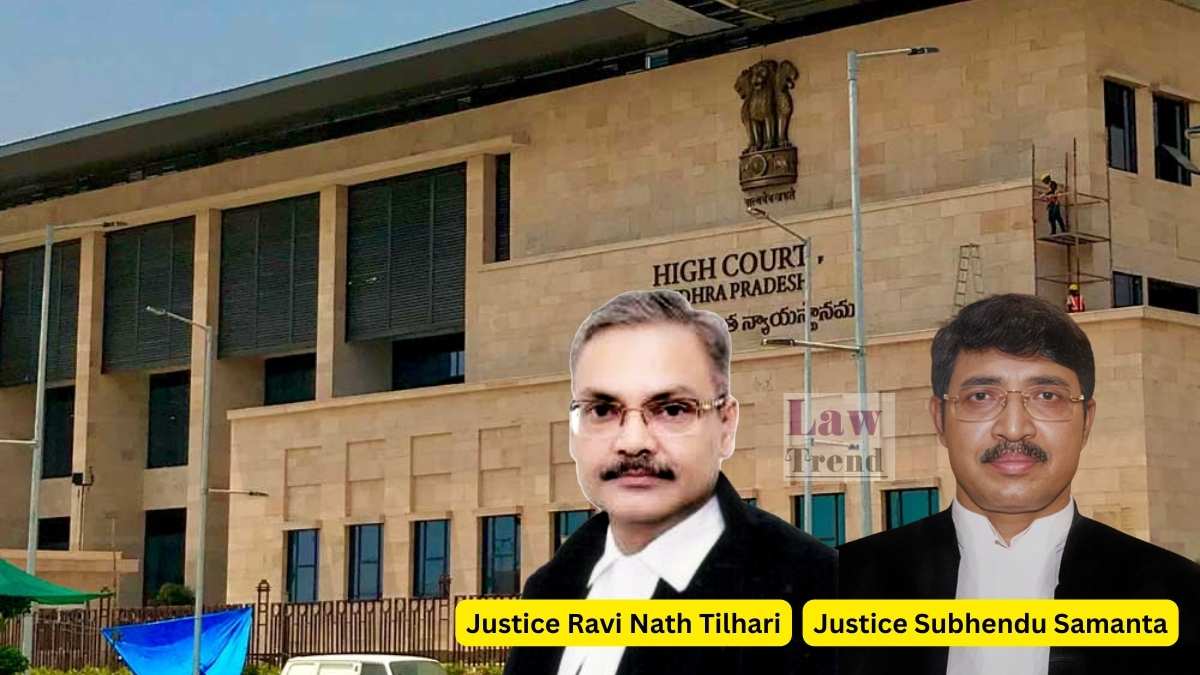
The High Court of Andhra Pradesh at Amaravati, comprising a Division Bench of Justice Ravi Nath Tilhari and Justice Subhendu Samanta, has held that a detention order passed under the Prevention of Illicit Traffic in Narcotic Drugs and Psychotropic Substances Act, 1988 (PIT NDPS Act) remains valid on remaining grounds even if one of the grounds is found to be legally unsustainable. Dismissing a habeas corpus writ petition filed against the detention of a person accused in multiple drug cases, the Court held that under Section 6 of the PIT NDPS Act, the grounds of detention are severable, ensuring that the invalidity of a single ground does not render the entire detention order inoperative.

Background of the Case

The petition was filed by Dunga Kumari under Article 226 of the Constitution of India seeking a Writ of Habeas Corpus for the release of her husband, Dunga Manikyam (the detenu).

On July 9, 2025, the Principal Secretary to Government (FAC), Revenue (Excise-II) Department, State of Andhra Pradesh, issued a detention order under Section 3(1) of the PIT NDPS Act, 1988. The authority concluded that the detenu was involved in “illicit traffic” within the meaning of Section 2(e)(iii) of the Act and that his activities were prejudicial to public order.

The case was subsequently placed before the Advisory Board, which submitted its opinion on August 7, 2025, stating that sufficient cause existed for detention. Consequently, the State Government confirmed the detention order on August 26, 2025, for a period of 12 months.

The detention order was grounded on the detenu’s involvement in six distinct criminal cases:

  1. Cr.No.128/2017 (Nakkapalli P.S.) under Sections 25, 8C, and 20(b) of the PIT NDPS Act involving 40 kgs of Ganja and an Auto.
  2. Cr.No.11/2018 (Rolugunta P.S.) under Sections 8C, 20(b)(ii)(c), and 25 involving 30 kgs of Ganja, a Car, and an Auto.
  3. Cr.No.28/2018 (Rolugunta P.S.) under Sections 8C, 20(b)(ii)(c), and 25 involving 60 kgs of Ganja, two Cars, and a Pulsar Bike.
  4. Cr.No.66/2018 (Pithapuram P.S.) under Sections 8C and 20(b)(ii)(c) involving 29 kgs of Ganja and an Auto.
  5. Cr.No.344/2019 (Payakaraopeta P.S.) under Sections 8C, 20(b)(i), 20(b)(ii)(c), and 25 involving 175 kgs of Ganja and an Auto.
  6. Cr.No.42/2025 (Payakaraopeta P.S.) under Sections 20(b)(ii)(c) and 25 read with 8(c) involving 600 kgs of Ganja and a Bolero vehicle.
READ ALSO  एकपक्षीय रूप से नियुक्त मध्यस्थ का फैसला अवैध; हाईकोर्ट ने कहा - ऐसा आदेश कानूनी रूप से शून्य और निष्पादन के अयोग्य

Arguments of the Parties

Counsel for the petitioner, Sri D. Purnachandra Reddy, argued that the detention order was unsustainable in law. He pointed out that while the detenu had secured bail in five out of the six cases, he was in judicial custody in the sixth case (Cr.No.42/2025) on the date the detention order was passed. The petitioner contended that the detaining authority failed to record satisfaction regarding either the necessity of issuing a detention order while the detenu was already in judicial custody or the imminent possibility of his release on bail in that specific case.

In support of his arguments, counsel for the petitioner relied upon judgments including Syed Mohiyuddin v. State of Andhra Pradesh, Champion R. Sangma v. State of Meghalaya, V. Adi Lakshmi v. State of Andhra Pradesh, Cheemparthi Parvin v. State of Andhra Pradesh, Lakshmi v. State of Andhra Pradesh, and Cheemparthi Salma v. State of Andhra Pradesh.

Responding to the contentions, Sri Kirthi Teja, learned Government Pleader representing the State, conceded that the detenu was in judicial custody in Cr.No.42/2025 and that the detention order did not explicitly record satisfaction regarding the likelihood of his release on bail. However, he submitted that the order would not be vitiated in its entirety. Referring to Section 6 of the PIT NDPS Act, 1988, he maintained that the detention order is deemed to have been made separately on each ground and could stand firmly on the basis of the remaining five criminal cases (Ground Nos. 1 to 5).

Court’s Analysis and Legal Findings

Examining the arguments and material on record, the Bench of Justice Ravi Nath Tilhari and Justice Subhendu Samanta evaluated Ground No. 6 against the triple tests required when issuing a preventive detention order against an incarcerated person. The Court noted the principles restated in Champion R. Sangma v. State of Meghalaya, which quoted the Supreme Court’s decision in Kamarunnissa v. Union of India:

“From the catena of decisions referred to above it seems clear to us that even in the case of a person in custody a detention order can validly be passed (1) if the authority passing the order is aware of the fact that he is actually in custody; (2) if he has reason to believe on the basis of reliable material placed before him (a) that there is a real possibility of his being released on bail, and (b) that on being so released he would in all probability indulge in prejudicial activity; and (3) if it is felt essential to detain him to prevent him from so doing. If the authority passes an order after recording his satisfaction in this behalf, such an order cannot be struck down on the ground that the proper course for the authority was to oppose the bail and if bail is granted notwithstanding such opposition, to question it before a higher court. What this Court stated in Ramesh Yadav was that ordinarily a detention order should not be passed merely to pre-empt or circumvent enlargement on bail in cases which are essentially criminal in nature and can be dealt with under the ordinary law. It seems to us well settled that even in a case where a person is in custody, if the facts and circumstances of the case so demand, resort can be had to the law of preventive detention.”

The Court observed that while the detaining authority satisfied the first test by being aware of the detenu’s custody in Cr.No.42/2025, it failed to record satisfaction on the second and third tests regarding the real possibility of release on bail and the necessity of detention to prevent further prejudicial acts. Consequently, the detention order could not stand on Ground No. 6 alone.

READ ALSO  When Oral Talaq is not Allowed It Can Also Not be in Written Form- Andhra Pradesh HC Gives Important Judgement on Talaq and Maintenance

However, the Court highlighted that unlike state preventive detention statutes involved in some of the cited precedents, the PIT NDPS Act, 1988 contains a specific provision under Section 6 governing severability of grounds.

Analyzing Section 6 of the PIT NDPS Act, the Court observed:

“Where a person has been detained in pursuance of an order of detention under sub-section (1) of section 3 which has been made on two or more grounds, such order of detention shall be deemed to have been made separately on each of such grounds and accordingly— (a) such order shall not be deemed to be invalid or inoperative merely because one or some of the grounds is or are— (i) vague, (ii) non-existent, (iii) not relevant, (iv) not connected or not proximately connected with such person, or (v) invalid for any other reason whatsoever, and it is not therefore possible to hold that the Government or officer making such order would have been satisfied as provided in sub-section (1) of section 3 with reference to the remaining ground or grounds and made the order of detention; (b) the Government or officer making the order of detention shall be deemed to have made the order of detention under the said sub-section (1) after being satisfied as provided in that sub-section with reference to the remaining ground or grounds.”

The Bench referred to Supreme Court rulings in Mortuza Hussain Choudhary v. State of Nagaland, Prakash Chandra Mehta v. Commissioner and Secretary, Government of Kerala, and Vashisht Narain Karwaria v. State of U.P., which affirmed that statutory severability clauses ensure an order does not fail in its entirety merely because one ground is invalid or inadmissible.

READ ALSO  Reasonable Time Always Depend on the Circumstances of the Case: Andhra Pradesh HC

Applying these statutory principles, the Court concluded that because the detention order was made on six grounds, it is legally deemed to have been passed separately on each ground. Therefore, even if the order cannot be sustained on Ground No. 6, it remains valid and enforceable under Ground Nos. 1 to 5.

Decision

The High Court sustained the detention order on Ground Nos. 1 to 5 and held that the detenu was not entitled to release. Finding no merit in the challenge, the Division Bench dismissed the Writ Petition with no order as to costs.

Case Title: Dunga Kumari Vs. The State Of Andhra Pradesh and Others

Case No.: Writ Petition No. 23639 of 2025

Bench: Justice Ravi Nath Tilhari and Justice Subhendu Samanta

Date: 08.07.2026

Law Trend
Law Trendhttps://lawtrend.in/
Legal News Website Providing Latest Judgments of Supreme Court and High Court

Related Articles

Latest Articles
