

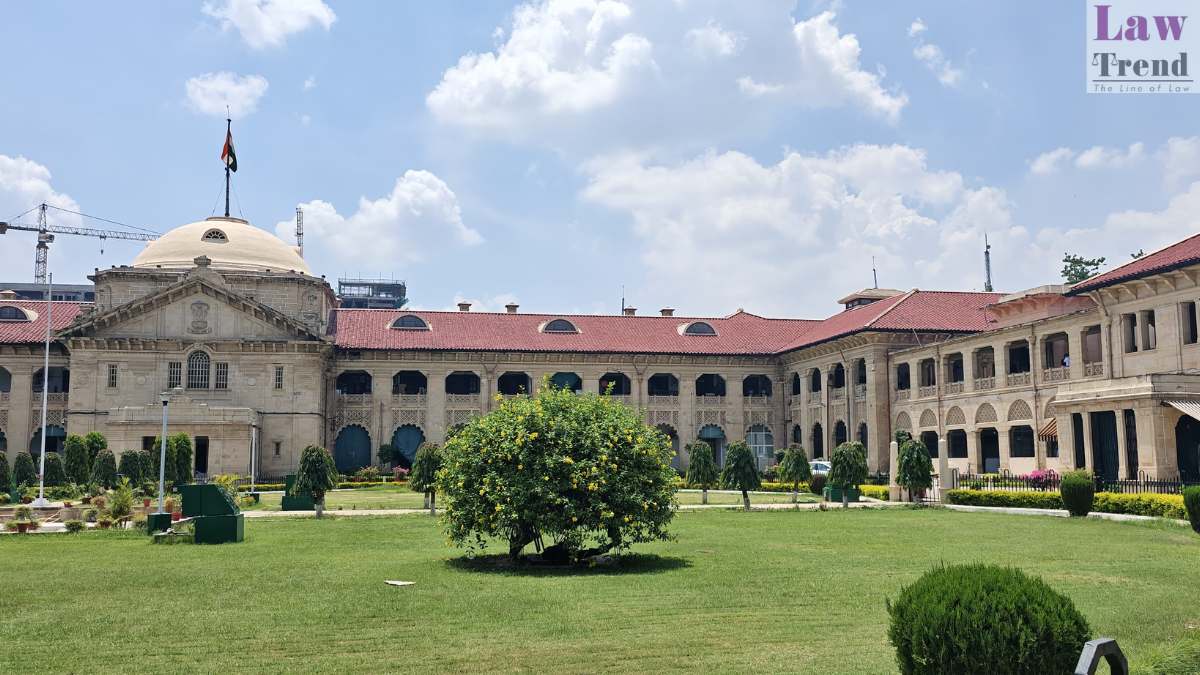
A two-judge bench of the Allahabad High Court has delivered a split verdict on whether to impose a two-year moratorium on property demolitions following the filing of a First Information Report (FIR). Despite the disagreement on the temporary ban, both judges unanimously ruled that state authorities must strictly adhere to due process and the rule of law when carrying out demolitions, warning that non-compliance would trigger contempt proceedings.
The July 20 order arose from a petition challenging the threatened demolition of a residential property in Uttar Pradesh and the sealing of commercial establishments following a criminal case registered against a relative of the property owners.
Judicial Division Over Post-FIR Moratorium
The division on the bench centered on a proposal to halt property demolitions for two years after an FIR is lodged. Justice Atul Sreedharan favored implementing the two-year hiatus to prevent immediate executive action against properties linked to accused persons. However, Justice Siddharth Nandan disagreed with the proposed moratorium, resulting in a split verdict on that specific measure.
Despite their difference on the post-FIR pause, both judges concurred that arbitrary state demolitions breach the doctrine of separation of powers and undermine the rule of law. Justice Sreedharan observed that in a meaningful democracy, individual rights must be shielded from state power, citing lines from Urdu poet Bashir Badr regarding the hardship of building a home versus the unremorseful destruction of settlements.
Origins of the Legal Challenge
The legal proceedings were initiated after state authorities sealed two properties—identified as the Indian Lodge and a Saw Mill—and allegedly threatened to demolish a residential house. The actions followed an FIR registered against a relative of the petitioners under the Protection of Children from Sexual Offences (POCSO) Act and the Uttar Pradesh Prohibition of Unlawful Religious Conversion Act.
Advocate Shamsuddin Khan, representing the petitioners, argued before the court that his clients are law-abiding citizens who do not reside with the accused nor hold any connection to his commercial enterprises. Khan submitted that state officials acted unconstitutionally by sealing the premises and threatening demolition without issuing prior notice or following statutory procedural requirements.
In response, Chief Standing Counsel Dileep Kumar Srivastava, appearing for the state, maintained that authorities had merely issued a notice to the petitioners. Srivastava argued that the petitioners retain the right to present their defense before the relevant municipal authority and could seek judicial remedy if an adverse demolition order is issued following a formal hearing.
Protection for Citizens and Municipal Complicity
Addressing the broader context of property enforcement, the High Court emphasized that constitutional protections extend to marginalized individuals lacking social or financial prominence. The bench rejected the application of a Benthamite utilitarian model—which justifies evicting a few for the broader public good—in the context of residential demolitions under Indian municipal law.
The court observed that residential structures are not built overnight and attributed unauthorized constructions largely to municipal inaction, political patronage, bureaucratic dishonesty, or deliberate official neglect. Holding the state complicit through its administrative machinery, the bench ruled that long-term occupants facing demolition, even those lacking clear title to the land, must be provided reasonable time and state assistance to resettle elsewhere.
The judgment described Part IV of the Constitution, which details the Directive Principles of State Policy, as the essential conscience governing state action rather than mere ornamental text. Referencing constitutional scholar V. Sudhish Pai, the court noted that building norm violations are widespread—including within structures built by development authorities themselves—and emphasized that courts must check punitive executive discretion while adapting the law to modern realities.
Strictures on Corruption and Institutional Integrity
The High Court linked unchecked administrative abuses to a broader decline in institutional integrity, citing recent allegations of donation theft at the Ram Temple as an illustration of widespread societal apathy toward corruption. Pointing to Transparency International’s 2025 Corruption Perceptions Index, in which India ranked 91st among 182 nations, the court noted that public tolerance for illicit practices remains high unless exposed.
To address systemic misconduct within public authorities, the court suggested that the state consider amending the Prevention of Corruption Act, 1988 to introduce the death penalty for individuals convicted of corruption, asserting that rigorous enforcement is necessary to restore institutional integrity and uphold a welfare state grounded in the rule of law.


