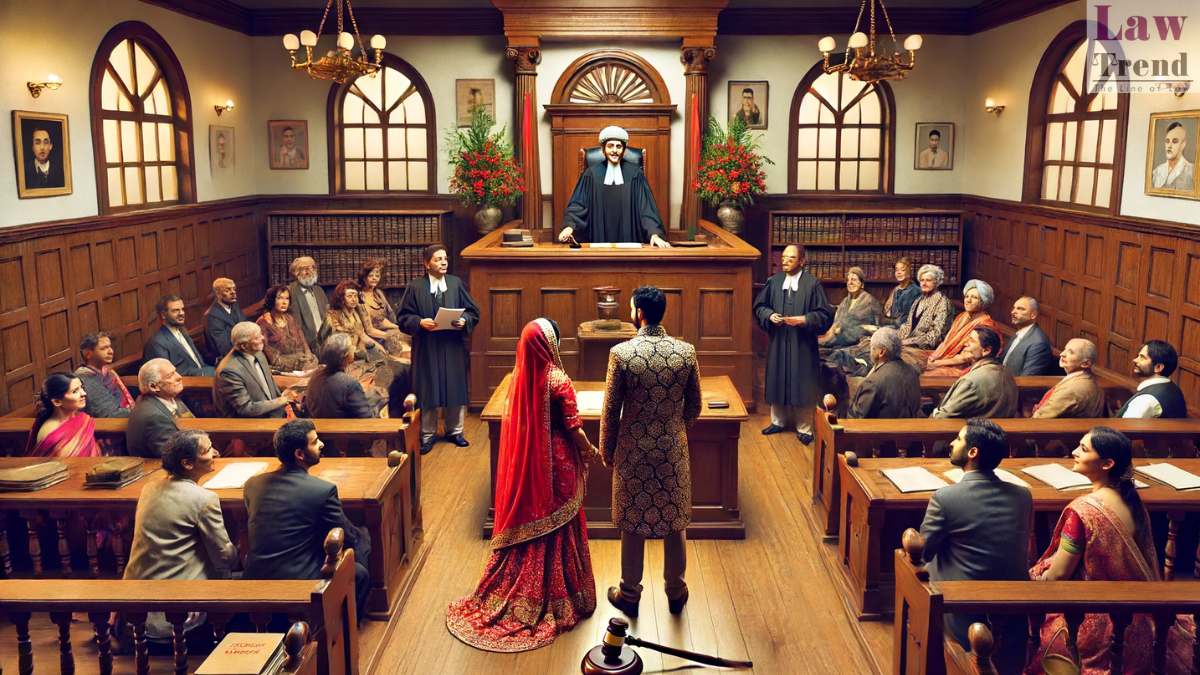
The High Court of Karnataka has dismissed an appeal filed by a husband seeking divorce, ruling that a marriage under Hindu law is a lifelong sacrament rather than a contract. A division bench comprising Justice DK Singh and Justice T.M.Nadaf upheld a Mysuru Family Court’s decision to reject the husband’s divorce petition, emphasizing that a spouse cannot simply walk away from a marriage by claiming they have lost interest in the relationship.
Background of the Case
The appellant-husband and the respondent-wife had an inter-caste love marriage solemnized on December 15, 2003, from which they have a daughter who is now almost a major. The legal dispute arose after 21 years of marriage.
The litigation history between the couple reveals that the husband had previously filed a divorce petition (M.C.No.381/2019), while the wife had filed a petition for the restitution of conjugal rights under Section 9 of the Hindu Marriage Act, 1955 (M.C.No.857/2019). These cases were clubbed together, resulting in a common judgment that dismissed the husband’s divorce plea and allowed the wife’s petition for restitution of conjugal rights.
Subsequently, the husband filed a fresh petition (M.C.No.404/2024) before the III Additional Principal Judge, Family Court, Mysuru, seeking dissolution of the marriage under Section 13(1A) of the Hindu Marriage Act, 1955. This section allows for divorce if there has been no resumption of cohabitation between the parties for a period of one year or upwards after the passing of a decree for restitution of conjugal rights.
Arguments of the Parties
In his petition, the husband alleged that after the previous court judgment, no efforts were made by either side to re-establish their conjugal life, and they continued to live separately at their respective places in Mysuru. He asserted that despite his sincere efforts and multiple requests asking his wife to rejoin him and lead a marital life, she did not respond. He argued that the marriage had broken down irretrievably.
In response, the wife filed a detailed statement of objections. She contended that she had looked after her husband and his parents with love and affection. She stated that her husband’s parents had advised them to reside on the first floor of their house for offering prayers and preparing food, as she belonged to the Brahmin caste. She asserted that she complied with this arrangement, never insisted on a separate residence, and never picked any quarrels with her husband or his family members. She denied all allegations of incompatibility.
Court’s Analysis and Observations
The Family Court evaluated the evidence and pleadings, framing key points to determine if the husband was entitled to a divorce on the grounds of non-resumption of marriage post the restitution decree. The Family Court found that the husband’s allegations of cruelty under Section 13(1)(ia) of the Hindu Marriage Act, 1955, could not be proved against the wife. Crucially, during his cross-examination, the husband admitted that he had not resumed his marital life because he was not interested in doing so.
Before the High Court, the counsel for the husband argued that because the husband had no interest in continuing the relationship, the marriage was dead for all practical purposes and a decree of divorce should be granted.
The High Court rejected this contention, observing that the husband was attempting to benefit from his own default. The bench remarked:
“The appellant wants to take advantage of his own wrong.”
Reflecting on the nature of matrimonial bonds under personal law, the court stated:
“The marriage under the Hindu Law is a sacrament and it is not a contract. Once the parties are married, the marriage is for life and one person cannot walk away from the marriage on the ground that he/she is left with no interest in the marriage with the other party.”
Decision of the Court
The High Court of Karnataka found no grounds to interfere with the judgment and decree passed by the Family Court. Accordingly, the bench dismissed the Miscellaneous First Appeal (MFA No. 4343 of 2026), and all pending interlocutory applications were disposed of.
Case Details:
Case Title: Sri Manjukiran v. Smt. Bindu M B
Case No.: Miscellaneous First Appeal No. 4343 of 2026 (FC)
Bench: Justice DK Singh and Justice T.M.Nadaf
Date: July 15, 2026